
Stegomyrmex manni
- Sci. Name
- Stegomyrmex manni
- Tribe
- Solenopsidini
- Subfamily
- Myrmicinae
- Author
- Smith, 1946
- Distribution
- Found in 6 countries
Introduction
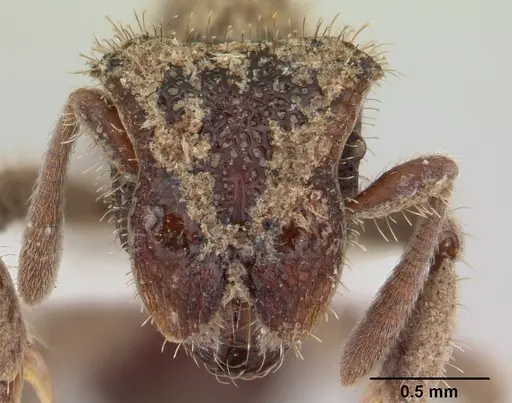
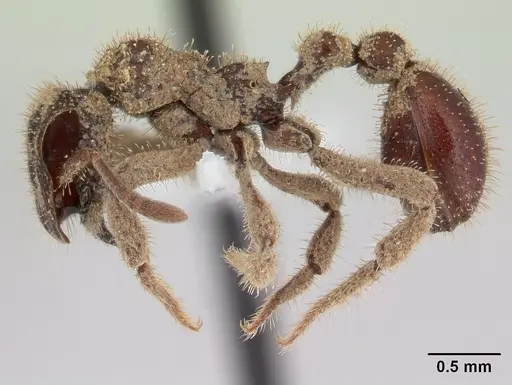
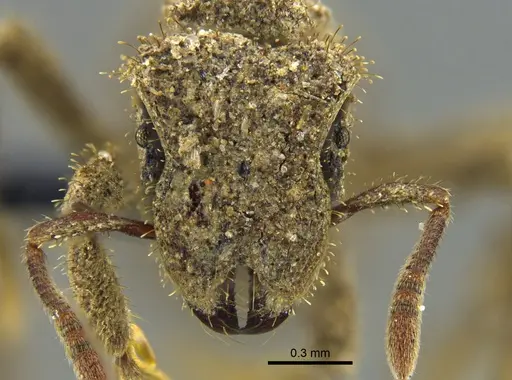
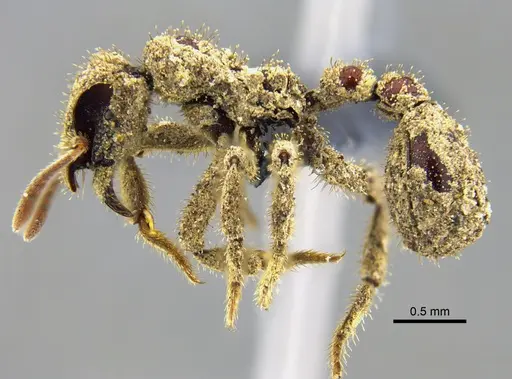
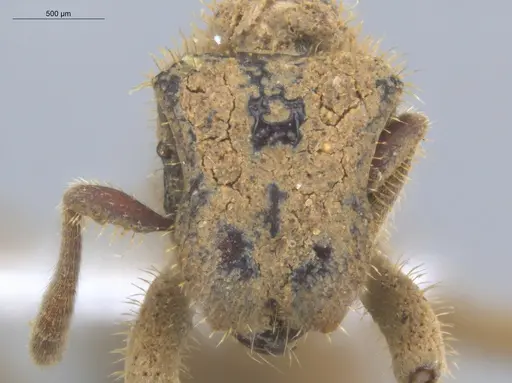
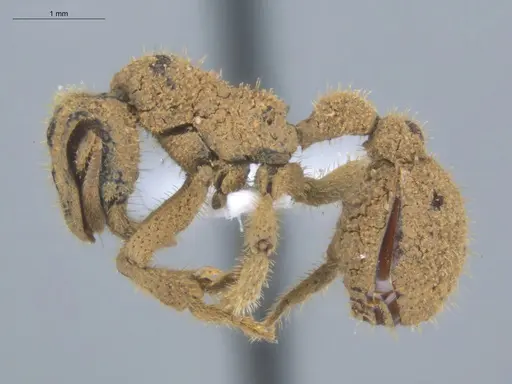
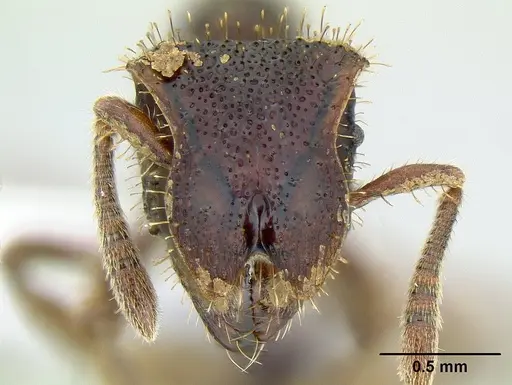
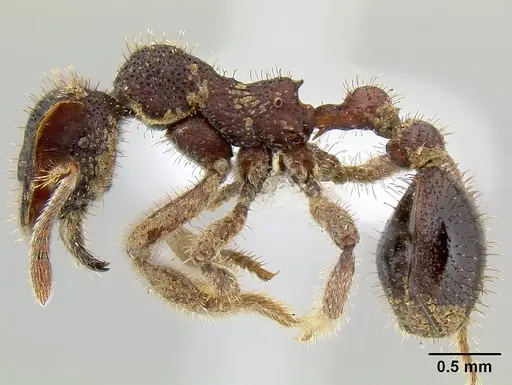
Stegomyrmex manni is a tiny, enigmatic ant from the tribe Solenopsidini. It lives on the forest floor of mature rainforests from Costa Rica to Colombia . Workers have three types of specialized hairs – long simple hairs, short spatulate hairs, and short hairs with truncated tips – that let them collect and hold clay particles on their body. This gives them incredible camouflage, making them almost invisible against the leaf litter . In side view, the promesonotum sits much higher than the propodeum, and the propodeal spines are blunt and point backward. The propodeal spiracles project strongly sideways . The genus Stegomyrmex is sister to all other solenopsidines, so this species is important for understanding ant evolution .
Quick Summary
- Difficulty: Hard
- Origin & Habitat: Native to mature rainforests in Costa Rica, Panama, Colombia, and parts of French Guiana [1][4][6]. Found in tropical wet forest at elevations from near sea level to about 1100 m [4]. Lives on the forest floor among leaf litter [4].
- Colony Type: Colony structure is unconfirmed – no published data on queen number or colony size in the wild.
- Size & Growth:
- Queen: Unknown – no measurements available in the literature [1]
- Worker: Unknown – no measurements available in the literature
- Colony: Unknown – no colony size data available
- Growth: Unknown
- Development: Unknown – no development data exists for this species (No data available on egg-to-worker development.)
- Antkeeping:
- Temperature: Based on their tropical rainforest habitat, keep at 24–28°C [1][4]. Use a heating cable on one side of the nest to create a gentle gradient if room temperature is cooler.
- Humidity: High humidity is essential – keep the nest substrate consistently moist but not waterlogged. Provide a water source for drinking.
- Diapause: No – this is a tropical species that does not require hibernation. Maintain warm conditions year-round.
- Nesting: A naturalistic setup works best: deep leaf litter with moist soil that allows workers to practice their camouflage behavior [4]. Y‑tong or plaster nests may work if humidity stays high, but avoid dry, sterile environments.
- Behavior: These ants are extremely slow‑moving and deliberate. At rest, workers stand perfectly still for minutes with antennae raised. When disturbed, they become paralyzed for several minutes – a defense mechanism that looks like playing dead [4]. They rely on camouflage and stillness, not aggression. Escape risk is unknown but likely low due to their slow movement, though their small size means standard barriers should still be used carefully.
- Common Issues: no established husbandry guidelines – this species has never been kept in captivity, humidity control is critical – too dry leads to desiccation, too wet invites mold, paralysis behavior can be mistaken for death – do not disturb motionless workers, wild‑caught colonies may carry parasites that are hard to detect or treat, slow and deliberate movement may be mistaken for weakness, but it is normal
Natural History and Camouflage
Stegomyrmex manni is one of the most remarkably camouflaged ants in the Neotropics. Workers have three types of specialized hairs: long simple hairs, short spatulate (club‑shaped) hairs, and short hairs with truncated tips [4]. The long truncated hairs scrape and capture soil particles, while the short plume‑like hairs hold them close to the body [4]. This makes the ants nearly invisible against the forest floor [3]. Workers move slowly and deliberately, when disturbed, they become completely paralyzed for several minutes [4]. The species was originally described from Panama (Barro Colorado Island) [1] and has since been recorded in Costa Rica, Colombia, and French Guiana [1][4][6]. An alate gyne (winged queen) was collected at La Selva Biological Station in Costa Rica [1]. The genus is evolutionarily significant as the sister group to all other Solenopsidini [5].
Housing and Nest Setup
These ants need a setup that mimics their forest floor habitat. Provide moist leaf litter and soil so workers can collect and adhere particles to their body – this is a natural behavior [4]. A naturalistic terrarium with a deep layer of humus and leaf litter works best. Y‑tong or plaster nests can be used if you keep humidity very high and offer a top layer of fine soil in the outworld. Avoid anything sterile or dry. Keep the nest area dark and quiet, as these ants are easily disturbed by vibration and light.
Feeding and Diet
The diet of Stegomyrmex manni has not been studied. Based on related Solenopsidini, they are likely predators of tiny invertebrates. Offer small live prey such as fruit flies, pinhead crickets, or small mealworms. You can also try a sugar source like honey water, though acceptance is unknown. Start with small items and watch for interest. Never offer prey large enough to overwhelm the ants. If they ignore food, try different prey sizes or types.
Temperature and Seasonal Care
As a tropical rainforest species from Central and South America, Stegomyrmex manni needs warm, stable temperatures year‑round. No scientific study gives exact preferences, but their habitat (mature tropical wet forest) suggests a range of about 24–28°C [1][4]. Use a heating cable on one side of the nest to create a gentle gradient. Do not cool them – they have no winter dormancy. Keep humidity high alongside the warmth (70–80% is a good target). Avoid drafts and sudden changes.
Behavior and Handling
The most notable behavior of Stegomyrmex manni is their extreme stillness. Workers move very slowly and will stand motionless for minutes with antennae raised [4]. When disturbed, they become paralyzed and play dead for several minutes [4]. This is a defensive adaptation, not a sign of illness. Never poke or shake motionless ants – wait for them to recover naturally. They are not aggressive, and their sting (present as a myrmicine) is unstudied but probably mild. Handle transfers with a soft brush, but avoid handling them altogether if possible. Their small size and slow movement make them fragile.
Frequently Asked Questions
Is Stegomyrmex manni a good species for beginners?
No – this species is not recommended for beginners. It has no established husbandry guidelines, requires high humidity and specific substrate for camouflage, and everything about its lifecycle is unknown. Keeping it is a challenge even for experienced antkeepers.
How long does it take for Stegomyrmex manni to develop from egg to worker?
This is unknown – no data exists. Related Solenopsidini may take 4–8 weeks at tropical temperatures, but that is pure speculation. Observe your colony carefully.
What should I feed Stegomyrmex manni?
The diet is unstudied. Based on related Solenopsidini, offer tiny live prey (fruit flies, pinhead crickets, small mealworms) and a sugar source (honey water). Start with small items and see what they accept. Do not give large prey.
Can I keep multiple Stegomyrmex manni queens together?
Colony structure is unconfirmed – there is no data on whether they accept multiple queens. Do not combine unrelated queens. House a single founding queen alone until more is known.
Why do my Stegomyrmex manni ants stop moving?
This is normal. They often stand perfectly still for minutes, and when disturbed they become paralyzed as a defense mechanism [4]. Do not disturb them – they will recover on their own. If they stay motionless for hours without recovering, there may be another issue.
Do Stegomyrmex manni need hibernation?
No – this is a tropical rainforest species that does not require a cooling period. Keep them warm (24–28°C) year‑round [1]. Cooling them could be fatal.
What makes Stegomyrmex manni special compared to other ants?
Their camouflage is extraordinary: workers collect and hold soil particles on their body using specialized hairs, becoming nearly invisible on the forest floor [3][4]. They are also the sister species to all other Solenopsidini, so they are important for evolutionary studies [5]. Their slow movement and paralysis defense are unique.
How big do Stegomyrmex manni colonies get?
Colony size is unknown – no data exists. Based on their cryptic lifestyle and the difficulty of finding them in the wild, colonies are probably small to moderate, but this is speculation.
What type of nest is best for Stegomyrmex manni?
A naturalistic setup with moist forest floor substrate and leaf litter is ideal, because it lets them practice their camouflage behavior [4]. Y‑tong or plaster nests can work if you keep humidity very high and provide a layer of fine soil or leaf litter in the outworld.
Report an Issue
The current care sheet is based fully on literature. See inconsistencies, or something that's incorrect? Please , it will be resolved after review from an admin. Contributing to the blogs tab also helps providing information, to make us be able to further improve the caresheets. Thank you for your support!
References

This caresheet is licensed under CC BY-SA 4.0 .
Community Blogs
CASENT0178590
View on AntWeb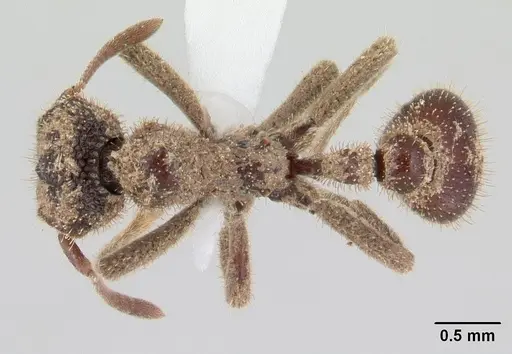
CBUMAGENT34494
View on AntWeb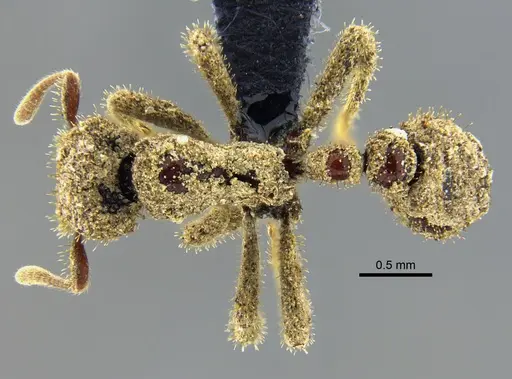
ECOFOG-MI15-0106-24
View on AntWeb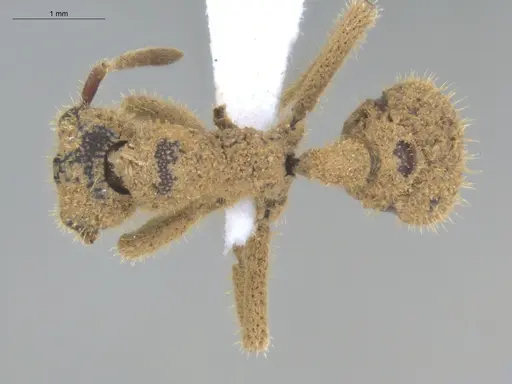
INB0003692959
View on AntWeb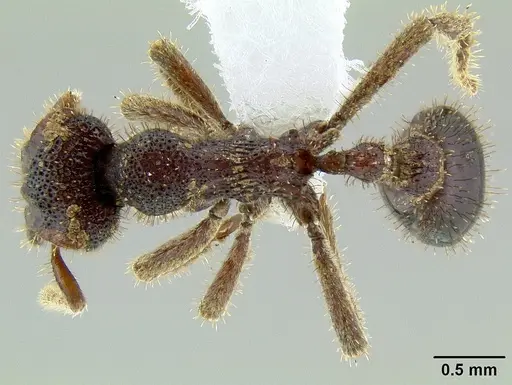
Literature
Loading distribution map...Loading products...