
Thompson's Thief Ant
Solenopsis tonsa
- Sci. Name
- Solenopsis tonsa
- Tribe
- Solenopsidini
- Subfamily
- Myrmicinae
- Author
- Thompson, 1989
- Common Name
- Thompson's Thief Ant
- Distribution
- Found in 1 countries
Introduction
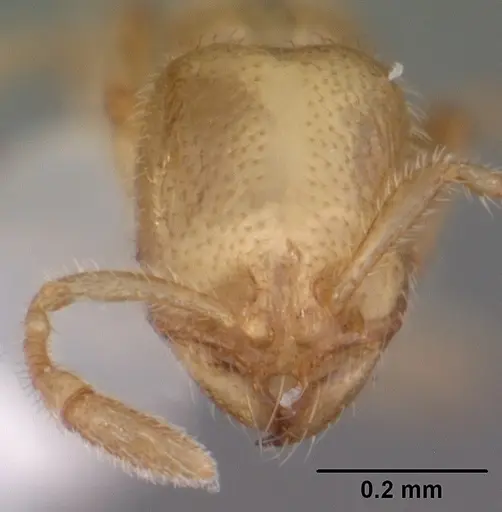
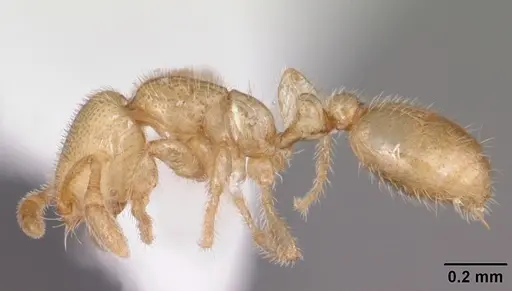
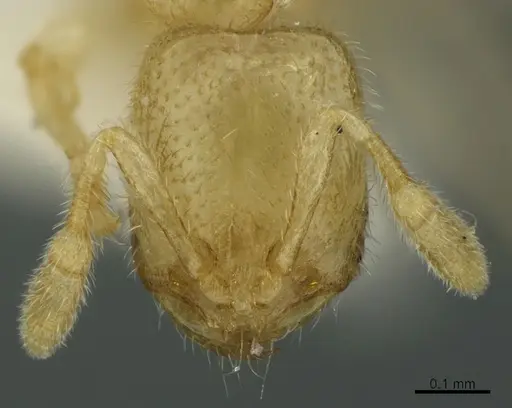
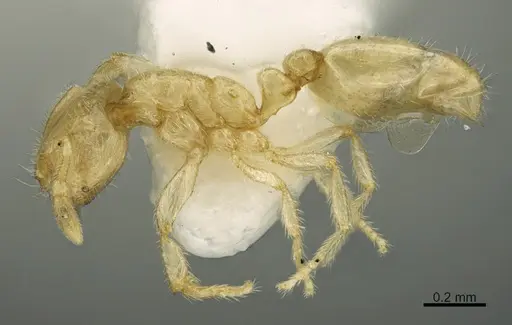
Solenopsis tonsa is a tiny thief ant from the Solenopsis pygmaea species complex. Workers are just 1.38-1.74 mm long, pale yellow, and covered in dense short hairs that give them a golden-haired pincushion look under magnification . They have a distinctive hair-free strip down the middle of the head. This is one of the few truly subterranean Solenopsis species, spending nearly all its life underground in sandy soils . Queens are much larger and dark reddish-brown with clear wings; males are similarly colored with cream legs and antennae . Like other Solenopsidini, they have a sting, but it is harmless to humans due to their tiny size. What makes S. tonsa interesting is how it was discovered: researchers noticed workers in vials had more dirt trapped in their unusually dense hairs, which led to a closer look and the species description . It is a cryptic, rarely collected ant that appears restricted to sandhill habitats in the southeastern United States.
Quick Summary
- Difficulty: Expert
- Origin & Habitat: Native to the southeastern United States (Florida, Alabama, Texas). Found in sandhill habitats with light brown moist sandy soils at elevations around 1500 feet. One of the few truly subterranean Solenopsis species, occurring more frequently at 20 cm soil depth than 10 cm [2][3].
- Colony Type: Colony structure is unconfirmed. As a member of the Solenopsis pygmaea complex, likely single-queen (monogyne) like other thief ants, but this has not been documented.
- Size & Growth:
- Queen: Queens are large relative to workers, but total length is not reported in the literature [1].
- Worker: 1.38-1.74 mm total length [1], among the smallest ants in North America.
- Colony: Unknown. Based on related Solenopsis species and its subterranean lifestyle, colonies are likely small, probably under 100 workers.
- Growth: Unknown. Inferred from related species as slow to moderate.
- Development: Estimated 6-10 weeks at optimal temperature based on genus-level patterns for small Solenopsis species. (Direct development data does not exist for this species. Temperature-dependent inference from related species suggests moderate development time.)
- Antkeeping:
- Temperature: This is a cool-adapted subterranean species. Research shows occurrence decreases as soil temperature increases [2]. Keep nest around 18-22°C, avoiding warmer conditions. Provide a gradient with cooler areas.
- Humidity: Needs moderate substrate moisture, keep the nest damp but not wet. Research indicates that occurrence decreases as soil moisture increases, so avoid waterlogged conditions [2]. Provide a drier area for self-regulation.
- Diapause: Unknown. Based on its southern distribution and subterranean lifestyle, likely minimal or no diapause. However, a cool winter period at 10-15°C may be beneficial if you choose to provide one.
- Nesting: Naturally nests underground in sandy soils. In captivity, provide a deep sandy substrate or a plaster nest with moisture retention. Do not use dry, warm setups. They are truly subterranean, they rarely come to the surface.
- Behavior: This is an extremely cryptic, subterranean species. Workers are rarely seen on the surface. They likely nest in small chambers underground and forage below the soil surface. As a thief ant, they probably steal food from other ant colonies' brood or caches. They have a sting (typical of Solenopsidini), but it is negligible to humans due to their tiny size. Escape risk is low due to their subterranean habits, but they may squeeze through standard barriers, use fine mesh if housing in open setups.
- Common Issues: extreme difficulty in locating and collecting this species in the wild, lack of documented captive breeding success, virtually unknown in the hobby, sensitivity to warm and dry conditions, easily stressed by standard antkeeping temperatures, subterranean lifestyle makes observation and feeding challenging, very small size means escape prevention is still necessary despite limited surface activity
Discovery and Identification
Solenopsis tonsa was formally described in 1989 by C.R. Thompson, who noted it may not be rare but merely previously unrecognized [1]. The discovery came almost by accident, researchers noticed that workers in vials had many dirt granules trapped in their unusually dense hairs, prompting a closer look that revealed the new species. Under magnification, workers look like a golden-haired pincushion. The most distinctive feature is the median hair-free strip down the center of the head, which gives the species its name 'tonsa' (Latin for 'shaven') [1]. Workers are pale yellow to light yellowish brown and among the smallest ants in North America at just 1.38-1.74 mm.
Subterranean Lifestyle
Solenopsis tonsa is one of the few truly subterranean Solenopsis species [2]. Research shows occurrence increases by 145% from 10 cm to 20 cm soil depth, they go deeper as the soil surface warms [2]. They are most prevalent in sandhill habitats with light brown moist sandy soils [2][3]. The species is expected to occur strictly in sandhill environments [2]. There are significant negative effects on occurrence as soil temperature and moisture increase, meaning they prefer cooler, moderately moist underground conditions rather than warm or waterlogged soils [2]. This makes them quite different from most captive ant species, which typically prefer warmer conditions.
Distribution and Range
Solenopsis tonsa is found across the southeastern United States. In Florida, it occurs from Leon County and Alachua County in the north south to Orange County [4]. In Alabama, it has been recorded in Baldwin and Mobile Counties in the southern part of the state [5]. Specimens have also been collected in Texas using subterranean baits at 1500 feet elevation in light brown moist sandy soils in forested areas [1]. The species has a patchy distribution tied to specific sandhill habitats, which explains why it was only recently discovered and remains rarely collected.
Feeding and Diet
As a thief ant (Solenopsis genus), this species likely has an opportunistic diet similar to other Solenopsis, they probably consume small insects, honeydew, and may steal food from other ant colonies. Research shows that S. tonsa does not remove seeds, so they are not seed predators [1]. However, being truly subterranean, their diet likely consists of small soil arthropods, larvae, and possibly fungal growth. In captivity, offering small live prey like springtails or fruit fly larvae would be most appropriate. Given their tiny size, standard ant foods may be too large. Sugar sources might be accepted but this is unconfirmed. Feed small amounts of appropriate-sized protein and observe acceptance.
Reproduction and Nuptial Flights
Virtually nothing is known about the reproductive biology of S. tonsa. The original describer (Thompson,1989) never collected sexuals and suspects mating flights occur in late summer since the two females he examined were fully sclerotized, had wings, and bore dates of August 15 (swept from a soybean field) and July 2 (from a nest collection) [1]. They are probably day flyers since they have never been taken in light traps. Queens are large and dark with clear wings. Males are dark reddish brown with clear wings and cream-colored legs and antennae [1]. The timing of nuptial flights remains unconfirmed.
Keeping This Species in Captivity
Keeping Solenopsis tonsa in captivity is extremely challenging and should be considered an expert-level undertaking. This species has virtually never been kept in captivity, there are no documented successful colonies in the antkeeping hobby. They require conditions opposite to most commonly kept ants: cool temperatures (18-22°C), consistent moisture in the substrate, and deep sandy soil to burrow into [2]. They are truly subterranean and rarely come to the surface, making observation difficult. A naturalistic setup with deep sandy substrate would be most appropriate. Standard test tube setups may not provide adequate depth or the right moisture conditions. If you are able to locate a colony, be prepared for a completely experimental approach. This species is best left to researchers and highly experienced antkeepers willing to document new observations.
Frequently Asked Questions
Is Solenopsis tonsa a good beginner ant species?
No. Solenopsis tonsa is not a beginner species, in fact, it is arguably one of the most difficult ants to keep in captivity. This species has virtually never been documented in the antkeeping hobby, and its biology is almost completely unknown. It requires cool, moist subterranean conditions opposite to what most ant species need. This is an expert-level species for those interested in pioneering captive husbandry of rarely kept subterranean ants.
What do Solenopsis tonsa ants eat?
Their diet in the wild is not well studied, but as thief ants, they likely eat small insects, larvae, and honeydew. They probably also steal food from other ant colonies. In captivity, offer small live prey appropriate to their tiny size (1.38-1.74 mm), springtails or fruit fly larvae would be most suitable. Sugar sources may be accepted but this is unconfirmed. Start with small amounts of various foods and observe what they accept.
How big do Solenopsis tonsa colonies get?
Colony size is unknown. Based on related Solenopsis species and their subterranean lifestyle, colonies are likely small, probably under 100 workers. This species is one of the few truly subterranean Solenopsis and occurs more frequently at deeper soil depths, suggesting they live in smaller, more dispersed colonies than surface-dwelling species.
What temperature should I keep Solenopsis tonsa at?
Keep them cool, around 18-22°C. Research shows that occurrence decreases as soil temperature increases, meaning this species prefers cooler underground conditions [2]. Avoid warm conditions appropriate for most tropical ant species. A heating cable is not recommended, instead, keep them in a cool room or provide a gradient with the cool end at room temperature.
Do Solenopsis tonsa need hibernation?
Diapause requirements are unknown. Based on its southern distribution (Florida, Alabama, Texas) and subterranean lifestyle, the species likely experiences minimal seasonal dormancy. However, keeping them at cool temperatures (10-15°C) during winter months may be beneficial and more closely matches their natural underground conditions. More research is needed.
Can I keep multiple Solenopsis tonsa queens together?
This has not been documented. The colony structure is unconfirmed, though like other Solenopsis thief ants, they are likely single-queen colonies. Combining unrelated queens is not recommended given the complete lack of information on their founding behavior.
How long does it take for Solenopsis tonsa eggs to become workers?
Direct development data does not exist for this species. Based on genus-level patterns for small Solenopsis species, estimate approximately 6-10 weeks from egg to first worker at optimal (cool) temperatures. This is a rough estimate, actual development time is unknown.
Where can I find Solenopsis tonsa in the wild?
This is one of the most difficult questions, the species is rarely collected and was only recognized in 1989. They occur in sandhill habitats in the southeastern US (Florida, Alabama, Texas) and are most common at soil depths of 20 cm in light brown moist sandy soils [2][3]. They have been collected using subterranean Vienna sausage baits at about 1500 feet elevation. Finding this species requires specialized underground sampling techniques and knowledge of the specific sandhill habitats where they occur.
Why is Solenopsis tonsa so rarely kept?
Several factors make this species extremely difficult to keep: 1) It was only described in 1989 and remains poorly studied. 2) It is truly subterranean, workers rarely come to the surface. 3) It requires cool, moist conditions opposite to most captive ant setups. 4) It is one of the smallest ants in North America, making observation and feeding challenging. 5) There are no documented captive colonies, no one has successfully bred this species in captivity yet. It remains a species for researchers rather than hobbyists.
Report an Issue
The current care sheet is based fully on literature. See inconsistencies, or something that's incorrect? Please , it will be resolved after review from an admin. Contributing to the blogs tab also helps providing information, to make us be able to further improve the caresheets. Thank you for your support!
References

This caresheet is licensed under CC BY-SA 4.0 .
Community Blogs
CASENT0104512
View on AntWeb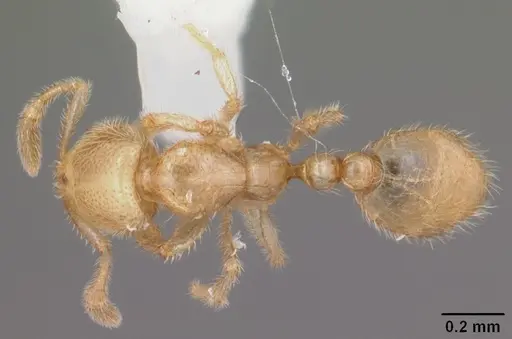
CASENT0923591
View on AntWeb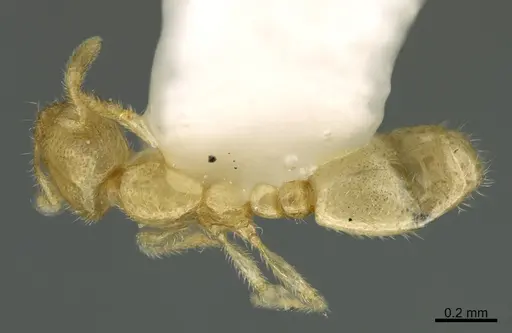
Literature
Loading distribution map...Loading products...