
Solenopsis macrops
- Sci. Name
- Solenopsis macrops
- Tribe
- Solenopsidini
- Subfamily
- Myrmicinae
- Author
- Santschi, 1917
- Distribution
- Found in 0 countries
Introduction
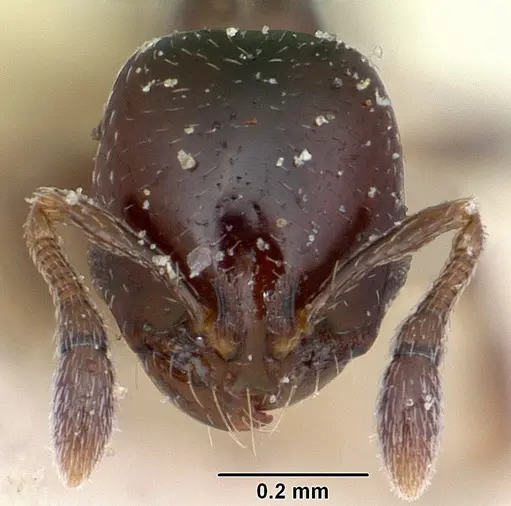
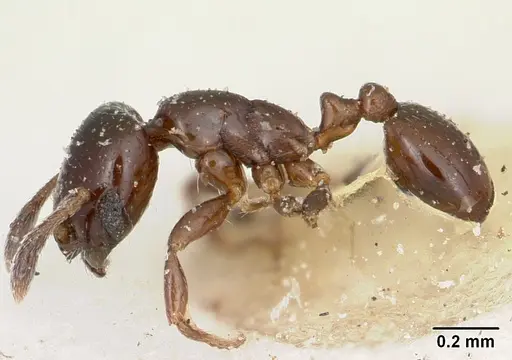
Solenopsis macrops is a tiny thief ant from the Solenopsis nigella species complex. Workers measure just 1.37-1.44 mm in total length, making them one of the smallest ants you might keep . They are dark brown all over, with a smooth and shiny mesopleuron and propodeum. Their most distinctive feature is a huge, kidney-shaped eye that extends down the side of the head almost to the mandibles, letting them see underneath their own head . This species is known only from the type locality in Tandil, Buenos Aires, Argentina, and is also recorded from the Caldenal district . It appears to have a very restricted range.
Quick Summary
- Difficulty: Hard
- Origin & Habitat: Neotropical region: central Argentina (Buenos Aires, Tandil, also Caldenal district) [2]. Likely inhabits dry grasslands or open scrub in the pampas region. No specific habitat details are published.
- Colony Type: Unconfirmed, colony structure has not been documented for this species. Until data emerges, treat as possibly monogyne (single queen).
- Size & Growth:
- Queen: Unconfirmed, queen has not been described.
- Worker: 1.37-1.44 mm [1]
- Colony: Unknown, no data exist. Related thief ants often have small colonies (a few hundred workers), but this is speculative.
- Growth: Unknown, no data. Likely moderate given small worker size and temperate origin.
- Development: Estimated 5-8 weeks at warm temperatures, based on typical Solenopsis development patterns. (Direct development data are unavailable for this species.)
- Antkeeping:
- Temperature: Keep at 22-26°C during the active season. They come from temperate Argentina and do well at moderate warmth. Provide a small gradient so they can choose their spot.
- Humidity: Moderate, keep the nest area slightly moist but not wet. Allow the substrate to dry out a bit between waterings. They are not moisture-dependent like rainforest species.
- Diapause: Likely required, as a species from temperate Argentina with distinct seasons, they probably need a winter rest. Reduce temperature to 10-15°C for 2-3 months during winter. This mimics their natural cycle [2].
- Nesting: Use small, tight-fitting nests due to their tiny size. Test tubes with cotton plugs work well for founding colonies. For larger colonies, choose Ytong or plaster nests with narrow chambers. They prefer dark, confined spaces.
- Behavior: These are secretive, small ants that likely forage in leaf litter and soil. As members of Solenopsis (thief ants), they may raid nests of other ant species. They are not aggressive toward humans and cannot deliver a noticeable sting due to their tiny size. Escape prevention is critical, they can slip through any gap wider than about 0.5 mm.
- Common Issues: escape prevention is the biggest challenge, their 1.4 mm body can pass through tiny gaps, use fluon barriers and check daily., very little species-specific data exists, most care advice is inferred from related species or general Solenopsis patterns., winter dormancy is often necessary but easy to mess up, incorrect temperatures or feeding during diapause can kill the colony., colonies are fragile when small, stress from vibrations, temperature swings, or moving can cause queen to stop laying or abandon the nest., limited availability, this species is rarely collected and may be hard to obtain legally (check local regulations).
Housing and Nest Setup
Because workers are only 1.4 mm long, you need a nest with very small openings. A test tube with a cotton plug works perfectly for founding colonies and can support dozens of workers. As the colony grows, move them to a small Ytong or plaster nest with narrow chambers. Avoid acrylic nests, they are hard to seal properly. Keep the nest dark by covering it with a cloth or placing it inside a nest box. Provide a small outworld with a lid that seals tightly. Use fluon or PTFE on the inner walls to prevent escapes [1].
Feeding and Diet
Like most thief ants, Solenopsis macrops is likely omnivorous with a preference for protein. Offer tiny prey such as fruit flies, pinhead crickets, or small pieces of mealworm. They will also accept sugar water or honey. Feed small amounts 2-3 times per week and remove uneaten food after 24 hours to prevent mold. During founding, place food near the nest entrance so the queen can access it. Always have fresh water available [1].
Temperature and Seasonal Care
This species comes from central Argentina, where summers are warm and winters cool. Keep the colony at 22-26°C during spring and summer. In autumn, gradually lower the temperature to 10-15°C over a few weeks and maintain this for 2-3 months. During the cold period, do not feed the colony, they will be inactive and food will rot. In spring, slowly warm them back up to active temperatures. This diapause is likely necessary for long‑term health [2].
Handling and Colony Maintenance
These ants are extremely small and delicate. When moving the colony, transfer entire nest sections (test tube or nest block) rather than picking up individual ants. Use soft tools (paintbrushes) if you must move them. Check barriers daily because even a tiny gap can let them escape. Because so little is known about this species, any observations you make, feeding preferences, brood development, colony size, are valuable. Take notes and share them with the antkeeping community [1].
Frequently Asked Questions
How long does it take for Solenopsis macrops to produce first workers?
The exact timeline is unknown for this species. Based on related Solenopsis species, expect 5-8 weeks from egg to first worker at 22-26°C. The queen raises the first brood alone, so development may be slower than in established colonies.
Can I keep multiple Solenopsis macrops queens together?
It is not recommended because colony structure is unconfirmed. Most Solenopsis species are monogyne (single queen) and will fight if forced together. Start with one queen and only attempt multi‑queen if you observe peaceful cohabitation in the same nest.
What size colony does Solenopsis macrops reach?
Colony size is unconfirmed. Based on related thief ants, colonies likely max out at a few hundred workers. They are not large colony formers like fire ants.
Are Solenopsis macrops good for beginners?
No, this species is rated as hard because so little is known about its care, and the tiny size makes escape prevention difficult. Beginners should start with hardier, well‑documented species first.
Do Solenopsis macrops need hibernation?
Yes, they likely require a winter dormancy period. They come from temperate Argentina with cold winters. Reduce temperature to 10-15°C for 2-3 months. This is inferred from their geography [2].
Why are my Solenopsis macrops escaping?
Their tiny size (1.4 mm) lets them crawl through gaps that seem impossibly small. Use fluon on all outworld rims, ensure container lids seal fully, and consider a double‑barrier system. Check barriers every day because these ants constantly test them.
What do I feed my Solenopsis macrops colony?
Offer small protein sources like fruit flies, pinhead crickets, or tiny mealworm pieces 2-3 times per week. They will also take sugar water or honey. Remove uneaten food after 24 hours. Portions should be very small, match the size of the workers.
When should I move my Solenopsis macrops to a formicarium?
Wait until the colony has at least 20-30 workers. Test tubes can support larger colonies (up to 100+ workers). Move to a Ytong or plaster nest only when the current home is clearly too small or the substrate is degrading.
Is Solenopsis macrops invasive anywhere?
No, this species is only known from a small area in central Argentina (Tandil and Caldenal district). There are no records of it being introduced elsewhere. Never release any ant into non‑native environments.
Report an Issue
The current care sheet is based fully on literature. See inconsistencies, or something that's incorrect? Please , it will be resolved after review from an admin. Contributing to the blogs tab also helps providing information, to make us be able to further improve the caresheets. Thank you for your support!
References

This caresheet is licensed under CC BY-SA 4.0 .
Community Blogs
CASENT0103214
View on AntWeb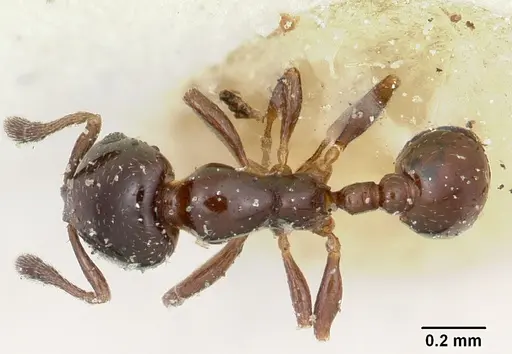
Literature
Loading distribution map...Loading products...