
Solenopsis leptanilloides
- Sci. Name
- Solenopsis leptanilloides
- Tribe
- Solenopsidini
- Subfamily
- Myrmicinae
- Author
- Santschi, 1925
- Distribution
- Found in 0 countries
Introduction
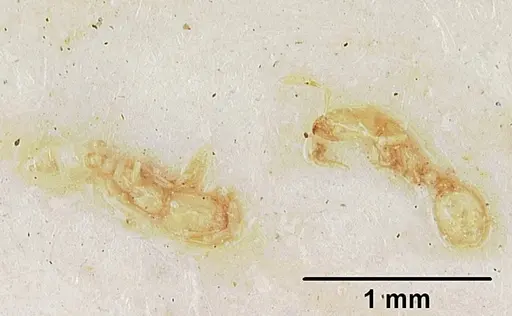
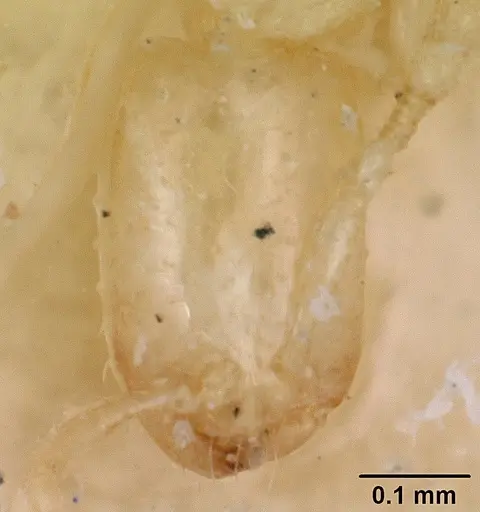
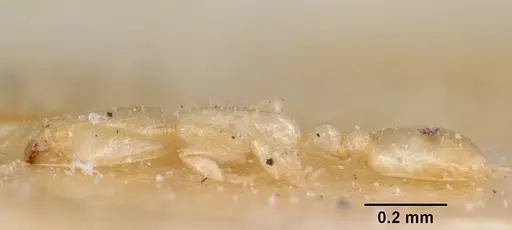
Solenopsis leptanilloides is an extremely tiny ant. Workers measure about 1.0-1.4 mm in total length, making them barely visible to the naked eye . They are uniformly pale yellow to light brown, with a rectangular head longer than wide. The head has coarse punctures, and the eyes are completely absent - a rare trait among ants . The antennae have a two-segmented club, and the postpetiole is oval when viewed from above. Like other Myrmicinae, they have a functional stinger . This species belongs to the Solenopsis pygmaea complex, a group of minute thief ants . The most remarkable thing about this species is its lifestyle: it lives as an inquiline inside the nests of the leafcutter ant Acromyrmex striatus. Workers are found in the upper chambers of host nests, rather than building their own colonies . This dependent relationship makes their biology highly unusual and poorly understood. Only workers have ever been collected - no queens, males, or other castes have been documented .
Quick Summary
- Difficulty: Expert
- Origin & Habitat: Native to northeastern Argentina, specifically Santa Fe province (Rosario area) and La Pampa province. Found living as an inquiline in the upper chambers of Amoimyrmex striatus (leafcutter ant) nests [1][4].
- Colony Type: Inquiline/guest species that lives inside Amoimyrmex striatus colonies. The colony structure is unknown, no queens have been found, and it's unclear if this species has independent colonies or depends entirely on host nests.
- Size & Growth:
- Queen: Unknown, no queens have been documented in scientific collections [2]
- Worker: Approximately 1.0-1.4 mm total length [1][2]
- Colony: Unknown, no colony size data exists for this species
- Growth: Unknown
- Development: Unknown, no development data exists for this species (Development has not been studied. Related Solenopsis species in the pygmaea complex develop from egg to worker in 4-6 weeks at warm temperatures, but this is not confirmed for S. leptanilloides.)
- Antkeeping:
- Temperature: No specific data. Based on the warm Argentine climate (Santa Fe and La Pampa), keep at 22-26°C as a starting point. Use a heating cable on one side to create a gradient. Adjust if workers seem sluggish or avoid the heated area.
- Humidity: No specific data. Their native habitat is likely moderate humidity given the inquiline relationship with leafcutter ants (which maintain humid nests). Keep the nest substrate consistently moist but not waterlogged. Aim for a moist environment with good ventilation.
- Diapause: Unconfirmed, their Argentine range has mild winters, so they may not need a true hibernation. If you want to try a cool period, drop to 15-18°C for a couple of months and observe. No reliable guidance exists.
- Nesting: As an inquiline of Amoimyrmex striatus, this species is adapted to living inside leafcutter nests. In captivity, offer small, dark, humid spaces, like test tubes or small plaster nests. Because they are blind and tiny, they need tight, enclosed chambers. Avoid large open areas.
- Behavior: This species is poorly documented. As an inquiline, they likely coexist peacefully with host colonies rather than fighting. They have a visible stinger [1] but are too small to sting humans. Their complete lack of eyes suggests they rely on chemical cues and are probably nocturnal or cryptic. Escape risk is extremely high due to their minute size, they can squeeze through gaps that seem impossible. Seal everything with fine mesh.
- Common Issues: escape prevention is critical, at ~1 mm, they get through gaps you can't see. Use 0.5 mm mesh and seal all joints., practically invisible, monitoring colony health is nearly impossible without magnification., inquiline lifestyle means they may need host colony context, captive success is uncertain., no queens have ever been found, you cannot start a colony from a founding queen. Wild workers alone won't reproduce., lack of eyes suggests sensitivity to light, keep nesting areas dark and minimize disturbance.
Size and Identification
Solenopsis leptanilloides is exceptionally small, workers measure roughly 1.0-1.4 mm total length, depending on the study [1][2]. They are uniform pale yellow to light brown, with a rectangular head longer than wide [1]. The head has coarse punctures, and the posterior margin is concave. A key feature is the complete absence of eyes [1]. The antenna club has two segments, the scapes are short, reaching about half the head length. The postpetiole is oval from above, and the gaster has sparse long hairs near the tip. The sting is visible [1]. This species differs from similar Solenopsis pygmaea by its more elongate head, and from Solenopsis westwoodi by its pale color (S. westwoodi is dark brown) [2].
Natural History and Distribution
This species is known only from Argentina: Santa Fe province (type locality Rosario) and La Pampa province (Santa Rosa) [1][5]. Workers were collected on August 6,2008,from the upper chambers of Amoimyrmex striatus leafcutter ant nests [1]. This inquiline relationship (living as a guest inside host nests) explains why the species is rarely found, they remain hidden inside host colonies. Solenopsis tetracantha has also been found in the same nests [4]. No queens, males, or reproductive forms have ever been collected [2]. The species belongs to the Solenopsis pygmaea complex, a group of minute thief ants with specialized ecologies [3].
Housing and Nest Setup
Keeping S. leptanilloides is extremely challenging due to their size and unknown needs. The number one problem is escape: at ~1 mm, they can squeeze through gaps between test tube stoppers and glass. You'll need very fine mesh (0.5 mm or smaller) on all ventilation holes, and every joint must be absolutely sealed. A small test tube with tight cotton wool plus a fluon barrier on the rim might work, but expect escape attempts. Since they are eyeless [1], they prefer dark, humid conditions. A small plaster or Y‑tong nest with tiny chambers scaled to their size is best for established groups. Keep the nest area dark and undisturbed. Their inquiline relationship with Acromyrmex [1] suggests they may need some organic substrate or a moist environment, but this is speculative.
Feeding and Diet
No specific diet is known for this species. As an inquiline in Acromyrmex nests [1], they might feed on fungal material, host debris, or receive food via trophallaxis. In captivity, offer very small prey like springtails, fruit fly larvae, or micro-arthropods. Also offer sugar water or diluted honey. Because they are tiny, even fruit flies may be too large, consider culturing springtails as a staple. Feed small amounts every 2-3 days and remove leftovers quickly. Their lack of eyes [1] suggests they may be nocturnal, so offer food in the evening.
Challenges and Limitations
This species is not suitable for most antkeepers. The biggest problem: no queens have ever been found [2], so you cannot start a colony from a queen. Wild-caught workers will die without producing offspring. The inquiline lifestyle suggests they may depend on Acromyrmex hosts for survival, captive success is highly uncertain. Their tiny size (1.0-1.4 mm) makes them nearly invisible, so monitoring is very difficult. There is almost no biological data on development, reproduction, or colony structure. For these reasons, S. leptanilloides is best left to researchers and not attempted as a pet.
Frequently Asked Questions
Can I keep Solenopsis leptanilloides in a test tube?
A test tube can work for housing, but escape prevention is the big issue. At ~1 mm, they can squeeze through tiny gaps. You'll need fine mesh on openings and a fluon barrier. Standard cotton stoppers won't hold them, try tightly packed dental floss plus fluon on the rim.
How long does it take for Solenopsis leptanilloides to develop from egg to worker?
Unknown, no development data exists for this species. Related Solenopsis in the pygmaea complex typically take 4-6 weeks at warm temperatures, but this is not confirmed for S. leptanilloides.
Do Solenopsis leptanilloides ants sting?
Yes, they have a visible stinger [1]. But at ~1 mm, their sting is too small to penetrate human skin, it's only relevant for prey or interacting with host ants.
Are Solenopsis leptanilloides good for beginners?
No. No queens have ever been documented [2], so you can't start a colony. Their inquiline lifestyle and lack of biological data make captive success very unlikely. This species is not recommended as a pet.
What do Solenopsis leptanilloides eat?
Unknown, but likely omnivorous like other Solenopsis. Offer very small prey (springtails, fruit fly larvae) and sugar water. Food must be tiny, even fruit flies may be too big. Springtail cultures are a good choice.
What temperature do Solenopsis leptanilloides need?
No specific data. Based on their Argentine origin, start at 22-26°C. Use a gradient so workers can choose. Adjust if they seem sluggish or avoid heat.
Can I keep multiple queens together?
Unknown, and probably irrelevant, because no queens have ever been found [2]. Without queens, you cannot establish a colony from wild workers.
How big do Solenopsis leptanilloides colonies get?
Unknown, there is no colony size data for this species.
Why are my Solenopsis leptanilloides dying?
Without documented captive colonies, we can't troubleshoot. Likely issues: escapes through tiny gaps, wrong humidity (too dry), stress from light or disturbance, or natural death of wild workers. They may simply be at the end of their lifespan.
Do Solenopsis leptanilloides need hibernation?
Diapause is unconfirmed. Their Argentine climate has mild winters, so they may not need a true hibernation. If you try, cool them to 15-18°C for a couple of months and watch for changes. No solid guidance exists.
Where is Solenopsis leptanilloides found in the wild?
Only in Argentina: Santa Fe province (Rosario) and La Pampa province (Santa Rosa). They live as inquilines in Amoimyrmex striatus leafcutter ant nests [1].
Report an Issue
The current care sheet is based fully on literature. See inconsistencies, or something that's incorrect? Please , it will be resolved after review from an admin. Contributing to the blogs tab also helps providing information, to make us be able to further improve the caresheets. Thank you for your support!
References

This caresheet is licensed under CC BY-SA 4.0 .
Community Blogs
CASENT0103202
View on AntWeb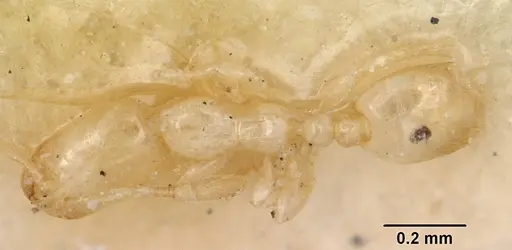
Literature
Loading distribution map...Loading products...