
Solenopsis interrupta
- Sci. Name
- Solenopsis interrupta
- Tribe
- Solenopsidini
- Subfamily
- Myrmicinae
- Author
- Santschi, 1916
- Distribution
- Found in 2 countries
Introduction
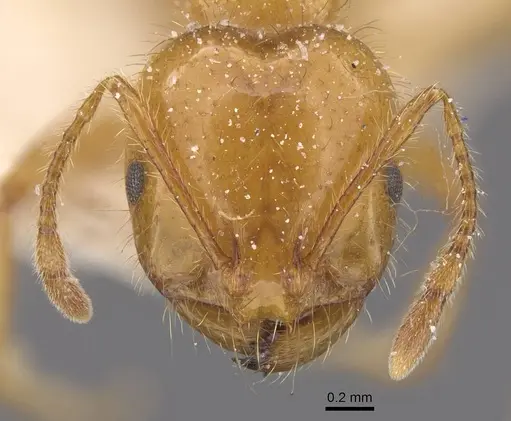
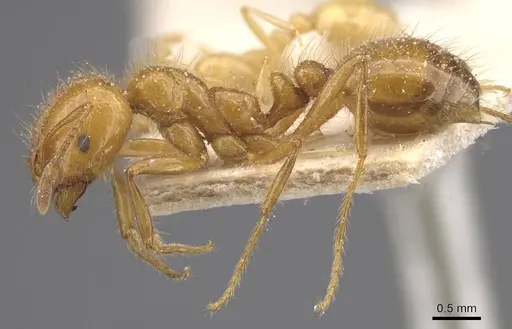
Solenopsis interrupta is a polymorphic fire ant species native to central-northern Argentina and Bolivia . Workers vary a lot in size: minor workers have elliptical heads, while majors develop strongly heart-shaped heads . They have a distinctive color pattern: reddish-yellow head, thorax, legs, and antennae, a dark brown to black gaster (back of the abdomen), and a large reddish-yellow spot on the first gaster segment . Their sting is reported to be excruciatingly painful, much more intense than other fire ants . What makes this species unique is its internal compass. Researchers found tiny magnetite particles in the head and antennae that are organized in a way that likely lets the ants sense Earth's magnetic field . About 58% of the body's magnetic material is in the head and antennae combined, and these parts show coordinated orientation changes when the magnetic field rotates . This probably helps foragers navigate back to the nest across open grasslands. The species also plays host to at least 13 different species of decapitating flies (Pseudacteon), which lay eggs inside workers and eventually decapitate them .
Quick Summary
- Difficulty: Expert
- Origin & Habitat: Central-northern Argentina (Córdoba, Mendoza provinces) northward into Bolivia [1]. Found in the Caldenal district and surrounding Neotropical grasslands, typically in warm, dry to moderately humid areas [6]. This is a tropical climate specialist adapted to temperate-to-warm conditions [7].
- Colony Type: Single-queen (monogyne) colonies, molecular studies place this species in a divergent clade separate from the socially polymorphic fire ants [8][9]. Ergatoid (wingless) replacement queens have not been reported for this species.
- Size & Growth:
- Queen: ~6-8 mm (estimated from related species in the Solenopsis saevissima group)
- Worker: ~3-6 mm (estimated from the Solenopsis saevissima group, no total length data available for this species)
- Colony: Unknown, no data available. Related monogyne saevissima group species typically reach 100-500 workers, but this is speculative.
- Growth: Moderate
- Development: Estimated 6-8 weeks at optimal temperature, based on related fire ant species. No specific data for S. interrupta. (Temperature strongly affects development speed. Founding queens do not need food, they raise first workers on stored reserves.)
- Antkeeping:
- Temperature: Keep the nest at 24-28°C. These ants come from warm grasslands and become sluggish below 20°C. A gentle temperature gradient (one side warmer) lets workers self-regulate. Avoid prolonged temperatures below 18°C or above 32°C.
- Humidity: Moderate humidity (around 40-60%). Provide a dry nest area with a moisture gradient, allow the substrate to partially dry between waterings. These ants come from warm, dry grasslands, so avoid constantly wet conditions.
- Diapause: Unknown. The species comes from temperate grasslands with mild winters, so a winter rest may be beneficial but is not confirmed. Some keepers recommend a mild diapause at 15-18°C for 2-3 months, but this is speculative.
- Nesting: Y-tong (AAC), plaster, or soil-based nests work well. Fire ants prefer dry, compact chambers over open, humid spaces. Provide a water test tube as a drinking source, but keep the overall nest on the drier side. Avoid acrylic nests.
- Behavior: This is an aggressive and defensive fire ant. Workers will swarm and sting repeatedly when disturbed, and the sting is excruciatingly painful [2]. Escape prevention is critical, workers are tiny and can squeeze through very small gaps. Use fluon and fine mesh. They are active foragers that recruit to food sources via pheromone trails. Colony relocation is common if conditions become unfavorable, so avoid moving the nest too often.
- Common Issues: sting pain, extremely painful sting makes handling risky, always use gloves and work in a well-lit area, escape prevention, tiny workers find any gap, seal the formicarium thoroughly with fluon and tight lids, parasite susceptibility, wild colonies may carry the microsporidian Thelohania solenopsae, which can kill captive colonies [11], desiccation risk, fire ants are vulnerable to drying out in low humidity, maintain moderate moisture, stress from disturbance, frequent nest relocation can cause brood abandonment or colony decline
Housing and Nest Setup
Solenopsis interrupta does well in Y-tong (AAC) or plaster nests with dry, compact chambers. A soil-based naturalistic setup also works, provided the substrate is allowed to dry between waterings. Avoid acrylic nests, as fire ants can easily chew through them. The workers are small but polymorphic, so chambers should be sized to accommodate majors, about 1-2 cm wide passages are fine. Fire ants are notorious escape artists: apply fluon to all edges of the outworld and use tight-fitting lids. Provide a water test tube connected to the nest to maintain a moisture gradient, the ants will choose the driest chamber for the brood. Keep the nest area dark or dimly lit, fire ants prefer dark nesting sites and will often move brood out of bright areas. [1]
Feeding and Diet
Fire ants are omnivorous generalists. Offer protein (small crickets, mealworms, or other insects) twice a week for growing colonies. Provide a constant source of sugar water or honey. Workers recruit aggressively to food sources using pheromone trails. Remove uneaten protein within 24-48 hours to prevent mold. Founding queens do not need food until the first workers emerge, they live off stored fat reserves. Once the colony has 20+ workers, you can feed them regularly.
Temperature and Seasonal Care
Maintain nest temperatures between 24-28°C for optimal brood development. These Argentine fire ants are adapted to warm grasslands and will become sluggish below 20°C. Use a small heating cable on one side of the nest to create a temperature gradient. Avoid temperatures above 32°C, which can cause desiccation. The species has been collected at elevations up to 2,280 m in Argentina, suggesting some tolerance for cooler conditions at higher altitudes [10]. A winter rest period (diapause) is common in many temperate Solenopsis, but no specific data exists for this species. If you choose to simulate winter, reduce temperatures to 15-18°C for 2-3 months. Keep the nest slightly drier during this period.
Defense and Sting Management
This is not a beginner-friendly species due to its sting. Solenopsis interrupta has one of the most painful stings among South American fire ants, described as 'excruciatingly painful' [2]. Workers swarm and sting repeatedly when the nest is disturbed. The venom is a mix of piperidine alkaloids, causing intense burning. Always use caution when opening the nest: work in a well-lit area, wear gloves, and avoid breathing on the colony. If stung, wash with soap and water and apply a cold compress. People with insect venom allergies should seek medical help. The formicarium must be secure from curious pets.
Health and Common Problems
Wild-caught colonies may carry the microsporidian Thelohania solenopsae, a parasite that can devastate captive colonies [11]. Quarantine new colonies for several weeks and watch for signs like sluggishness, reduced brood production, or sudden worker die-offs. In their native range, S. interrupta is attacked by at least 13 species of Pseudacteon decapitating flies [5]. While these flies are unlikely in captivity, they represent a natural threat outdoors. The main causes of captive colony failure are: escape (tiny workers find any gap), desiccation (too dry), and stress (excessive disturbance during founding). Regular observation, a stable moisture gradient, and minimal disturbance prevent most problems.
Unique Biology: Magnetic Navigation
Solenopsis interrupta has a built-in magnetic compass. Researchers found biogenic magnetite (Fe₃O₄) particles in the head and antennae that are organized in a way that responds to Earth's magnetic field direction [3][4]. The head and antennae together hold about 58% of the magnetic material in the body, with the antennae containing about 31% and the head 27% [3]. In laboratory experiments, the resonant signal of these body parts changes depending on their orientation relative to the magnetic field, evidence of a functioning magnetoreception system [4]. This likely helps foragers navigate back to the nest in open grassland habitats. The amount of magnetic material also varies with seasons, dropping significantly during dry months [12]. This is one of the best-documented cases of magnetoreception in ants.
Frequently Asked Questions
Does Solenopsis interrupta have a painful sting?
Yes, the sting is described as excruciatingly painful, far more than other fire ants [2]. Handle with extreme caution, using gloves and protective gear.
How long does it take for Solenopsis interrupta eggs to develop into workers?
There is no specific data for this species, but based on related Solenopsis fire ants, you can expect roughly 6-8 weeks from egg to worker at optimal temperatures (around 26°C). Development is slower at lower temperatures.
What temperature do Solenopsis interrupta ants need?
Keep the nest at 24-28°C. These ants come from warm grasslands and become inactive below 20°C. Provide a temperature gradient with a warm area.
Do Solenopsis interrupta ants need hibernation?
Unknown. No studies have examined diapause in this species. Since they come from temperate grasslands with mild winters, a winter rest may be beneficial, but it is not confirmed. Some keepers recommend a mild diapause at 15-18°C for 2-3 months, but this is speculative.
How big do Solenopsis interrupta colonies get?
Colony size for this species is unknown. Related monogyne fire ants in the saevissima group usually form colonies of 100-500 workers, but this is just an estimate. No colony size data has been published for S. interrupta.
Can I keep multiple Solenopsis interrupta queens together?
No, this species is monogyne (single-queen). Molecular studies place it in a clade separate from socially polymorphic fire ants, and it is not known to exhibit polygyny [8]. Multiple queens would fight until only one remains.
What do Solenopsis interrupta ants eat?
They are omnivorous. Provide protein (small insects like crickets, mealworms) twice a week and offer a constant supply of sugar water or honey. Young colonies (founding queens) do not need food until the first workers appear.
Is Solenopsis interrupta good for beginners?
No, this species is not recommended for beginners due to its extremely painful sting and high escape risk. Keepers should have experience with aggressive, stinging ants before attempting this species.
What type of nest is best for Solenopsis interrupta?
Y-tong (AAC), plaster, or soil-based nests work well. Avoid acrylic nests. Provide dry, compact chambers and a water source that creates a moisture gradient. Fire ants prefer drier conditions than many tropical species.
Where is Solenopsis interrupta native to?
Central-northern Argentina (Córdoba, Mendoza provinces) northward into Bolivia. They inhabit the Caldenal district and surrounding Neotropical grassland regions [6][1].
Why do Solenopsis interrupta ants have magnetic material in their heads?
The magnetite particles in their heads and antennae form a biological compass. Studies show that the material is organized and responds to the direction of Earth's magnetic field, helping foragers navigate back to the nest [3][4].
Report an Issue
The current care sheet is based fully on literature. See inconsistencies, or something that's incorrect? Please , it will be resolved after review from an admin. Contributing to the blogs tab also helps providing information, to make us be able to further improve the caresheets. Thank you for your support!
References

This caresheet is licensed under CC BY-SA 4.0 .
Community Blogs
CASENT0913900
View on AntWeb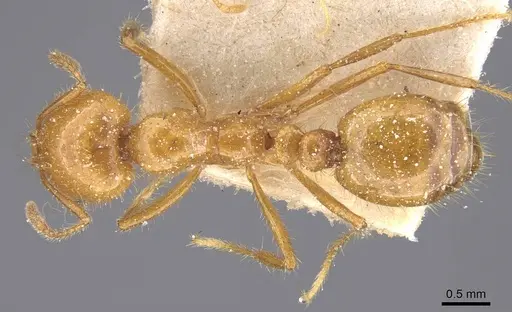
Literature
Loading distribution map...Loading products...