
Royidris shuckardi
- Sci. Name
- Royidris shuckardi
- Tribe
- Crematogastrini
- Subfamily
- Myrmicinae
- Author
- Forel, 1895
- Distribution
- Found in 1 countries
Introduction
Royidris shuckardi is an extremely rare ant from Madagascar, known only from a single queen collected in the late 1800s . The queen is rusty orange (ferruginous) and about 3.2 mm long (head+mesosoma measurement, total length unknown) . Workers have never been confirmed for this species - specimens once thought to be its workers are now recognized as different Royidris species . Its type locality is Moramanga in Toamasina Province, but experts suspect that location may be an error because other related Royidris ants live hundreds of kilometers away in dry, spiny forests . This taxonomic mystery makes R. shuckardi one of the most poorly understood ants in Madagascar .
Quick Summary
- Difficulty: Expert
- Origin & Habitat: Endemic to Madagascar. The holotype queen was collected at Moramanga (Toamasina Province) [3]. Related species in the shuckardi complex live in dry, spiny forests of Toliara Province and have also been recorded from burned and unburned grassland and dry deciduous forest in the Beanka Reserve, Melaky Region [4][1]. These areas are hot and dry.
- Colony Type: Unknown, only the holotype queen exists. No colony structure, queen number, or social system has been documented [2].
- Size & Growth:
- Queen: size data unavailable (head+mesosoma length ~3.2 mm, but total length not recorded) [1]
- Worker: size data unavailable (no confirmed workers) [2]
- Colony: Unknown
- Growth: Unknown
- Development: Unknown, no data (No development data exists. Related myrmicine ants usually take 4-8 weeks from egg to worker at warm temperatures, but this is purely speculative.)
- Antkeeping:
- Temperature: Unconfirmed. Based on the dry, hot habitat of related species, you can try 22-28°C with a gradient [4].
- Humidity: Moderate to low, the dry spiny forest habitat suggests they prefer drier conditions. Keep the nest substrate slightly moist but not wet, with some dry areas available [1].
- Diapause: Unknown, Madagascar’s mild winters may not require a true diapause, but this is speculation.
- Nesting: Related species nest in dead twigs above ground [1]. For captive care, small test tubes, Y-tong (AAC) nests, or plaster nests with narrow chambers would be appropriate. Provide some vertical space.
- Behavior: Behavior is unstudied. Related species are generalist foragers that scavenge and may collect small insects. Their tiny size (if workers existed) would make escape prevention critical, they could slip through standard barriers. Based on subfamily (Myrmicinae, tribe Crematogastrini), defense mechanism is likely 'smearing' venom with a flattened stinger rather than piercing.
- Common Issues: this species is virtually unknown in captivity, no husbandry protocols exist, only a single queen specimen exists, so no wild colonies have ever been documented, workers have never been definitively associated with the queen, making species identification uncertain, if you obtain ants labeled 'R. shuckardi', they are almost certainly a different, related species (R. gravipuncta, R. longiseta, or R. peregrina)
Taxonomic Mystery
Royidris shuckardi was originally described by Forel in 1895 as a worker, but later found to be a dealated queen [1]. Heterick (2006) linked this queen to a group of workers, but Bolton and Fisher (2014) showed those workers belong to three separate species: Royidris gravipuncta, Royidris longiseta, and Royidris peregrina [2]. The queen cannot be matched to any known worker, and its type locality (Moramanga in eastern Madagascar) is very different from the dry areas where the related species live [2]. This means any ant sold as R. shuckardi is almost certainly one of those other species.
Natural Habitat and Distribution
The holotype queen came from Moramanga, Toamasina Province, Madagascar [3]. Workers of the shuckardi complex (the related species previously confused with R. shuckardi) are widespread in dry, spiny forests of Toliara Province in southern Madagascar [1]. They have also been found in burned and unburned grassland and dry deciduous forest in the Beanka Reserve, Melaky Region [4]. They nest in dead twigs above ground and are also collected from pitfall traps, under stones, and as ground foragers [1].
Morphology and Identification
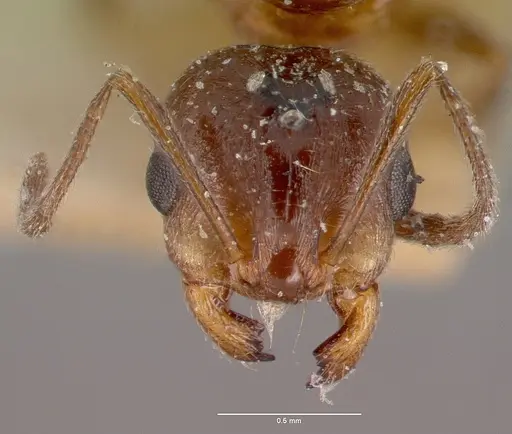
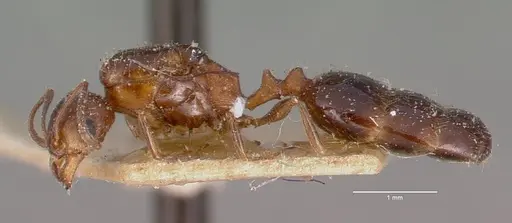
The holotype queen is rusty orange (ferruginous) [1]. It has a distinctive head: in full-face view, the eyes are placed in front of the midlength of the head sides, and the sides behind the eyes are long and shallowly convex, converging toward a short, medially indented posterior margin [2]. The queen’s head+mesosoma length is about 3.2 mm (total length is not recorded) [1]. Workers from the related Royidris species (which are often mistaken for R. shuckardi) are tiny, orange with a darker head and chocolate gaster, have 12 antennal segments with a 4-segmented club, and large eyes [1]. They are monomorphic [1]. The best way to distinguish true R. shuckardi queens from related species is the forward eye position, in the worker‑associated queens of the complex, the eyes sit at or near the midlength of the head sides [2].
Nesting and Foraging
Related species in the shuckardi complex nest opportunistically in dead twigs above ground [1]. They forage on the ground and are also found under stones. This suggests they prefer pre‑existing cavities and drier conditions. For captive care, provide small test tubes, Y‑tong (AAC) nests, or plaster nests with narrow chambers. Mimic the dead‑twig environment by offering a bit of dry twig or bark in the outworld.
Keeping This Species in Captivity
WARNING: true Royidris shuckardi is essentially impossible to keep. It is known only from a single 125‑year‑old queen specimen, with no confirmed workers, no established colonies, and no documented husbandry. Any ant labeled as R. shuckardi is almost certainly one of the related species (Royidris gravipuncta, Royidris longiseta, or Royidris peregrina) [2]. If you are interested in keeping a Royidris species, try to obtain a confirmed colony of one of those three better‑understood species. Even then, expect tiny ants, dry conditions, and very limited information. This is not a species for beginners or even most experts.
Frequently Asked Questions
Can I keep Royidris shuckardi ants in captivity?
No, true R. shuckardi is known only from a single queen collected in 1895. No colonies exist in captivity and no care information is available. Any ants sold under this name are actually one of the related species [2].
How do I identify Royidris shuckardi?
It is extremely difficult. The species is defined only by the holotype queen. Queens have eyes placed in front of the midlength of the head sides, while related species have eyes at the midlength [2]. Workers were never confirmed for this species. Specimens in collections are usually one of the three related worker‑based species [2][1].
What do Royidris shuckardi eat?
Unknown. Related Royidris species are generalist scavengers that take small insects and honeydew, but diet for true R. shuckardi is unconfirmed.
Where is Royidris shuckardi found?
The single known specimen was collected at Moramanga, Toamasina Province, Madagascar [3]. Workers of related species live in dry, spiny forests of southern Madagascar and in the Beanka Reserve [1][4].
How big do Royidris shuckardi colonies get?
Unknown, no colony has ever been observed. Related species probably form small colonies, likely under 500 workers, but this is speculative.
Do Royidris shuckardi ants sting?
Not documented. As a myrmicine ant, it likely has a stinger. Based on subfamily traits, the defense is probably 'smearing' venom with a flattened stinger rather than a piercing sting. Given the tiny size, any sting would be minimal.
What temperature and humidity do Royidris shuckardi need?
Unconfirmed. Based on the dry, hot habitat of related species (dry spiny forest), try 22-28°C with low to moderate humidity. Provide a moisture gradient [4].
How long does it take for Royidris shuckardi to develop from egg to worker?
Unknown, no data exists. Related myrmicine species typically take 4-8 weeks at warm temperatures, but this is a rough guess.
Is Royidris shuckardi a good species for beginners?
No, it is completely unsuitable for anyone. The true species is known only from a museum specimen, with no captive records. Beginners should avoid even the related species, which are poorly documented.
Can I keep multiple Royidris shuckardi queens together?
Unknown, social structure has never been studied. Without any data, do not attempt to combine queens.
Do Royidris shuckardi need hibernation?
Unknown, Madagascar has mild winters, so a true diapause may not be necessary, but this is speculation without any captive observations.
Why is Royidris shuckardi so poorly understood?
It is known only from a single queen collected over 125 years ago, the type locality may be wrong, and workers have never been linked to it. This makes it one of the most mysterious ants in Madagascar [2][1].
Report an Issue
The current care sheet is based fully on literature. See inconsistencies, or something that's incorrect? Please , it will be resolved after review from an admin. Contributing to the blogs tab also helps providing information, to make us be able to further improve the caresheets. Thank you for your support!
References

This caresheet is licensed under CC BY-SA 4.0 .
Community Blogs
CASENT0010761
View on AntWeb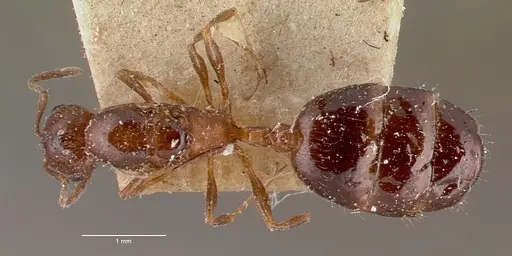
Literature
Loading distribution map...Loading products...