
Royidris anxietas
- Sci. Name
- Royidris anxietas
- Tribe
- Crematogastrini
- Subfamily
- Myrmicinae
- Author
- Bolton & Fisher, 2014
- Distribution
- Found in 1 countries
Introduction
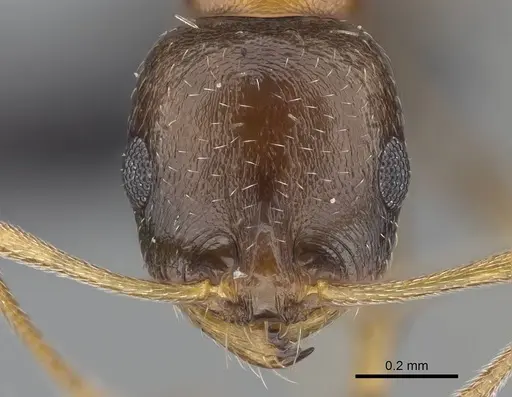
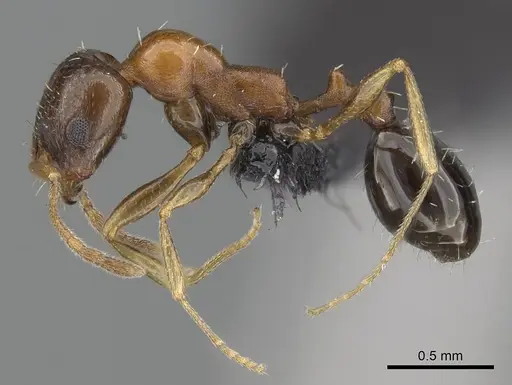
Workers are 2.5-2.8 mm in total length , making this one of the smallest ants you can keep. They belong to the *robertsoni* species group within the genus *Royidris* and have a distinctly sculptured head, a 3-segmented antennal club, and a domed promesonotum that gives them a hunched look . Coloration varies - some workers are brown to orange-brown with a black gaster, others are uniformly dark brown . These ants are endemic to Madagascar and have been collected mainly in dry forest edges and burned savannah, but also from uapaca woodland and once from an urban garden . Because they were only described in 2014 and only the worker caste is known, almost nothing is confirmed about their colony structure, queen, or behavior. They represent a challenge for experienced keepers interested in rare, poorly documented species.
Quick Summary
- Difficulty: Hard
- Origin & Habitat: Endemic to Madagascar. Collected from dry forest edges, burned savannah, uapaca woodland [1]. Soil‑dwelling and adapted to dry, dark conditions [2].
- Colony Type: Unknown, only the worker caste has been collected, the queen has never been described [1].
- Size & Growth:
- Queen: Unknown (queen not described)
- Worker: 2.5-2.8 mm [1]
- Colony: Unknown, no data exists on maximum colony size in the wild or captivity.
- Growth: Unknown
- Development: Unknown, no development data exists. Based on typical small Myrmicinae from tropical regions, you can estimate 6-10 weeks at warm temperatures (24-28 °C), but this is entirely speculative. (All development timelines are unconfirmed. Use warm, stable conditions and watch for nanitics.)
- Antkeeping:
- Temperature: Likely 24-28 °C based on the tropical climate of Madagascar’s Makay Mountains. Provide a slight gradient so the ants can choose their preferred spot. Avoid temperatures below 20 °C or above 32 °C. [1]
- Humidity: Adapted to dry conditions (dry forest, savannah) [2]. Keep the nest substrate on the dry side, only a small area slightly moist. Overly wet conditions may stress the colony.
- Diapause: No, as a tropical Madagascar species, year‑round warm temperatures are expected.
- Nesting: Ground‑dwelling, likely nests in small chambers in soil or under debris. A simple test tube setup or a small formicarium with dryish substrate and a tiny moist zone should work. Because the queen is unknown, keep it small and simple.
- Behavior: Behavior is poorly documented. Like other tiny ground‑dwelling Myrmicinae, they are probably shy and non‑aggressive, foraging on the ground surface. Their 2.5-2.8 mm size makes escape prevention critical, they can slip through standard ant mesh. Use fine mesh (holes
- Common Issues: tiny workers (2.5-2.8 mm) require very fine mesh, standard ant mesh will not contain them., virtually no documented care information, expect trial and error., queen has never been collected, you may not be able to confirm you have a true queen (only workers known)., very limited availability in the hobby, rarely offered for sale.
Housing and Nest Preferences
Because Royidris anxietas is only known from the worker caste and its natural nest site has never been recorded, any advice is guesswork [1]. In the wild it was collected from dry forest edges, burned savannah, and uapaca woodland, suggesting a ground‑dwelling life in dry, sunny spots [1][2]. For captive colonies, start with a small test tube setup, a water reservoir at one end separated by cotton. Keep the substrate side mostly dry, with only a tiny damp area. Avoid using acrylic nests, Y-tong (AAC), plaster, or a small soil nest with fine, dryish sand/soil mix would be more appropriate. The nest chambers must be tiny (a few mm high) to suit the workers’ small size. An outworld should have a fine‑mesh lid (holes
Feeding and Diet
No dietary data exists for Royidris anxietas [1]. Based on its size and the habits of other small Myrmicinae, it probably forages for small arthropods and sugary secretions. Offer tiny protein sources like fruit flies, pinhead crickets, or small pieces of mealworm. Sugar water or honey can be provided on a small cotton ball. Give small amounts first and remove uneaten prey after 24-48 hours to prevent mold. Acceptance may vary because the species is unstudied.
Temperature and Environment
The type locality in the Makay Mountains (Madagascar) experiences a tropical climate with distinct dry and wet seasons [1]. Keep your colony warm, ideally 24-28 °C. A heating cable on one side of the setup creates a useful temperature gradient. Because the species lives in dry forest and savannah, avoid high humidity, the nest should be dry with only a small moist zone. No hibernation is needed, provide stable warmth year‑round. Sudden temperature swings should be avoided.
Behavior and Temperament
With no behavioral studies, we can only infer from the genus and ecology. Royidris species are minute, ground‑foraging ants that are likely timid and non‑aggressive [1]. Their worker size of 2.5-2.8 mm means they can squeeze through tiny gaps, use the finest mesh you can find (0.3-0.5 mm opening) or a fluon barrier. They are not known to sting in a way that affects humans, like most Myrmicinae they have a small stinger used for defense (smear venom), but it’s negligible to people. Handle the colony gently and give it plenty of dark, quiet spots.
Colony Establishment
Only worker ants have been collected, the queen has never been described [1]. Founding behavior is therefore completely unknown. If you somehow obtain a queen, provide a quiet, dark test tube with a water reservoir and keep it at 24-28 °C. Do not disturb during the founding stage. Based on small Myrmicinae, first workers might appear in 6-10 weeks, but this is pure speculation. There is a real risk that the queen may require semi‑claustral conditions (feeding during founding) or have other unstudied needs.
Frequently Asked Questions
Can I keep Royidris anxietas in a test tube?
Yes, a test tube setup is ideal for such small ants. Use a tube with a water reservoir at one end, separated by a cotton plug. Keep it horizontal so the ants can choose between the humid and dry ends. Their tiny size (2.5-2.8 mm) means they’ll fit comfortably.
How long does it take for Royidris anxietas to produce first workers?
No development data exists for this species [1]. Based on small tropical Myrmicinae, you might see nanitics after 6-10 weeks at 24-28 °C, but this is an unconfirmed guess.
Do Royidris anxietas ants sting?
Royidris belongs to the subfamily Myrmicinae, which usually has a functional stinger, but the sting of this tiny ant would be minimal and not dangerous to humans. Their primary defense is likely to smear venom rather than pierce (tribe Crematogastrini).
What temperature do Royidris anxietas need?
Aim for 24-28 °C, based on the tropical climate of their type locality in Madagascar [1]. A slight temperature gradient helps the colony self‑regulate. Avoid temperatures below 20 °C.
Are Royidris anxietas good for beginners?
No. Their care is completely undocumented, the queen is unknown, and the workers are so tiny that escape prevention is very challenging. This species is only suitable for experienced keepers willing to experiment.
How big do Royidris anxietas colonies get?
Colony size is unknown, no data exists [1]. Based on related Royidris species, colonies probably stay small (maybe a few hundred workers at most), but this is speculative.
What do Royidris anxietas eat?
Specific diet is unconfirmed. Offer small insects (fruit flies, pinhead crickets) and sugar water or honey. Remove uneaten food after 24-48 hours. They may be picky.
Do Royidris anxietas need hibernation?
No, as a tropical Madagascar species, they do not require a dormant period. Keep them at 24-28 °C year‑round.
Why are my Royidris anxietas escaping?
Their 2.5-2.8 mm size lets them slip through standard ant mesh. Use wire mesh with openings
Can I keep multiple queens together?
Because colony structure is unknown and the queen has never been studied, it is not recommended to combine queens [1]. Keep a single queen if you are lucky enough to obtain one.
When should I move Royidris anxietas to a formicarium?
Wait until the test tube is visibly overcrowded or the water dries out too quickly. Because colony size is unknown, use your judgment, if the ants seem cramped, move them to a small nest with tiny chambers. Do not move prematurely.
Is Royidris anxietas aggressive?
Aggression is unconfirmed. Based on their small size and ground‑dwelling habits, they are likely shy and non‑aggressive. Provide hiding spots and handle gently.
Report an Issue
The current care sheet is based fully on literature. See inconsistencies, or something that's incorrect? Please , it will be resolved after review from an admin. Contributing to the blogs tab also helps providing information, to make us be able to further improve the caresheets. Thank you for your support!
References

This caresheet is licensed under CC BY-SA 4.0 .
Community Blogs
CASENT0205644
View on AntWeb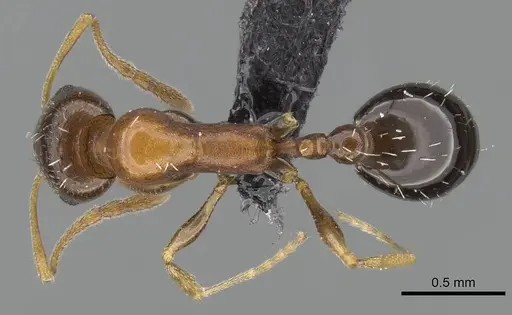
Literature
Loading distribution map...Loading products...