
Rotastruma stenoceps
- Sci. Name
- Rotastruma stenoceps
- Tribe
- Crematogastrini
- Subfamily
- Myrmicinae
- Author
- Bolton, 1991
- Distribution
- Found in 2 countries
Introduction
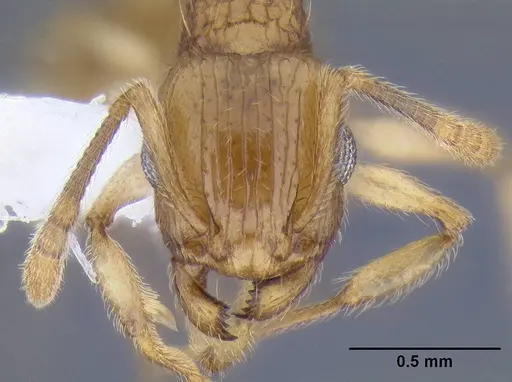
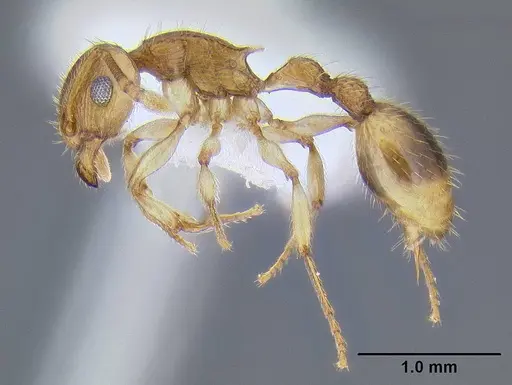
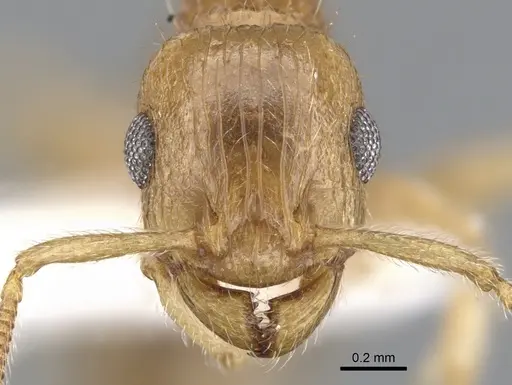
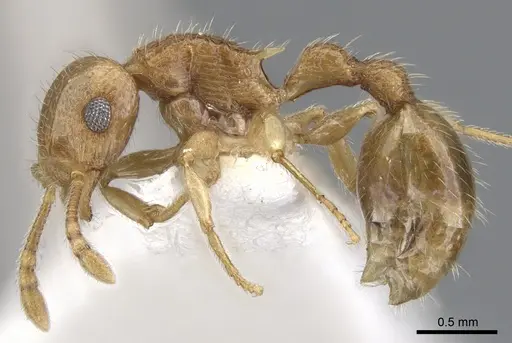
Rotastruma stenoceps is a small, rare myrmicine ant native to southern and central China and Hong Kong, with a recent record from Macao . Workers measure about 3.7mm and have a distinctive golden-brown coloration with a rectangular head and short propodeal spines pointing backward . Queens are slightly larger at 4.3mm and share a similar appearance, with a thick cuticle and golden-brown body . This species is part of the Crematogastrini tribe and is closely related to Paratopula, with both genera forming an Indo-Pacific clade . The genus Rotastruma is extremely rarely collected, with R. stenoceps known only from a handful of specimens across its range in Guangdong, Hubei, Hunan, Yunnan, Hong Kong, and Macao .
Quick Summary
- Difficulty: Expert
- Origin & Habitat: Southern and central China (Guangdong, Hubei, Hunan, Yunnan), Hong Kong, and Macao. Found in arboreal habitats – the related R. recava nests in dead twigs and near trees. One queen was collected from a railing adjacent to a hiking trail in a Lophostemon confertus plantation at approximately 21:00 h [2].
- Colony Type: Colony structure is unconfirmed. This is a rarely collected species with no documented colony observations.
- Size & Growth:
- Queen: 4.33mm [2]
- Worker: 3.7mm [5]
- Colony: Unknown – no colony size data exists for this species
- Growth: Unknown
- Development: Unconfirmed – no development data exists for this species (Development timeline has not been studied. For an estimate, related arboreal Myrmicinae typically take 6-10 weeks at optimal temperatures, but this is not confirmed for Rotastruma.)
- Antkeeping:
- Temperature: Unknown – no thermal studies exist. Based on its range in southern China, start at 20-26°C and observe your colony's activity to adjust.
- Humidity: Unknown – no humidity data exists. As an arboreal species from a subtropical region, moderate humidity (around 50-70%) is a reasonable starting point. Provide a water source and monitor.
- Diapause: Unknown – no seasonal data exists. Southern Chinese populations may have reduced activity in winter but likely do not require true hibernation. If you keep a colony, you can lower temperatures slightly in winter but watch for stress.
- Nesting: Likely arboreal – the related R. recava nests in dead twigs and near trees [2]. Recommend a formicarium with vertical or angled chambers, or a naturalistic setup with twigs and branches. A Y-tong (AAC) nest with narrow chambers would work well for their small size.
- Behavior: Behavior is poorly documented. One queen was seen walking on a railing at night (~21:00 h), which might indicate nocturnal activity, but it could also be a nuptial flight timing [2]. Workers likely forage in the arboreal stratum. No sting is visible on the queen [2], but the species belongs to the Crematogastrini tribe, which uses a smear defense mechanism – a modified stinger to wipe venom onto enemies. Escape risk is moderate given their small size – use tight lids and barriers.
- Common Issues: extremely limited availability – this species is rarely collected and almost never available in the antkeeping hobby, no captive breeding data exists – establishing a colony would require wild-caught queens, which are hard to locate, temperature and humidity requirements are unknown and must be figured out through careful observation, growth rate and development timeline are unconfirmed, making colony management experimental, arboreal nesting preference may need specialized setups different from typical ground-nesting ant setups
Distribution and Habitat
Rotastruma stenoceps is known from southern and central China (Guangdong, Hubei, Hunan, Yunnan provinces), Hong Kong, and Macao [2][4][1]. The type locality is the Ding-Hu Mountains in Guangdong,60km west of Guangzhou, where the holotype worker was collected in June 1983 [6]. This species appears to be arboreal – the related R. recava has been found in dead twigs and near trees, suggesting Rotastruma may nest in similar microhabitats [2]. One queen was collected from a monoculture plantation of Lophostemon confertus in Hong Kong, walking on a railing next to a hiking trail at about 21:00 h [2]. The genus is part of an Indo-Pacific clade closely related to Paratopula [3].
Identification and Appearance
Workers measure about 3.7mm in total length and have a rectangular head that is slightly wider than long [5][2]. The body is a uniform golden-brown, with the gaster darker light-brown [2]. The propodeal spines are short and point backward, which separates R. stenoceps from the similar R. epispina [6]. The sides of the head have projecting hairs, and the propodeal spiracle sits near the metapleural gland bulla [2]. Queens are slightly larger at 4.33mm and share the same golden-brown color, though the mandibles are a bit darker and the gaster is lighter brown [2]. The queen has 12 antenna segments ending in a 3-segmented club, triangular mandibles with 6 teeth, and large eyes with about a dozen ommatidia [2]. No sting is visible on the queen [2]. The cuticle is thick, and most of the body surface is sculptured except for the antennae, legs, and gaster [2].
Nesting and Care Recommendations
Based on the arboreal nesting of the related R. recava, R. stenoceps likely nests in dead twigs, hollow stems, or under bark in trees [2]. For captive care, set up a nest with vertical elements like twigs, branches, or cork bark arranged vertically. A Y-tong (AAC) formicarium with narrow chambers scaled to their small size (workers ~3.7mm) could also work. Humidity is unknown, so start with moderate levels (around 50-70%) and provide a water source. Keep the temperature in the low-to-mid 20s°C (20-26°C) based on their subtropical range in southern China. Watch your colony for signs of stress – workers clustering, avoiding certain areas, or being lethargic – and adjust conditions as needed. Escape prevention is important given their small size, use tight-fitting lids and appropriate barriers.
Feeding and Diet
The diet of Rotastruma stenoceps has not been documented. As a myrmicine ant, they are likely omnivorous, similar to other arboreal Myrmicinae – probably feeding on honeydew from aphids and scale insects, plus small insects and arthropods for protein. Offer sugar water or honey as an energy source, and provide tiny protein items like fruit flies, pinhead crickets, or other small arthropods. Since workers are about 3.7mm, prey should be appropriately sized. Start with small amounts and see what your colony accepts. Remove uneaten food after 24-48 hours to prevent mold.
Challenges and Limitations
R. stenoceps is one of the rarest ants in the hobby because of its limited distribution and the difficulty of finding colonies in the wild. This species is basically unavailable to most antkeepers, and there are no captive breeding programs. Almost all biological details – colony structure, founding behavior, development timeline, exact temperature and humidity needs, and colony size – are unknown. Keeping this species would involve a lot of experimentation and careful observation. If you do get a queen, keep detailed notes because any data from captivity would be scientifically valuable for such a poorly studied species.
Frequently Asked Questions
Is Rotastruma stenoceps available in the antkeeping hobby?
No. This is one of the rarest ant species in the hobby due to its limited distribution in southern China and Hong Kong, and the difficulty of finding colonies in the wild. Almost no specimens exist in captivity.
What do Rotastruma stenoceps ants eat?
Their diet hasn't been documented, but as a myrmicine ant they likely eat honeydew from aphids and scale insects, plus small insects for protein. Offer sugar water or honey and appropriately sized prey.
What temperature should I keep Rotastruma stenoceps at?
Exact needs are unknown. Based on their range in southern China, start at 20-26°C. Watch your colony and adjust based on activity levels.
What size are Rotastruma stenoceps workers?
Workers are about 3.7mm in total length. Queens are slightly larger at roughly 4.3mm.
Where is Rotastruma stenoceps found?
This species is known from southern and central China (Guangdong, Hubei, Hunan, Yunnan provinces), Hong Kong, and Macao. The type locality is the Ding-Hu Mountains in Guangdong.
Do Rotastruma stenoceps ants sting?
No sting is visible on described specimens [2]. However, as part of the Myrmicinae subfamily and Crematogastrini tribe, they likely have a modified stinger used for smearing venom onto enemies (a smear defense mechanism). Standard handling precautions are still wise.
How do I set up a nest for Rotastruma stenoceps?
Based on the related R. recava nesting in dead twigs and near trees, this species prefers arboreal setups. Try a naturalistic nest with vertical elements like twigs, branches, or cork bark. A Y-tong formicarium with narrow chambers also works for their small size.
How long does it take for Rotastruma stenoceps to develop from egg to worker?
The development timeline is unconfirmed – no research exists. For an estimate, related arboreal Myrmicinae typically take 6-10 weeks from egg to worker at optimal temperatures, but that's just a guess for this species.
Do Rotastruma stenoceps need hibernation?
Diapause needs are unknown. Southern Chinese populations may slow down in winter but likely don't require true hibernation. If you keep a colony, you can lower temperatures slightly in winter but monitor for stress.
Is Rotastruma stenoceps good for beginners?
No. This species is not for beginners because it's extremely rare (almost impossible to get), care requirements are unknown, and success depends on experimental husbandry. Only experienced antkeepers with access to specimens and patience should attempt it.
Report an Issue
The current care sheet is based fully on literature. See inconsistencies, or something that's incorrect? Please , it will be resolved after review from an admin. Contributing to the blogs tab also helps providing information, to make us be able to further improve the caresheets. Thank you for your support!
References

This caresheet is licensed under CC BY-SA 4.0 .
Community Blogs
CASENT0106285
View on AntWeb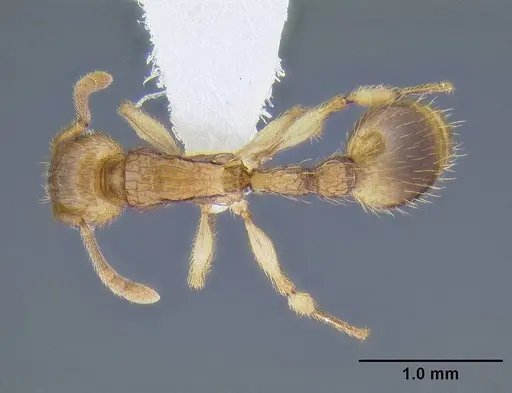
CASENT0901994
View on AntWeb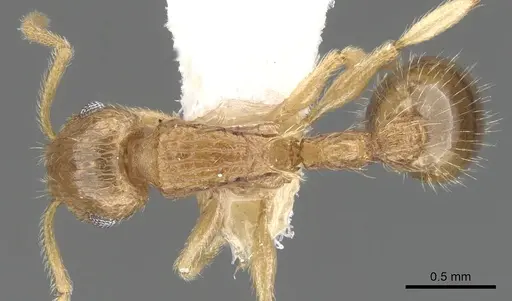
Literature
Loading distribution map...Loading products...