
Rogeria tsumani
- Sci. Name
- Rogeria tsumani
- Tribe
- Solenopsidini
- Subfamily
- Myrmicinae
- Author
- LaPolla & Sosa-Calvo, 2006
- Distribution
- Found in 1 countries
Introduction
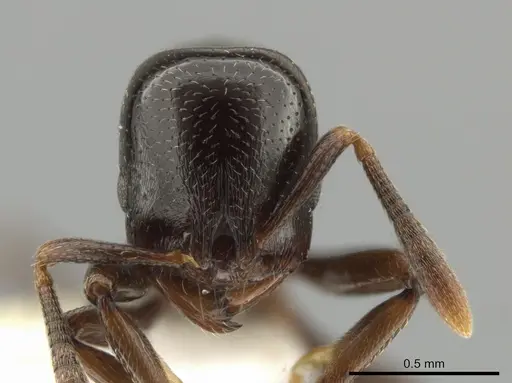
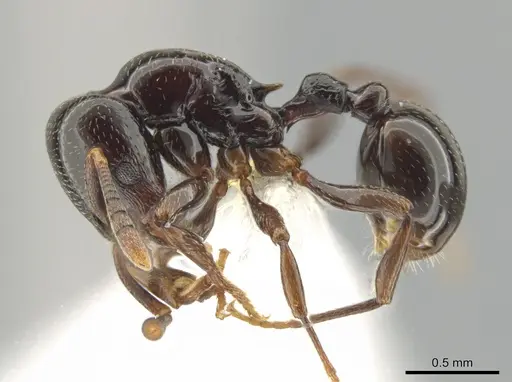
Rogeria tsumani is an extremely rare ant species known only from two worker specimens collected in Guyana. Workers measure about 3.75-3.88mm in total length, with a reddish-dark brown body, darker propodeum, and light brown legs . The mesosoma is smooth and shiny with scattered short appressed hairs, and they possess long propodeal spines that angle slightly backward . This species was discovered when a rotten branch fell from about 30 meters height in the forest; Weber collected the ants while examining the debris . The species is likely a canopy-dwelling ant, as the nest was never located despite searching . Only workers are known - queens and males remain undescribed, making this one of the most poorly documented ant species .
Quick Summary
- Difficulty: Expert
- Origin & Habitat: Guyana, South America, specifically the Oronoque River area near the New River junction (2°45′00″N 57°26′00″W). This is a tropical rainforest region. The species appears to be canopy-dwelling, collected only from a fallen rotten branch at about 30 meters height [1].
- Colony Type: Unknown, only worker specimens have been collected. Colony structure (single queen vs. multiple queens) has not been determined. No data exists for this species.
- Size & Growth:
- Queen: Unknown, queens have never been described [1]
- Worker: about 3.75-3.88 mm total length [1]
- Colony: Unknown, colony size has not been documented
- Growth: Unknown, no development data exists for this species
- Development: Unknown, no breeding or development has been observed. Based on typical patterns for small Myrmicinae in tropical environments, a rough estimate would be 4-8 weeks at optimal temperature, but this is a guess. (Development timeline is unconfirmed. Related Solenopsidini species typically develop from egg to worker in 4-8 weeks under warm conditions.)
- Antkeeping:
- Temperature: Estimated 24-28°C based on tropical canopy-dwelling ant patterns. Start in the mid-20s and observe colony activity. Avoid temperatures below 20°C or above 32°C.
- Humidity: High humidity required, think tropical rainforest canopy. Keep nest substrate consistently moist but not waterlogged. Provide a water tube and mist occasionally. Target 70-85% relative humidity.
- Diapause: Unknown, no seasonal data exists. As a tropical species from Guyana, diapause is unlikely but not confirmed.
- Nesting: Given their tiny size and likely arboreal nature, small test tube setups or Y-tong/plaster nests with tight chambers work well. Provide high humidity and small passages. Avoid acrylic nests.
- Behavior: Behavior is undocumented. Based on placement in Solenopsidini (which includes predatory ants), they likely forage for small arthropods and may tend aphids for honeydew. Their small size and canopy origin suggest they are shy and not aggressive. Escape prevention is critical due to their tiny size, use fine mesh and tight-fitting lids.
- Common Issues: escape prevention is critical due to their very small size, they can squeeze through standard barrier gaps, no captive breeding data exists, establishing a colony may be extremely difficult, humidity control is challenging, too dry causes desiccation, too wet causes mold, temperature instability can stress these tropical ants, virtually no information on diet acceptance in captivity
Discovery and Rarity
Rogeria tsumani is one of the rarest ant species, known from only two worker specimens collected in 1936 by N.A. Weber in Guyana [1]. The ants were found when a rotten branch fell from about 30 meters height in the tropical forest, Weber collected the specimens from the debris [1]. Despite searching through the branch, he could not locate the nest [1]. This explains why we know almost nothing about their biology, they likely live high in the canopy and are extremely difficult to find. The species was formally described in 2006 by Lapolla and Sosa-Calvo, nearly 70 years after collection [1]. The type locality is the Oronoque River just above its juncture with the New River in the Iwokrama Forest of Guyana [1].
Identification and Appearance
Workers are tiny at 3.75-3.88 mm total length [1]. The body is reddish-dark brown, with the propodeum being notably darker brown, and the legs light brown [1]. The mesosoma is smooth and shiny with scattered short appressed hairs, a key identification feature shared with only three other Rogeria species: Rogeria bruchi, Rogeria foreli, and Rogeria prominula [1]. The propodeal spines are long and slightly inclined backward, which helps distinguish R. tsumani from similar species [1]. The petiole has a distinct node that is convex in lateral view, and the head is roughly square when viewed from above [1]. The eyes are relatively small compared to similar species [1].
Housing and Setup
Given their extremely small size (under 4 mm) and likely canopy-dwelling nature, you need specialized housing. A small test tube setup works well for founding colonies, use a small diameter tube (10-12 mm) with a water reservoir at one end secured with cotton. For established colonies, a small Y-tong or plaster nest with tight chambers scaled to their tiny size is ideal. Escape prevention is critical, these ants can squeeze through the tiniest gaps. Use fine mesh (at least 0.5 mm) on any ventilation holes and seal all connections. Place the nest in a dark area as they likely avoid light. A humidity chamber (outworld) connected to the nest helps maintain moisture.
Temperature and Humidity
As a tropical species from Guyana, they require warm and humid conditions. Aim for 24-28°C, typical for Neotropical forest ants. A heating cable on one side of the nest can create a gentle gradient, but avoid direct heat. For humidity, keep the substrate consistently moist but not waterlogged. A moist cotton ball as a water source works well. Monitor for condensation on nest walls. If the nest seems dry or ants cluster excessively, increase misting.
Feeding and Diet
The diet of Rogeria tsumani is completely unconfirmed, but based on its placement in the Solenopsidini tribe (which includes predatory ants like Solenopsis), they likely eat small arthropods. Start with small live prey appropriate to their size: fruit flies (Drosophila), springtails, and tiny mealworms. They may also accept sugar sources like diluted honey or sugar water, though this is speculative. Feed small amounts of protein 2-3 times per week and remove uneaten prey after 24 hours to prevent mold. Given their rarity and lack of captive specimens, acceptance of various foods is entirely experimental. Do not overfeed, excess food decomposes and creates mold problems in small nests.
Challenges and Limitations
This species presents extreme challenges for antkeeping. First, no captive colonies exist, they have never been found in sufficient numbers. Second, even if you obtain a colony, we have no confirmed information about their founding behavior, diet, or colony structure. Third, their tiny size makes them difficult to house and easy to lose through escape. Fourth, being canopy-dwelling, they likely have specific humidity and spatial requirements hard to replicate. For all these reasons, Rogeria tsumani should be considered expert-only, suitable only for advanced keepers who enjoy working with poorly documented species. Consider starting with well-known species like Lasius niger, Camponotus floridanus, or Messor barbarus if you are new to antkeeping. [1]
Frequently Asked Questions
Can I keep Rogeria tsumani as a pet ant?
It is extremely unlikely you will find this species for sale. Rogeria tsumani is known from only two worker specimens collected in 1936, no colonies have ever been found. Even professional myrmecologists have not located additional specimens despite decades of searching in Guyana. This species is not available in the hobby and would be expert-only even if it were available due to complete lack of biological data [1].
How big do Rogeria tsumani colonies get?
Unknown, colony size has never been documented. Only two workers have ever been collected. Based on related Rogeria species and their small worker size (3.75-3.88 mm), colonies are likely small, possibly under 100 workers. Many canopy-dwelling ants maintain smaller colonies than their ground-nesting relatives.
What do Rogeria tsumani ants eat?
Diet is unconfirmed. Based on their placement in the Solenopsidini tribe (which includes predatory ants like fire ants), they likely eat small arthropods. In captivity, experiment with small live prey like fruit flies, springtails, and tiny mealworms. Sugar acceptance is unknown but possible, related species sometimes consume honeydew from aphids. Start with protein prey and offer sugar water occasionally, but success is entirely speculative.
What temperature do Rogeria tsumani ants need?
Estimated 24-28°C based on their tropical origin in Guyana. This is a guess based on typical Neotropical forest ant requirements. Start in the mid-20s and observe colony behavior, if they are active and foraging, the temperature is likely suitable. Avoid temperatures below 20°C or above 32°C. Use a small heating cable on one side of the nest to create a gentle gradient if room temperature is below 24°C.
Do Rogeria tsumani need hibernation?
Unlikely, as a tropical species from Guyana (near the equator), they probably do not require a diapause period. No seasonal data exists for this species, but their natural habitat near 2°N latitude experiences minimal temperature variation year-round. Do not force hibernation unless you observe clear seasonal slowing in an established colony. Keep them at stable tropical temperatures year-round [1].
Are Rogeria tsumani good for beginners?
No, this species is completely unsuitable for beginners. They are one of the rarest ants in the world with zero captive breeding data. We do not know their founding behavior, diet, temperature, humidity, or colony structure. Even expert keepers would struggle. If you are new to antkeeping, start with well-documented species like Lasius niger, Camponotus floridanus, or Messor barbarus [1].
How long does it take for Rogeria tsumani to develop from egg to worker?
Unknown, no breeding or development has ever been observed. Based on typical patterns for small Myrmicinae in tropical environments, a rough guess would be 4-8 weeks from egg to worker at optimal temperature (around 26°C). Related Solenopsidini species develop quickly in warm conditions, but this is speculative.
Can I keep multiple Rogeria tsumani queens together?
Unknown, colony structure has never been documented. We do not know if they are single-queen (monogyne) or multi-queen (polygyne). Queens have never been found or described. Combining unrelated queens is not recommended since we have no data on their social structure. If you ever obtain a colony, keep queens separate until you observe clear social tolerance [1].
Where does Rogeria tsumani live in the wild?
Only known from Guyana, South America, in the Iwokrama Forest area near the Oronoque River. They are believed to be canopy-dwelling, living high in tropical rainforest trees. The only specimens were collected from a rotten branch that fell from about 30 meters height. The nest was never located. This is an extremely rare, possibly endangered species that has never been found in sufficient numbers to study its natural history [1].
Report an Issue
The current care sheet is based fully on literature. See inconsistencies, or something that's incorrect? Please , it will be resolved after review from an admin. Contributing to the blogs tab also helps providing information, to make us be able to further improve the caresheets. Thank you for your support!
References

This caresheet is licensed under CC BY-SA 4.0 .
Community Blogs
CASENT0646224
View on AntWeb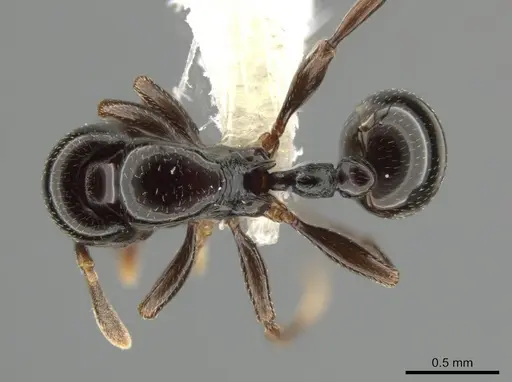
Literature
Loading distribution map...Loading products...