
Rogeria sicaria
- Sci. Name
- Rogeria sicaria
- Tribe
- Solenopsidini
- Subfamily
- Myrmicinae
- Author
- Kempf, 1962
- Distribution
- Found in 1 countries
Introduction
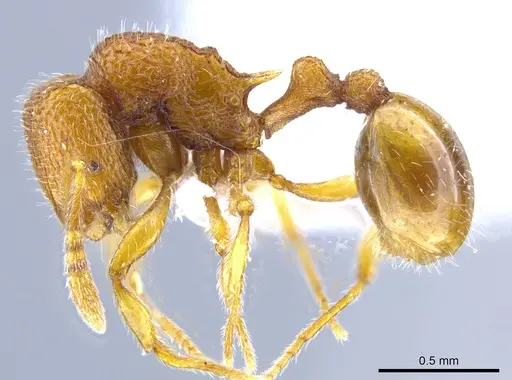
Rogeria sicaria is an extremely rare Neotropical ant species known from only a single worker specimen collected in São Paulo, Brazil. Workers are tiny at just 2.8 mm total length, with a golden-brown coloration and distinctive long propodeal spines that angle upward and outward . The genus Rogeria belongs to the tribe Solenopsidini (same tribe as fire ants), and these ants possess a functional stinger typical of that group. This species is one of the most poorly known ants in existence. It has never been observed alive, and no colony, queen, male, or any biological data beyond a single dead worker exists in scientific literature. Its closest relatives (R. germaini, R. pellecta, R. lacertosa) are also known only from southern Brazil, suggesting this group prefers specific microhabitats in the Atlantic Forest region . For antkeepers, this means captive care is entirely speculative and based on inference from related species and tribe-level patterns.
Quick Summary
- Difficulty: Expert
- Origin & Habitat: Known only from a single specimen collected in São Paulo state, Brazil (Agudos,19km SSE of Bauru) from dry leaf litter in second growth forest floor using Berlese-Tullgren funnels [2]. The broader distribution likely includes Venezuela as well, spanning humid tropical to cloud forests in northern South America [3].
- Colony Type: Unknown, only worker caste has ever been collected. Colony structure (single-queen vs multi-queen) is unconfirmed.
- Size & Growth:
- Queen: Unknown, queen caste has never been described [1]
- Worker: ~2.8 mm total length (TL) [1]
- Colony: Unknown, colony size has never been documented
- Growth: Unknown
- Development: Unknown, no breeding or development data exists for this species (Development timeline is entirely unstudied. Related Solenopsidini species typically develop from egg to worker in 4-8 weeks at warm temperatures, but this is a rough estimate with very low confidence.)
- Antkeeping:
- Temperature: Inferred: Based on Brazilian origin and forest floor habitat, aim for 22-26°C. Related tropical litter ants typically thrive in this range.
- Humidity: Inferred: Forest floor litter suggests high humidity needs. Keep substrate consistently moist but not waterlogged.
- Diapause: Unknown, no seasonal data exists. Brazilian tropical species may not require true hibernation, but may show reduced activity during cooler months.
- Nesting: Inferred: Natural nesting occurs in forest floor leaf litter. In captivity, a small test tube setup or tight-chambered Y-tong/plaster nest works well. Their tiny size means escape prevention must be excellent.
- Behavior: Presumed defensive: As members of Solenopsidini, they likely possess a functional stinger and may deliver painful stings similar to smaller Solenopsis species [1]. Foraging style is unknown but likely opportunistic scavenging and predation on tiny arthropods. Activity level is unconfirmed but likely nocturnal or crepuscular based on very small eyes [1]. Escape risk is high due to their minute size, they can squeeze through remarkably small gaps.
- Common Issues: no captive data exists, this species has never been kept in captivity, only one specimen has ever been collected, suggesting extreme rarity or very specialized sampling requirements, queen and male castes unknown, cannot establish colonies from wild, no feeding or dietary preferences documented for this species, tiny size makes escape prevention critical, standard test tube setups may need additional barriers
Rarity and Collection History
Rogeria sicaria is one of the most poorly documented ant species in the world. The entire scientific knowledge base consists of a single worker collected in November 1955 in São Paulo, Brazil, using a Berlese-Tullgren funnel to extract insects from dry leaf litter [2]. This collecting method involves sifting through forest floor debris and using heat to drive tiny arthropods into collection containers, it gives us our only glimpse into this species' habitat preferences.
Kempf originally described the specimen in 1962,and Kugler re-examined it during a comprehensive revision of the genus in 1994 [1]. Despite additional ant surveys across Brazil and Venezuela over the subsequent decades, no additional specimens have been found [3]. This could indicate genuine rarity, very specialized microhabitat requirements, or simply that they live in areas not commonly sampled by myrmecologists. For prospective keepers, this means there is no established husbandry protocol and no source for establishing colonies.
Identification and Morphology
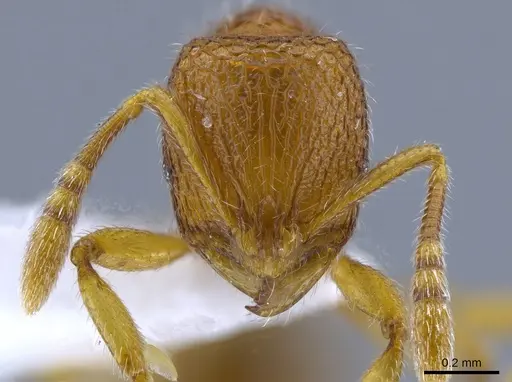
The holotype worker measures just 2.8 mm in total length, making Rogeria sicaria one of the smaller Neotropical ant species [1]. Key identifying features include extremely long propodeal spines that angle strongly upward and outward, a long petiolar peduncle with a prominent keel, and very small eyes containing only 8 facets [1]. The body is uniformly golden-brown with distinctive stiff erect hairs mixed with shorter appressed hairs on the head, mesosoma, and gaster. The head and mesosoma have coarse areolate sculpture, especially on the sides and dorsum.
The species belongs to the Solenopsidini tribe, which includes fire ants (Solenopsis) and other small predatory ants. Rogeria possesses a functional stinger with a dorsal flange, meaning these ants can deliver venomous stings, though the potency is unknown [1]. The small eye size suggests either nocturnal or subterranean habits, or simply reduced reliance on visual cues.
Housing and Care (Speculative)
Since no captive husbandry data exists for this species, all care recommendations are speculative inferences based on related species and typical patterns for tiny Neotropical litter ants. The original collection from dry leaf litter in second growth forest suggests they prefer humid, shaded environments with abundant organic matter [2].
For housing, use a small test tube setup or tight-chambered Y-tong/plaster nest. The tiny worker size (2.8 mm) means escape prevention must be excellent, standard cotton barriers may need reinforcement with fluon or other barriers. Temperature should be maintained in the 22-26°C range, typical for Brazilian tropical species. Humidity should be high, with the nest substrate kept consistently moist but not waterlogged.
Feeding is entirely speculative, but Solenopsidini ants are typically omnivorous with a preference for small protein sources. Offer small live prey like springtails, fruit flies, or tiny crickets. Sugar sources may be accepted but are not a primary food for most litter-dwelling Solenopsidini. Start with small live prey and observe acceptance before establishing a feeding routine.
Legal and Ethical Considerations
Rogeria sicaria has never been found in sufficient numbers to establish a captive breeding population, and no legal framework specifically protects this species. However, Brazilian ant fauna is subject to national biodiversity laws, and collecting permits may be required for scientific collection. For antkeepers, the practical issue is simpler: there is no documented source for this species, and no colonies exist in captivity anywhere in the world.
If additional specimens were ever discovered, ethical antkeeping practices would recommend against removing the last known individuals of such a rare species from the wild. This species represents a case where appreciation is best left to scientific observation rather than captive keeping, there is simply too little known to provide proper care, and the species may already be extinct or critically endangered without our knowledge. [1]
Frequently Asked Questions
Can I keep Rogeria sicaria ants?
No practical option exists to keep this species. Only a single worker has ever been collected in scientific history (1955), and no colonies have ever been found or documented. There is no source for obtaining this species, and no captive husbandry information exists. Even if specimens were found, the ethical and practical challenges of establishing care for such an unknown species would be enormous.
How big do Rogeria sicaria colonies get?
Colony size is completely unknown, no colony has ever been observed. The single known specimen gives us no information about colony structure or size.
What do Rogeria sicaria ants eat?
Diet is unconfirmed. As members of Solenopsidini (the fire ant tribe), they likely eat small insects and arthropods, similar to related genera like Solenopsis and Wasmannia. The forest floor leaf litter habitat suggests they may be predators or scavengers on tiny invertebrates. No direct feeding observations exist for this or closely related species.
Where is Rogeria sicaria found?
Only known from a single specimen collected in São Paulo state, Brazil, specifically in Agudos (19km SSE of Bauru) in 1955 [2]. The broader genus distribution includes Venezuela as well [3], but this particular species has never been found again despite extensive ant surveys in the region.
Are Rogeria sicaria good for beginners?
This species is not suitable for any level of antkeeping, beginner or expert. No specimens exist in captivity, no care information exists, and the species may be extinct or extremely rare. Even if available, the complete lack of biological data would make successful keeping nearly impossible. There are many well-documented species available that make far better choices for keepers at all levels.
What temperature do Rogeria sicaria ants need?
Temperature requirements are unconfirmed. Based on their Brazilian origin and forest floor habitat, a range of 22-26°C is a reasonable starting point. This matches typical conditions for Neotropical litter ants and related Solenopsidini species. However, without any direct observations of live colonies, this recommendation is purely speculative.
How long do Rogeria sicaria workers live?
Worker lifespan is completely unknown. No living specimens have ever been studied, and even the basic biology of this species remains undocumented. Related Solenopsidini workers typically live several months to over a year, but this is not specific to this species.
Do Rogeria sicaria need hibernation?
Diapause requirements are unknown. As a Brazilian tropical species from the Atlantic Forest region, true hibernation is unlikely. However, reduced activity during cooler or drier seasons may occur. Without any captive observations, we cannot confirm whether they need a winter rest period or prefer constant warm conditions year-round.
Why is Rogeria sicaria so rare?
The extreme rarity likely reflects one or more factors: genuine scarcity in the wild, highly specialized microhabitat requirements not easily sampled by standard methods, potential extinction since 1955,or simply living in areas not commonly surveyed. The fact that no additional specimens have been found in over 65 years of subsequent ant research suggests either very local distribution or possible extinction.
Report an Issue
The current care sheet is based fully on literature. See inconsistencies, or something that's incorrect? Please , it will be resolved after review from an admin. Contributing to the blogs tab also helps providing information, to make us be able to further improve the caresheets. Thank you for your support!
References

This caresheet is licensed under CC BY-SA 4.0 .
Community Blogs
CASENT0650668
View on AntWeb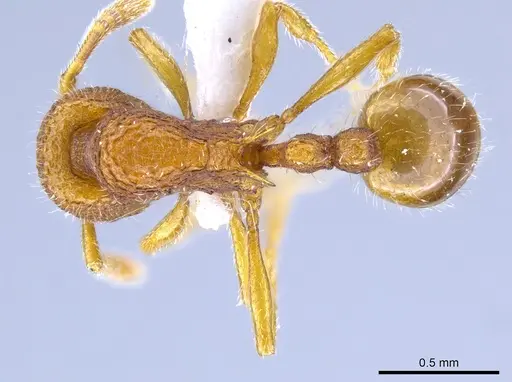
Literature
Loading distribution map...Loading products...