
Rogeria nevadensis
- Sci. Name
- Rogeria nevadensis
- Tribe
- Solenopsidini
- Subfamily
- Myrmicinae
- Author
- Kugler, 1994
- Distribution
- Found in 1 countries
Introduction
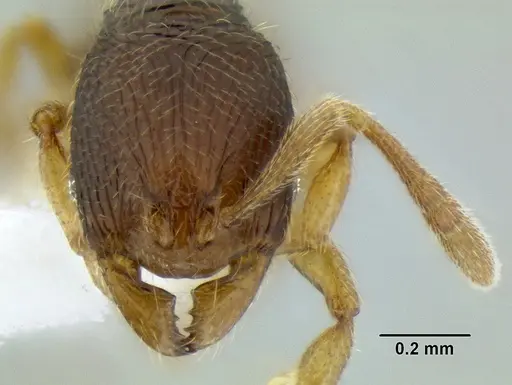
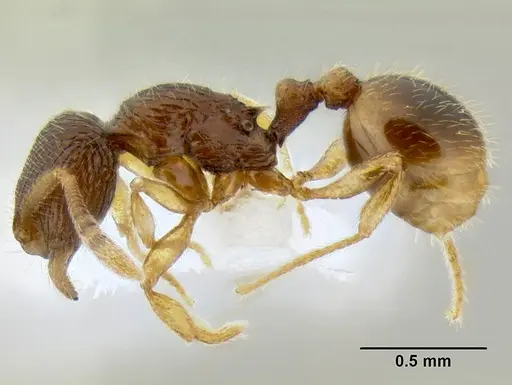
Rogeria nevadensis is a tiny ant from the Sierra Nevada de Santa Marta in Colombia and Venezuela . Workers are just 2.2-2.5mm long, making them one of the smallest species you'll encounter . They are brown to dark reddish-brown with brownish-yellow legs and a reddish face area. Their eyes are very small, with only 7-10 facets . The upper body has rough, long ridges, and the propodeal spines are short and narrow. These ants live in montane wet forest at 1300-1340m elevation, where it's cool and damp year-round . This species is poorly known in captivity. Only workers have been found – no queens or males are described in science . Because they belong to the Solenopsidini tribe, they have a functional stinger. Their tiny size and specific habitat needs make them a challenge even for experienced keepers.
Quick Summary
- Difficulty: Expert
- Origin & Habitat: Sierra Nevada de Santa Marta in Colombia and Venezuela. Found in montane wet forest and rain forest at 1300-1340m elevation [1][2].
- Colony Type: Unknown – only workers have been collected. No queen or male specimens have been documented [1].
- Size & Growth:
- Queen: Unknown – queen has not been described [1].
- Worker: 2.2-2.5mm [1].
- Colony: Unknown – colony size not documented [1].
- Growth: Unknown – no development data available.
- Development: Unknown – development not studied. Based on similar tiny Myrmicinae, estimate 6-10 weeks at optimal temperature. (No direct data available, estimate based on genus-level patterns for small tropical Myrmicinae.)
- Antkeeping:
- Temperature: Keep cool compared to typical tropical ants – aim for 18-22°C. Their natural montane habitat stays much cooler than lowland rainforest. Use a heating cable on one side of the nest to create a gentle gradient [1].
- Humidity: High humidity is essential – they come from wet montane forest. Keep nest substrate consistently moist but not waterlogged. Think damp forest floor conditions year-round [1].
- Diapause: Unknown – no data on overwintering requirements. Their high-elevation habitat may experience cooler seasonal temperatures, but true hibernation may not be necessary in captivity.
- Nesting: In nature they nest in rotting logs and moist forest floor debris. In captivity, a small test tube setup or a small Y-tong nest works well. Keep chambers tight and appropriately scaled to their tiny size. Avoid large open spaces.
- Behavior: These ants are tiny and likely secretive. As predators in the Solenopsidini tribe, they probably hunt small invertebrates. Their very small eyes suggest they may rely more on chemical cues than visual navigation. Escape prevention must be excellent – their tiny size means they can squeeze through standard barriers. Handle with care as they possess a stinger, though given their minute size, the sting effect would be minimal for humans.
- Common Issues: tiny size makes escape likely without fine mesh barriers., no queen described – founding behavior is completely unknown., high humidity requirements can lead to mold if ventilation is poor., cool temperature needs may conflict with typical room temperatures., colony size unknown – difficult to plan long-term housing., no captive breeding data available – establishing a colony may be extremely difficult.
Report an Issue
The current care sheet is based fully on literature. See inconsistencies, or something that's incorrect? Please , it will be resolved after review from an admin. Contributing to the blogs tab also helps providing information, to make us be able to further improve the caresheets. Thank you for your support!
References

This caresheet is licensed under CC BY-SA 4.0 .
Community Blogs
CASENT0106209
View on AntWeb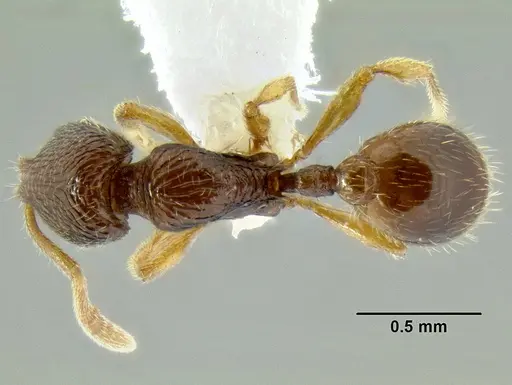
Literature
Loading distribution map...Loading products...