
Rogeria megastigmatica
- Sci. Name
- Rogeria megastigmatica
- Tribe
- Solenopsidini
- Subfamily
- Myrmicinae
- Author
- Kugler, 1994
- Distribution
- Found in 1 countries
Introduction
Rogeria megastigmatica is a small ant species endemic to the Solomon Islands, known only from Guadalcanal and San Cristobal islands . Workers measure 4.5-4.9 mm in total length . The species was described in 1994 by C. Kugler from collections made in the 1960s by P.J.M. Greenslade . It belongs to the stigmatica-group and is notably larger than its close relative Rogeria stigmatica - at least 35% larger . Only the worker caste has ever been collected; queens and males remain unknown. This is a very rare ant in both science and the hobby, with no documented natural history or captive husbandry data.
Quick Summary
- Difficulty: Unknown, this species is not suitable for antkeeping due to extremely limited knowledge and no captive records
- Origin & Habitat: Endemic to the Solomon Islands (Guadalcanal and San Cristobal) in tropical Oceania [1]. Specific microhabitat details are unknown.
- Colony Type: Unknown, only workers have been collected, colony structure (monogyne/polygyne) is undocumented.
- Size & Growth:
- Queen: Unconfirmed, no queens have ever been collected or described [2]
- Worker: 4.5-4.9 mm total length (workers only) [2]
- Colony: Unknown, no colony collections have been documented
- Growth: Unknown
- Development: Unknown, no brood development has been studied (All known specimens are isolated workers. No data on colony size, development, or reproduction exists.)
- Antkeeping:
- Temperature: Estimated 24-28°C based on tropical Solomon Islands origin. No direct thermal studies exist.
- Humidity: Estimated high humidity (70-80%) based on tropical island habitat. No direct data.
- Diapause: Unlikely, Solomon Islands have no cold season. No research available.
- Nesting: Unknown, no natural nesting observations documented. Related Rogeria species nest in soil, rotting wood, or under stones in forests.
- Behavior: Behavior is unstudied. As a member of Solenopsidini (Myrmicinae), it likely possesses a functional stinger used for prey capture and defense. Its size (4.5-4.9 mm) is moderate, escape prevention should follow standard methods for ants of that size.
- Common Issues: This species has never been kept in captivity, no husbandry protocols exist., No queens have ever been collected, so captive colonies cannot be established from wild sources., Only five worker specimens are known in scientific collections, making acquisition impossible., Food preferences and feeding behavior are completely undocumented., Wild-caught individuals may carry unknown parasites or diseases with no treatment knowledge.
Species Overview and Distribution
Rogeria megastigmatica is one of the rarest ants known. It was described by C. Kugler in 1994 from specimens collected by P.J.M. Greenslade in 1962 on Guadalcanal and San Cristobal (Solomon Islands) [2]. The species is endemic to the Solomon Islands and has not been recorded elsewhere [1]. Only a handful of workers exist in museum collections. The closely related Rogeria stigmatica occurs on other Solomon Islands but is at least 35% smaller [2]. This species belongs to the stigmatica-group within the genus Rogeria.
Identification and Morphology
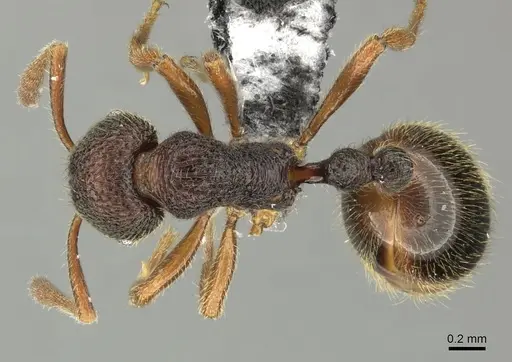
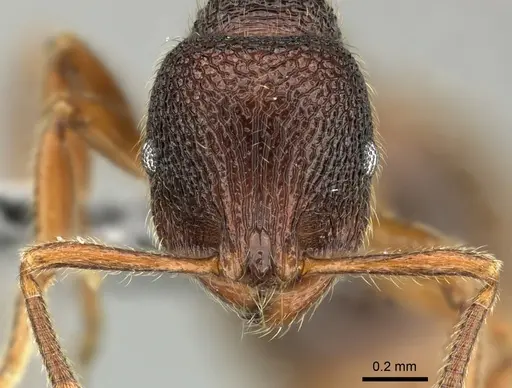
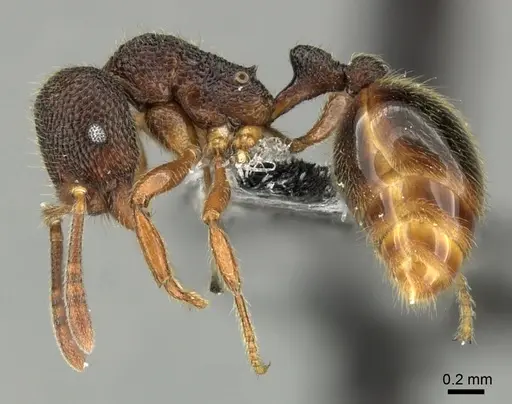
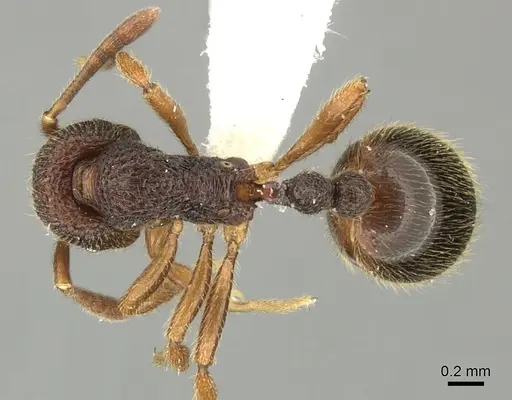
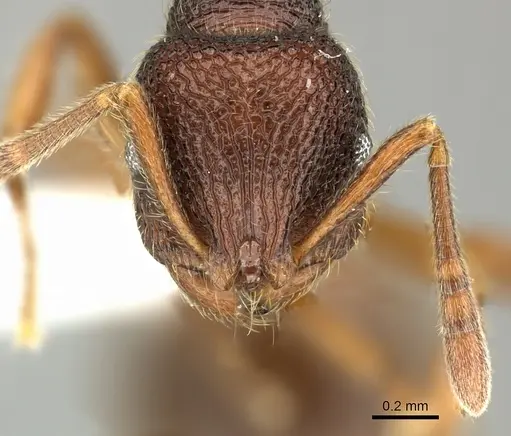
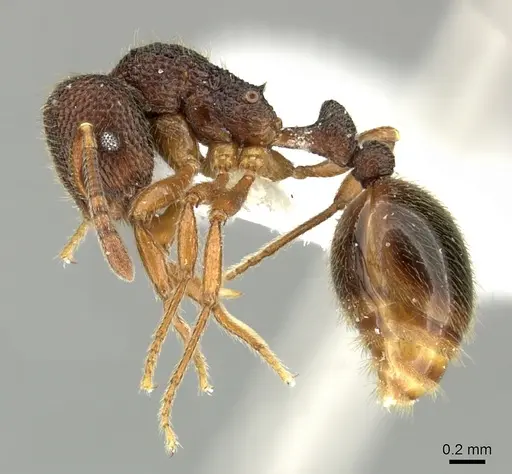
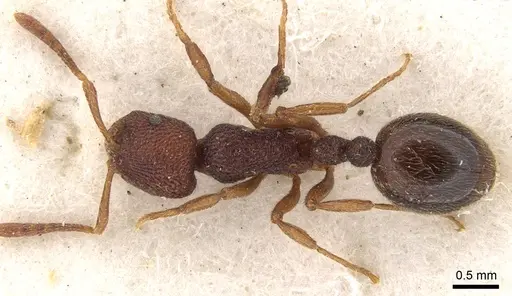
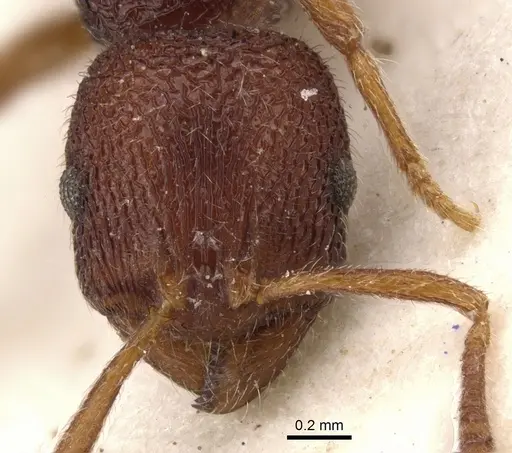
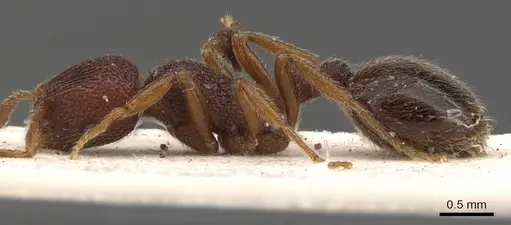
Workers of Rogeria megastigmatica measure 4.5-4.9 mm in total length [2]. Key features include triangular mandibles with at least six teeth, a convex median clypeal apron, and a strongly asymmetrical petiolar node in side view. The metanotal groove is not narrow or sharply defined. The pronotum is areolate (pitted) with a rugose-areolate patch in the center, the dorsal propodeum has transverse rugulae (wrinkles). The petiolar peduncle is smooth while the sides of the node are areolate [2]. This species is easily separated from Rogeria stigmatica by its larger size and the asymmetrical petiolar node.
Taxonomy and Relationships
Rogeria megastigmatica belongs to the subfamily Myrmicinae and tribe Solenopsidini, a group that includes well-known genera such as Solenopsis (fire ants) and Wasmannia. Solenopsidini ants possess a functional stinger used for defense and prey capture. The species is placed in the stigmatica-group based on morphological characters [2]. The genus Rogeria contains about 40 described species, mostly from the Neotropics and Australasia. This species is one of the few Rogeria recorded from the Solomon Islands.
Current Knowledge Gaps
Almost nothing is known about Rogeria megastigmatica beyond the few worker specimens. No queens or males have ever been collected or described. No colony has ever been observed in the wild. Natural history, including diet, nesting habits, nuptial flight timing, and brood development, is completely undocumented [2][1]. This species has never been kept in captivity, and no husbandry literature exists. For these reasons, it is not suitable for antkeeping and remains a subject only for taxonomic research.
Frequently Asked Questions
Can I keep Rogeria megastigmatica ants as a pet?
No, this species has never been kept in captivity. No queens have been collected, so it is impossible to start a colony. The few known specimens were collected in 1962 and are in museum collections, not available for hobbyists.
Where does Rogeria megastigmatica live?
It is endemic to the Solomon Islands, recorded only from Guadalcanal and San Cristobal [1]. The specific habitats (e.g., forest floor, leaf litter, rotting wood) are unknown.
How big are Rogeria megastigmatica workers?
Workers measure 4.5-4.9 mm in total length, making them moderately sized ants. They are at least 35% larger than the related Rogeria stigmatica [2].
What do Rogeria megastigmatica ants eat?
Unknown, no dietary studies exist for this species. Related Solenopsidini are generally predatory or omnivorous, but specific food preferences are unstudied.
How do Rogeria megastigmatica colonies form?
Unknown, no queens have ever been collected, so founding behavior (claustral or semi-claustral) and colony structure (monogyne or polygyne) are completely unknown.
What temperature do Rogeria megastigmatica ants need?
No specific temperature requirements are documented. Based on its tropical origin (Solomon Islands), it likely prefers warm conditions around 24-28°C, but this is an estimate.
Is Rogeria megastigmatica available for purchase?
No, this species is not available in the ant trade. It is extremely rare, known only from five worker specimens, and has never been collected for captive purposes.
How long do Rogeria megastigmatica ants live?
Unknown, no life cycle data exists. Development time from egg to worker has never been studied.
Are Rogeria megastigmatica endangered?
The conservation status has not been assessed. It is extremely rare in collections, but the actual population status in the Solomon Islands is unknown due to limited surveys.
Report an Issue
The current care sheet is based fully on literature. See inconsistencies, or something that's incorrect? Please , it will be resolved after review from an admin. Contributing to the blogs tab also helps providing information, to make us be able to further improve the caresheets. Thank you for your support!
References

This caresheet is licensed under CC BY-SA 4.0 .
Community Blogs
Literature
Loading distribution map...Loading products...