
Rogeria exsulans
- Sci. Name
- Rogeria exsulans
- Tribe
- Solenopsidini
- Subfamily
- Myrmicinae
- Author
- Wilson & Taylor, 1967
- Distribution
- Found in 1 countries
Introduction
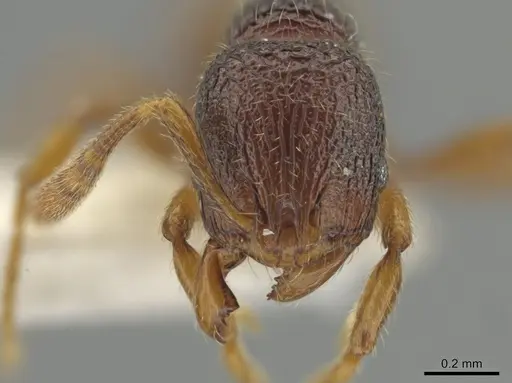
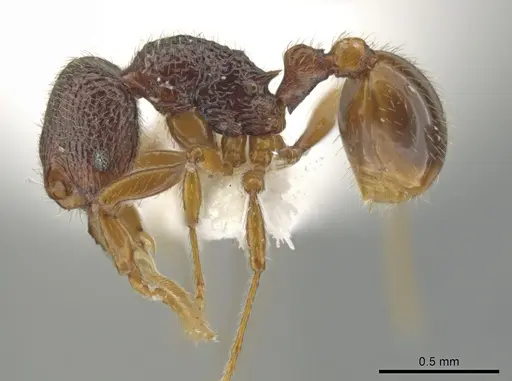
Rogeria exsulans is a very small ant species, with workers measuring just 2.5-3.0mm in length . They have a dark reddish-brown head and mesosoma, with lighter yellowish-brown mandibles, antennae, and legs. This species belongs to the creightoni-group, characterized by a distinct petiolar keel and dentate inferior process. They are known only from the island of Upolu in Samoa, where they live in rain forest habitats at elevations of 600-700m . This is one of the most geographically restricted ant species in the world – found only on a single Pacific island. In their natural habitat, they nest under dead bark, in rotten logs, and within moss and ferns growing on trees . Their limited distribution makes them a species of interest for advanced antkeepers who study rare Pacific ants.
Quick Summary
- Difficulty: Expert
- Origin & Habitat: Endemic to Upolu island, Samoa, in tropical rain forest habitats at 600-700m elevation [2][3]. Found under dead bark, in rotten logs, and in moss and ferns on trees [1].
- Colony Type: Unknown colony structure – only workers have been collected, no queens or males have been described [1]. The colony size in the wild is unconfirmed.
- Size & Growth:
- Queen: Unknown – queen has never been described [1]
- Worker: 2.5-3.0mm [1]
- Colony: Unknown – only four worker specimens have been collected [1]
- Growth: Unknown
- Development: Unknown – no breeding or development data exists for this species (Development timeline has not been studied. Related Rogeria species in tropical conditions typically develop from egg to worker in 4-8 weeks, but this is an estimate only.)
- Antkeeping:
- Temperature: Keep warm at 24-28°C – these are tropical rain forest ants from Samoa [1]. Use a heating cable on one side of the nest to create a gentle gradient if room temperature is below this range.
- Humidity: High humidity is essential. These ants live in moss and decaying wood in rain forests [1]. Keep the nest substrate consistently moist but not waterlogged. The substrate should feel damp to the touch, with some condensation visible on nest walls.
- Diapause: No – this is a tropical species from Samoa near the equator. They do not require a winter rest period.
- Nesting: Provide a humid nest setup similar to their natural microhabitat. Y-tong (AAC) nests or plaster nests work well for very small ants. Include a water reservoir to maintain humidity. Avoid dry setups.
- Behavior: These are tiny, cryptic ants that likely forage in the leaf litter and on vegetation. As members of the tribe Solenopsidini, they have a functional stinger. Their small size (2.5-3mm) means escape prevention must be excellent – they can easily slip through standard test tube barriers. Use fine mesh and tight-fitting lids. They are likely shy and non-aggressive, avoiding confrontation rather than engaging threats.
- Common Issues: tiny size makes escape likely without fine mesh barriers, no queen or breeding data exists – establishing a colony may be impossible, high humidity requirements can lead to mold if ventilation is poor, very limited range means wild colonies are protected and unavailable, no captive breeding history to guide care requirements
Distribution and Rarity
Rogeria exsulans is one of the most geographically restricted ant species known to science. It has been collected only on the island of Upolu in Samoa, at elevations between 600-700m [2][3]. This makes it a true endemic – found nowhere else on Earth. The original description was published by Wilson and Taylor in 1967,and only four worker specimens have ever been collected [1]. This extreme rarity means the species is unlikely to appear in the antkeeping hobby, as no established colonies have ever been exported or studied in captivity.
Natural History
In the wild, Rogeria exsulans lives in tropical rain forest habitats on Upolu island. They have been found nesting under dead bark, within rotten logs, and in moss and ferns growing on trees and tree trunks [1]. This suggests they prefer humid, shaded microhabitats with decaying organic matter. The species was collected using berlesate extraction – a method that involves sifting through leaf litter and moss to extract tiny arthropods. This collecting method confirms they are cryptic, surface-dwelling ants that live in the forest floor layer.
Identification and Morphology
Workers are very small at 2.5-3.0mm total length [1]. They can be identified by their dark reddish-brown head and mesosoma, with lighter yellowish-brown mandibles, clypeus, antennae, and legs. The species belongs to the creightoni-group, characterized by a distinct petiolar keel (a ridge-like structure on the petiole) and a dentate inferior process (toothed lower process). They have relatively large oval eyes and the terminal segments of the gaster are rotated downward. The sculpture is strongly areolate (pitted pattern) on the posterior head and promesonotum [1].
Keeping Requirements
Since no captive colonies exist, care requirements must be inferred from their natural habitat. These are tropical rain forest ants requiring warm temperatures (24-28°C) and high humidity [1]. Their natural habitat in moss and decaying wood indicates they need consistently moist substrate. A Y-tong or plaster nest with a water reservoir works well for maintaining humidity. Because they are only 2.5-3mm long, escape prevention is critical – use fine mesh barriers and tight-fitting lids. Feed small live prey appropriate to their size, such as springtails or fruit flies. Sugar water may also be accepted.
Sting Apparatus
As members of the tribe Solenopsidini within the subfamily Myrmicinae, Rogeria exsulans possesses a functional stinger. The sting apparatus has been described in the revision of the genus by Kugler (1994) [1]. However, given their tiny size (2.5mm), any sting would be minimal and unlikely to penetrate human skin. They are more likely to rely on cryptic behavior than stinging for defense.
Frequently Asked Questions
Can I keep Rogeria exsulans as a pet ant?
No – this species is virtually unavailable in the antkeeping hobby. Only four worker specimens have ever been collected, all from a single island in Samoa. No queen has ever been described, meaning captive breeding would be impossible even if a worker colony were somehow obtained [1].
Where does Rogeria exsulans live?
Only on Upolu island in Samoa, at elevations of 600-700m in tropical rain forests [2][3]. They are found nowhere else on Earth – a true island endemic.
How big are Rogeria exsulans ants?
Workers are very small at just 2.5-3.0mm in total length [1].
What temperature do Rogeria exsulans need?
As tropical rain forest ants from Samoa, they require warm conditions around 24-28°C [1]. The consistent warmth and humidity of their native habitat should be replicated in captivity.
Do Rogeria exsulans need hibernation?
No – they are tropical ants from near the equator in Samoa and do not require a winter rest period. Keep them warm year-round.
How do I set up a nest for Rogeria exsulans?
Use a humid nest setup such as a Y-tong (AAC) or plaster formicarium with a water reservoir. These ants naturally live in moss and decaying wood in rain forests, so maintain consistently damp substrate. Their very small size also requires fine mesh for escape prevention [1].
What do Rogeria exsulans eat?
While not directly studied, they likely forage on small arthropods and honeydew in the wild. In captivity, you could offer small live prey like springtails or fruit flies, along with sugar water or honey. Their tiny size means the prey should be appropriately scaled.
Are Rogeria exsulans aggressive?
No – these are tiny, cryptic ants that live in leaf litter and moss. They are more likely to flee from threats than to engage in aggressive behavior. Their primary defense is remaining hidden.
How big do Rogeria exsulans colonies get?
Unknown – only four worker specimens have ever been collected, and no established colonies have been studied [1]. Based on their tiny size and cryptic habits, colonies are likely small.
Can I find Rogeria exsulans in the wild?
Only on Upolu island in Samoa, at elevations of 600-700m in rain forests [2][3]. However, they are extremely rare and have only been collected four times in scientific history. Collecting them would require specialized permits and expertise.
Is Rogeria exsulans endangered?
Their extreme rarity and limited distribution (single island, single location) could make them vulnerable. However, no formal conservation assessment exists for this species.
Report an Issue
The current care sheet is based fully on literature. See inconsistencies, or something that's incorrect? Please , it will be resolved after review from an admin. Contributing to the blogs tab also helps providing information, to make us be able to further improve the caresheets. Thank you for your support!
References

This caresheet is licensed under CC BY-SA 4.0 .
Community Blogs
CASENT0742614
View on AntWeb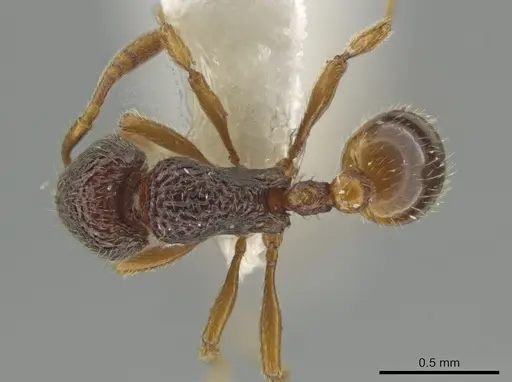
Literature
Loading distribution map...Loading products...