
Pseudomyrmex inquilinus
- Sci. Name
- Pseudomyrmex inquilinus
- Tribe
- Pseudomyrmecini
- Subfamily
- Pseudomyrmecinae
- Author
- Ward, 1996
- Distribution
- Found in 0 countries
Introduction
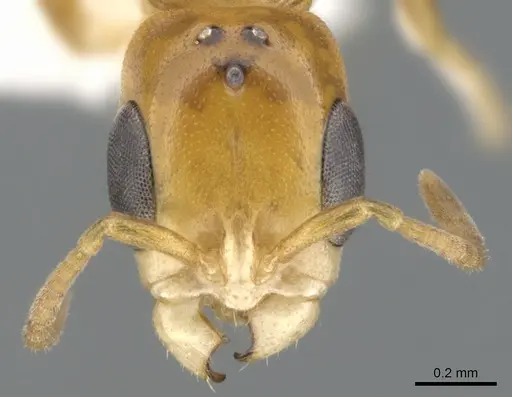
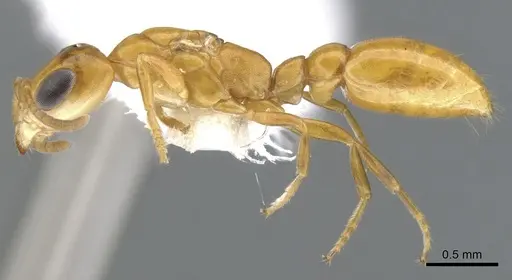
Pseudomyrmex inquilinus is a tiny, workerless social parasite (inquiline) from northern Argentina. The queens are very small for the genus Pseudomyrmex - only head width measurements are available (0.63-0.65 mm) . They are pale orange to orange-brown and have distinctive concave, toothless mandibles adapted for gripping the host queen's petiole . This species is known only from the Monte desert biome in Argentina, specifically the Santa Maria area in Catamarca and Tucumín provinces, where it lives in the nests of an undescribed host (Pseudomyrmex sp. PSW-64) that inhabits dead Baccharis stems . What makes P. inquilinus unusual is its completely parasitic lifestyle. It has no workers of its own - it relies entirely on host workers for survival. Multiple parasitic queens can live together in a single host nest, and they are often found riding directly on the host queen's back, holding on with their specialized mandibles . Despite being parasites, they do not prevent the host from producing its own sexuals; both parasitized nests examined still contained host sexual pupae .
Quick Summary
- Difficulty: Expert
- Origin & Habitat: Northern Argentina (Catamarca and Tucumín provinces), specifically the Santa Maria area in the Monte desert biome. Found in dead stems of Baccharis shrubs (particularly Baccharis salicifolia) in riparian grassland near the Rio Santa Maria. The region has very low annual rainfall (~182 mm) [1].
- Colony Type: Workerless social parasite (inquiline). Multiple parasitic queens can inhabit a single host nest. Relies entirely on host workers for all colony functions. No worker caste exists [1].
- Size & Growth:
- Queen: Size data unavailable (only head width known: 0.63-0.65 mm) [1]
- Worker: Workerless species, no workers produced [1]
- Colony: Unknown, depends on host colony size. Multiple parasitic queens (9+) can coexist in one host nest [1]
- Growth: N/A
- Development: N/A, workerless species (This species produces no workers. All brood production depends on the host colony.)
- Antkeeping:
- Temperature: Unknown, no captive data exists. The host species occurs in a warm, arid region, but specific requirements are undocumented.
- Humidity: Unknown, the Monte desert is arid, but host nests inside plant stems may provide a more stable microclimate. No captive observations are available.
- Diapause: Unknown, no studies on diapause requirements.
- Nesting: In nature, found in dead stems of Baccharis shrubs alongside the host colony. Captive housing is not possible without the specific host species (Pseudomyrmex sp. PSW-64), which remains undescribed and has never been cultured [1].
- Behavior: Queens are not aggressive and show no antagonistic behavior toward host workers. They spend most of their time near the host queen, often riding on her back while she is carried by host workers. The specialized concave mandibles are adapted for gripping the host queen's petiole [1]. The species is completely dependent on the host colony for survival, as it produces no workers. Escape risk is high if kept without a host, but the species cannot survive independently.
- Common Issues: cannot be kept in captivity, it is an obligate social parasite that requires a specific undescribed host species (Pseudomyrmex sp. PSW-64), which has never been cultured., Without the host species, the parasite cannot survive because it produces no workers., The host species itself remains undescribed and is only known from a tiny geographic area in Argentina., Even if host and parasite were somehow obtained, the complex host-specific relationship would make captive maintenance extremely challenging., This species has never been documented in the antkeeping hobby due to its parasitic nature and the difficulty of obtaining the host.
Why This Species Cannot Be Kept
Pseudomyrmex inquilinus is an obligate social parasite that has completely lost its worker caste. This means it cannot survive without its specific host, and the host species (Pseudomyrmex sp. PSW-64) remains undescribed and has never been cultured in captivity [1]. Unlike some parasites that can be kept with close relatives as hosts, P. inquilinus appears to have very narrow host specificity, having been found only in nests of this single, geographically restricted host in Argentina [1]. Even if you could obtain both species, maintaining the parasitic relationship in captivity would require expert-level knowledge of both species' biology. For all practical purposes, this species is not available in the antkeeping hobby and cannot be maintained by hobbyists.
The Parasitic Relationship
P. inquilinus is a classic example of inquiline social parasitism in ants. Queens invade host colonies and live alongside the host queen without being attacked, field observations showed no antagonistic behavior from host workers toward the parasite queens [1]. Multiple parasitic queens (up to nine or more) can coexist in a single host nest, all relying on host workers for food, nest maintenance, and brood care. The parasite queens do not kill the host queen, and they do not inhibit the host's sexual production, parasitized nests still produce host sexual pupae [1]. The queens have specialized morphology: their concave, toothless mandibles are perfectly shaped to grip the host queen's petiole, allowing them to ride on the host queen's back as she is carried by host workers [1].
Natural History and Distribution
This species is known only from a very restricted area in northern Argentina, specifically the Santa Maria valley in Catamarca and Tucumín provinces. Both the parasite and its host were found exclusively in this region during extensive collecting efforts [1]. The habitat is the Monte desert biome, with very low annual rainfall (~182 mm). The host nests in dead stems of Baccharis shrubs, particularly Baccharis salicifolia, which are abundant in riparian areas along the Rio Santa Maria. Other plants in the area include Salix humboldtiana, Prosopis, Juncus, and various grasses [1]. The entire host-parasite system appears to be geographically restricted to this valley, making the species exceptionally rare even in its natural range.
Related Species and Taxonomy
Pseudomyrmex inquilinus was described by Philip S. Ward in 1996. It is immediately distinguishable from all other Pseudomyrmex species by several unique features: the concave, toothless masticatory margin of the mandibles, reduced palp formula (3,2), and the distinctive shape of the petiole (which lacks a posterior face) [1]. The host species belongs to the Pseudomyrmex pallidus group, specifically the P. flavidulus complex, a taxonomically challenging group of closely related species. Members of this complex are characterized by orange to orange-brown coloration, relatively elongate heads, and dense pubescence on abdominal tergite IV [1]. The host remains undescribed and is referred to by the code number Pseudomyrmex sp. PSW-64 in the scientific literature [2].
Frequently Asked Questions
Can I keep Pseudomyrmex inquilinus in my ant farm?
No. This species is an obligate social parasite that requires a specific undescribed host species (Pseudomyrmex sp. PSW-64), which has never been cultured in captivity. It produces no workers and cannot survive independently. It is not available in the hobby.
What do Pseudomyrmex inquilinus ants eat?
They do not forage or hunt. As an inquiline parasite, they are fed by host workers through trophallaxis (mouth-to-mouth food sharing). The parasite cannot feed itself and relies entirely on the host colony for nutrition.
How big do Pseudomyrmex inquilinus colonies get?
Colony size is limited by the host colony. Multiple parasitic queens (9+ have been observed) can coexist in a single host nest, but since this species produces no workers, the 'colony' is just the parasite queens living within the host colony.
Do Pseudomyrmex inquilinus ants sting?
Like other Pseudomyrmex, they likely have a sting, but it is very small and not medically significant. Since you cannot keep this species, the sting is not a practical concern.
Where can I find Pseudomyrmex inquilinus for sale?
This species is not available in the antkeeping hobby. It is extremely rare in the wild, known only from a tiny area in northern Argentina. Even if you traveled there, collecting would require scientific permits, and the host species is undescribed, making identification impossible for non-experts.
Are Pseudomyrmex inquilinus good for beginners?
No species could be less suitable for beginners. This is an expert-level species in theory only, in practice it is completely unavailable and cannot be kept without its specific, undescribed host species. There is no captive husbandry information.
Do Pseudomyrmex inquilinus need hibernation?
Unknown. No captive observations have been documented. The species lives in the Monte desert biome of Argentina, which has mild winters, but specific diapause requirements are unstudied.
Can I use a different host species for Pseudomyrmex inquilinus?
No. This parasite appears to have very narrow host specificity, having been found only in nests of one specific host species (Pseudomyrmex sp. PSW-64). Using other Pseudomyrmex species as hosts would almost certainly fail, as the parasite cannot integrate into unrelated host colonies.
How do Pseudomyrmex inquilinus queens enter host nests?
The exact mechanism is not documented, but like other inquiline parasites, the queen likely enters the host nest by slipping in alongside host workers during normal colony activity. Unlike some parasites that kill the host queen, P. inquilinus queens coexist peacefully with the host queen and are even carried by host workers [1].
Why does Pseudomyrmex inquilinus have no workers?
This is a derived trait common among inquiline social parasites. Over evolutionary time, the parasite species lost its worker caste because the host workers perform all colony functions. This allows the parasite to invest all its energy into reproduction rather than maintaining a worker force. The loss of workers is an adaptation to a parasitic lifestyle, the queen simply lays eggs that are cared for by host workers [2].
Report an Issue
The current care sheet is based fully on literature. See inconsistencies, or something that's incorrect? Please , it will be resolved after review from an admin. Contributing to the blogs tab also helps providing information, to make us be able to further improve the caresheets. Thank you for your support!
References

This caresheet is licensed under CC BY-SA 4.0 .
Community Blogs
CASENT0902926
View on AntWeb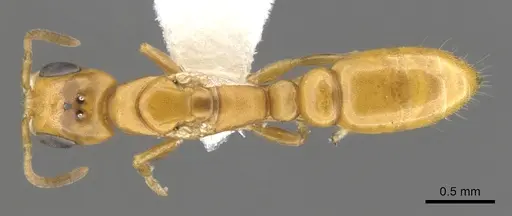
Literature
Loading distribution map...Loading products...