
Pristomyrmex cebuensis
- Sci. Name
- Pristomyrmex cebuensis
- Tribe
- Crematogastrini
- Subfamily
- Myrmicinae
- Author
- Zettel, 2007
- Distribution
- Found in 0 countries
Introduction
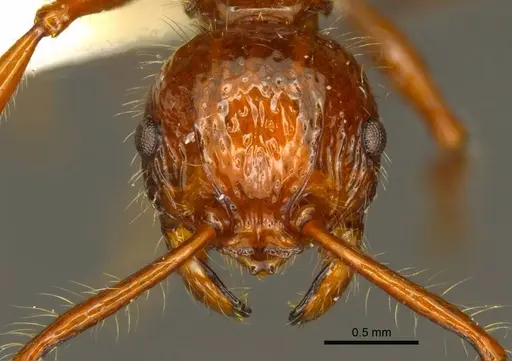
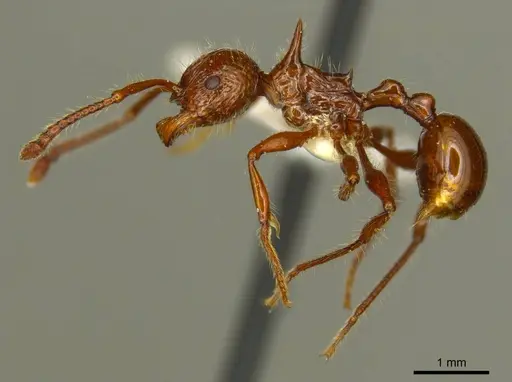
Pristomyrmex cebuensis is a large ant species endemic to Cebu Island in the Philippines. Workers measure 4.89-5.34 mm in total length and have a reddish-brown coloration with long pronotal spines that are more than four times longer than the propodeal spines . The head has coarse punctures, and the clypeus has a prominent median carina . This species was described in 2007 and is known only from a single location at 800-900 m elevation . This species remains poorly studied, with no published data on colony structure, founding behavior, or specific care requirements.
Quick Summary
- Difficulty: Expert
- Origin & Habitat: Philippines (Cebu Island), found at 800-900m elevation in the hills behind Cebu City [1]
- Colony Type: Unconfirmed, colony structure has not been documented
- Size & Growth:
- Queen: Unknown, queen caste has not been described
- Worker: 4.89-5.34 mm [1]
- Colony: Unknown, no data on colony size
- Growth: Unknown
- Development: Unknown, no studies on development timeline. Based on related Pristomyrmex species, it might take 4-8 weeks at tropical temperatures, but this is an estimate. (Development is likely temperature-dependent.)
- Antkeeping:
- Temperature: Likely 24-28°C based on tropical Philippine origin.
- Humidity: Keep nest substrate consistently moist but not waterlogged.
- Diapause: No, as it is a tropical species.
- Nesting: Likely prefers soil-based nests or test tube setups.
- Behavior: Not documented, but based on genus Pristomyrmex, species are typically predatory and may be moderately aggressive. Their long pronotal spines suggest a defensive strategy. Based on subfamily Myrmicinae and tribe Crematogastrini, they likely use a smear defense mechanism. Escape risk is moderate due to their size.
- Common Issues: no biological data exists, keepers are essentially pioneering captive husbandry for this species., colony founding is completely unstudied, queen behavior and requirements unknown., diet preferences are undocumented, must be determined through experimentation., temperature and humidity requirements are inferred, not confirmed., risk of purchasing wild-caught colonies that may have parasites or damage.
Taxonomy and Description
Pristomyrmex cebuensis was described by Herbert Zettel in 2007 based on workers from Cebu Island, Philippines. The holotype measures 5.17 mm in total length, with paratypes ranging from 4.89-5.34 mm [1]. The species is distinguished by its long pronotal spines (0.52-0.62 mm), which are more than four times longer than the propodeal spines (0.11-0.15 mm) [1]. The clypeus has a prominent median carina and lateral rugae, and the head has coarse punctures [1].
Distribution and Habitat
This species is endemic to Cebu Island in the Philippines. The type locality is at 800-900 m elevation in the hills behind Cebu City [1]. No other locations are known.
Morphology
Workers have reddish-brown coloration. The mandibles have four teeth on the masticatory margin, and the frontal carinae are strongly developed [1]. The petiolar node has 3-5 pairs of setae, and the first gastral tergite lacks erect hairs [1].
Frequently Asked Questions
Where does Pristomyrmex cebuensis come from?
This species is endemic to Cebu Island in the Philippines, found at 800-900 m elevation [1].
How do I identify Pristomyrmex cebuensis?
Workers are 4.89-5.34 mm with reddish-brown color. The most distinctive feature is the extremely long pronotal spines (0.52-0.62 mm) which are more than four times longer than the propodeal spines. The head has coarse punctures and the clypeus has a sharp median carina [1].
Report an Issue
The current care sheet is based fully on literature. See inconsistencies, or something that's incorrect? Please , it will be resolved after review from an admin. Contributing to the blogs tab also helps providing information, to make us be able to further improve the caresheets. Thank you for your support!
References

This caresheet is licensed under CC BY-SA 4.0 .
Community Blogs
CASENT0919748
View on AntWeb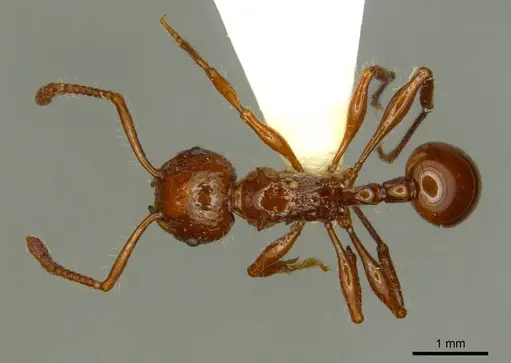
Literature
Loading distribution map...Loading products...