
Pheidole rubiceps
- Sci. Name
- Pheidole rubiceps
- Tribe
- Attini
- Subfamily
- Myrmicinae
- Author
- Wilson, 2003
- Distribution
- Found in 3 countries
Introduction
Pheidole rubiceps is a small tropical ant native to the rainforests of Venezuela and French Guiana. Only known from the type locality (Rancho Grande,1100 m) and a few records in French Guiana . It belongs to the fallax group and shows the classic Pheidole dimorphism: major workers (soldiers) have enlarged heads, while minor workers are much smaller. The name 'rubiceps' means 'red-headed, ' referring to the reddish-yellow head of majors contrasting with a brown body . Almost nothing is documented about its biology in the scientific literature, the AntWiki entry explicitly states 'Nothing is known about the biology of rubiceps.' This makes it an experimental species for antkeepers. Its habitat appears to be leaf-litter in transition forests .
Quick Summary
- Difficulty: Unknown, Insufficient Data
- Origin & Habitat: Tropical rainforest in Venezuela (Rancho Grande,1100 m elevation) and French Guiana. Collected from leaf-litter in transition forest zones [2][1].
- Colony Type: Not documented. Most Pheidole species are monogyne (single queen), but this has not been confirmed for P. rubiceps.
- Size & Growth:
- Queen: Undescribed, no published measurements. Body length unknown, inferred from genus patterns roughly 5-7 mm but unconfirmed.
- Worker: No total length measurements available. Head measurements (not body length) are published: major head width ~1.22 mm, minor head width ~0.60 mm [1]. Body sizes remain unrecorded.
- Colony: Unknown, no data. Most Pheidole species reach hundreds to low thousands of workers, but not confirmed.
- Growth: Unknown, no data.
- Development: Unknown, no data. Tropical Pheidole typically develop in 4-8 weeks, but this is an estimate. (All timeline information is inferred from genus-level patterns, no specific data exists.)
- Antkeeping:
- Temperature: Not documented. Based on tropical rainforest habitat, likely requires warm temperatures around 24-28°C [2].
- Humidity: Not documented. Leaf-litter dwellers typically need high humidity, aim for moist but not waterlogged substrate, with a humidity gradient.
- Diapause: No data. Tropical species from Venezuela and French Guiana likely do not require a diapause period, but this is unconfirmed.
- Nesting: Not documented. Probably nests in decaying wood or soil pockets. In captivity, tested setups include Y-tong or soil nests with small chambers.
- Behavior: Not documented. Pheidole species are generally non‑aggressive but will defend the nest. Minor workers are tiny (~0.6 mm head width), so fine mesh barriers are essential to prevent escape. Majors likely help crack seeds and defend the colony, but no specific observations exist.
- Common Issues: almost no biological data exists, all care recommendations are educated guesses from genus patterns [1]., tiny minor workers can escape through standard barrier gaps, use very fine mesh or fluon barriers., tropical species may be sensitive to temperature drops, avoid prolonged exposure below 20°C., unknown diet acceptance, offer small insects and seeds, but may refuse some foods, observe and adjust., mould and bacterial growth in high humidity, ensure nest ventilation and clean leftover food promptly.
Discovery and Taxonomy
Pheidole rubiceps was described by E. O. Wilson in 2003 from specimens collected at Rancho Grande, Venezuela (1100 m elevation). The specific epithet 'rubiceps' (Latin for 'red‑headed') refers to the reddish‑yellow head of the major workers contrasting with a brown body [1]. It belongs to the fallax group, which includes similar Neotropical species like Pheidole cardinalis, Pheidole caribbaea, and Pheidole obscurior. Only a handful of records exist, one from the type locality in Venezuela and a few from French Guiana [1].
Natural Habitat
This species has been collected in transition forest leaf‑litter in French Guiana, and the type locality in Venezuela sits at 1100 m elevation in a tropical rainforest setting. Transition forests lie between different forest types, so the habitat likely features high humidity, warm year‑round temperatures, and dense leaf‑litter [2][1]. As a leaf‑litter dweller, it probably nests in moist decaying wood, under bark, or in soil pockets.
Size and Morphology
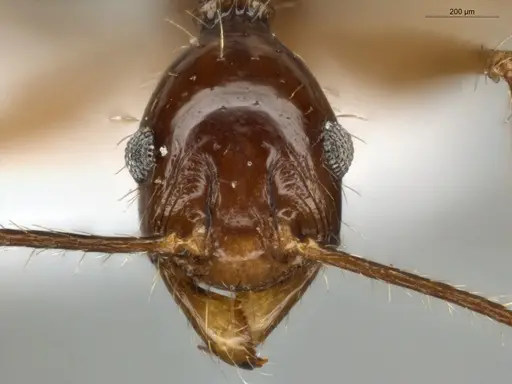
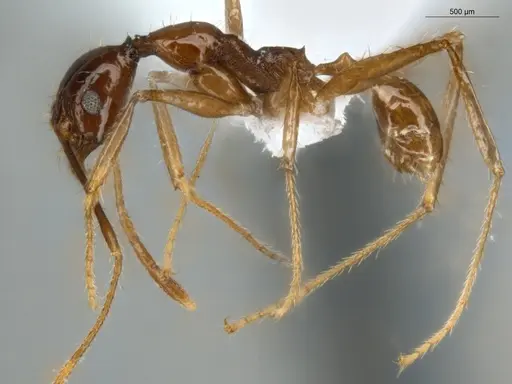
Pheidole rubiceps exhibits strong worker dimorphism. Major workers have enlarged heads, head width about 1.22 mm, head length 1.36 mm [1]. Minor workers are much smaller, with a head width of about 0.60 mm and head length 0.82 mm [1]. The AntWiki scale bar shows majors roughly 4-5 mm total length and minors about 2-3 mm, but precise total lengths have not been published. Majors are bicolored: reddish‑yellow head and mandibles contrasting with a medium brown body, legs light brown with yellow tarsi [1].
Care Recommendations (Inferred)
Since nothing is documented about this species' biology, all care is based on genus‑level inference and habitat information. Provide a warm environment (24-28°C) and high humidity, use a Y‑tong, plaster, or soil nest with chambers sized for tiny workers. Offer a varied diet: small insects (fruit flies, pinhead crickets) and seeds suitable for Pheidole. Because minor workers are minute, use fine steel mesh or fluon to prevent escape. Start with standard Pheidole care and adjust based on colony response. Document all observations, as any captive data would be valuable.
Research Gaps
Pheidole rubiceps is one of the least‑studied Pheidole species. Its biology is almost entirely unknown: colony structure, founding behavior, development timeline, diet preferences, and behavior are all undocumented. The AntWiki entry explicitly states 'Nothing is known about the biology of rubiceps.' This makes it an experimental species, antkeepers who manage to keep it will be contributing to basic knowledge. Carefully record every observation. [1]
Frequently Asked Questions
How do I care for Pheidole rubiceps ants?
Because no specific biological data exists, care is based on genus‑level inference. Provide warm temperatures (24-28°C), high humidity (moist substrate), and a Y‑tong or soil nest with small chambers. Feed small insects and seeds. Use fine mesh to contain tiny minor workers. This is an experimental species, you will be learning alongside the scientific community [1].
What do Pheidole rubiceps eat?
Not documented. Most Pheidole are seed‑harvesters and predators, so offer small insects (fruit flies, pinhead crickets) and appropriate seeds. Sugar water or honey may also be accepted, but observe your colony to determine preferences, this is unknown for P. rubiceps.
How long does it take for Pheidole rubiceps to develop from egg to worker?
Unknown for this species. Tropical Pheidole typically develop in 4-8 weeks at optimal temperatures, but without specific data, expect several months. No reliable timeline can be given.
Are Pheidole rubiceps good for beginners?
Not recommended due to the complete lack of documented care information. This species is for experienced antkeepers who enjoy experimentation and documentation, you would be establishing care protocols from scratch [1].
How big do Pheidole rubiceps colonies get?
Unknown, no data. Most Pheidole species mature at several hundred to a few thousand workers, but this is unconfirmed for P. rubiceps.
What type of nest should I use for Pheidole rubiceps?
A naturalistic setup with moist substrate, or a Y‑tong/plaster nest with small chambers, would be a good starting point. Ensure chambers are sized for tiny minor workers. The species is a leaf‑litter dweller, so tight, humid spaces are likely preferred [2].
Do Pheidole rubiceps need hibernation?
Unlikely, this is a tropical species from Venezuela and French Guiana, where temperatures remain warm year‑round. No diapause period is expected, but this has not been experimentally confirmed. Keep them at stable warm temperatures instead.
Can I keep multiple Pheidole rubiceps queens together?
Unknown. Most Pheidole are monogyne, but this has not been documented for P. rubiceps. Without data, it is not recommended to attempt multi‑queen setups.
Why is Pheidole rubiceps so hard to find information on?
This species was described in 2003 and remains one of the least‑studied Pheidole. It is known from very few specimens, and no research has examined its biology. The AntWiki entry states 'Nothing is known about the biology of rubiceps.' [1].
Report an Issue
The current care sheet is based fully on literature. See inconsistencies, or something that's incorrect? Please , it will be resolved after review from an admin. Contributing to the blogs tab also helps providing information, to make us be able to further improve the caresheets. Thank you for your support!
References

This caresheet is licensed under CC BY-SA 4.0 .
Community Blogs
ECOFOG-MI15-0171-14
View on AntWeb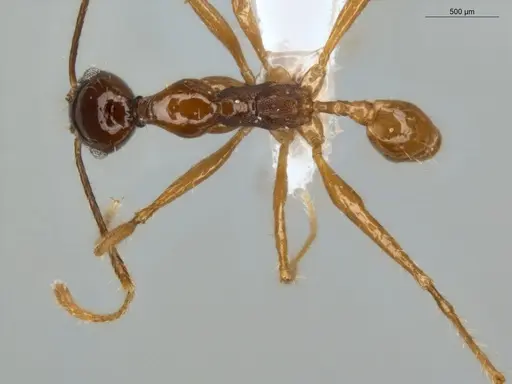
Literature
Loading distribution map...Loading products...