
Pheidole heliosa
- Sci. Name
- Pheidole heliosa
- Tribe
- Attini
- Subfamily
- Myrmicinae
- Author
- Fischer <i>et al.</i>, 2012
- Distribution
- Found in 1 countries
Introduction
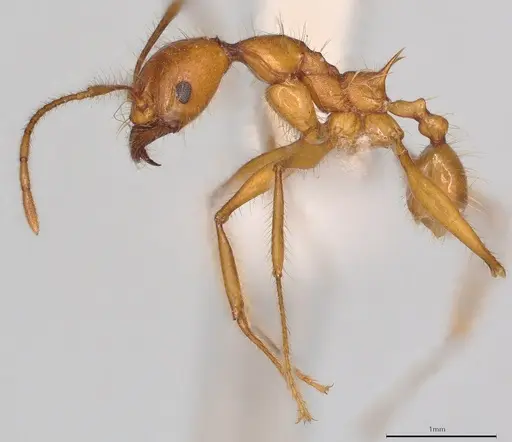
Pheidole heliosa is an ant species from the Afrotropical region, belonging to the Pheidole pulchella group . Minor workers are orange to yellow, while major workers are darker reddish-orange . It is the largest species in the pulchella group, with an elongated body and long scapes, legs, and mandibles . The species is known from Ivory Coast and Cameroon, where it is found in sifted leaf-litter . Body size data is unavailable, as total length measurements are not provided in the research. What makes P. heliosa interesting is its abundance of standing hairs, which are the highest in the pulchella group, including laterally projecting hairs on the meso- and metapleuron .
Quick Summary
- Difficulty: Medium
- Origin & Habitat: West Africa, Ivory Coast and Cameroon. Found in sifted leaf-litter from tropical forest habitats [1][3].
- Colony Type: Unconfirmed, no specific information on queen number or social structure in the research.
- Size & Growth:
- Queen: Size data unavailable, no measurements provided for queens.
- Worker: Size data unavailable, body length not measured, head measurements are available but not representative of full body size.
- Colony: Unknown, no specific data, estimated to reach several hundred workers based on related species [3].
- Growth: Moderate, inferred from typical Pheidole development patterns.
- Development: Estimated 6-8 weeks based on typical Pheidole genus development [3]. (Development time is inferred from genus-level data, as specific studies on P. heliosa are lacking.)
- Antkeeping:
- Temperature: Keep warm, roughly 24-28°C, based on tropical habitat.
- Humidity: Keep nest substrate consistently moist but not waterlogged, based on leaf-litter habitat.
- Diapause: No, tropical species from West Africa do not require diapause.
- Nesting: Prefer tight chambers in damp soil or leaf-litter, in captivity, use test tubes for founding and Y-tong or plaster nests for established colonies.
- Behavior: Pheidole heliosa is non-aggressive and active foragers. Major workers have enlarged heads but are not particularly defensive. Their small size requires serious escape prevention measures [1][3].
- Common Issues: escape prevention is critical due to very small size, limited husbandry information for newly described species, humidity management to prevent mold issues, slow founding phase with claustral queens, potential parasites from wild-caught colonies
Nest Preferences
In the wild, Pheidole heliosa has been collected from sifted leaf-litter in tropical forest habitats of Ivory Coast and Cameroon [1][3]. This indicates they naturally nest in damp, shaded microhabitats on the forest floor. For captive care, test tube setups work well for queen founding, providing a dark, humid chamber. Once the colony establishes, transition to a Y-tong or plaster nest with chambers scaled to their tiny size. Maintain consistent humidity without stagnation, ensure some ventilation to prevent mold while keeping the substrate damp. Avoid tall, open spaces, these ants prefer compact chambers.
Feeding and Diet
Pheidole species are generalist foragers with a diet based on seeds, protein, and sugary liquids. In captivity, offer protein sources like small mealworms or fruit flies twice weekly, and constant access to sugar water or honey. They likely accept small seeds as part of their natural diet. Remove uneaten protein within 24-48 hours to prevent mold. Prey items should be appropriately sized for their small workers. [3]
Temperature and Care
As a tropical species from West Africa, Pheidole heliosa requires warm conditions. Maintain nest temperatures between 24-28°C, with a slight gradient allowing workers to self-regulate. A heating cable on top of the nest can create this gradient. Room temperature may suffice if your home stays in the low-to-mid 20s°C, but supplemental heating often benefits active colonies. Monitor colony behavior to adjust temperature as needed. [1][3]
Behavior and Temperament
Pheidole heliosa displays typical Pheidole behavior, they are active, non-aggressive ants that focus on foraging and colony growth. Major workers have enlarged heads but are not particularly aggressive. Workers will readily forage and recruit nestmates through pheromone trails. Their small size makes them excellent escape artists, use fine mesh barriers and apply Fluon to potential escape points. [1][3]
Colony Founding
The founding behavior of Pheidole heliosa has not been directly documented. Based on typical Pheidole genus patterns, they likely exhibit claustral foundation, where the queen seals herself in a chamber after mating. Expect a quiet founding phase of 4-8 weeks before the first workers emerge. During this time, keep the queen in complete darkness and avoid disturbances. Do not feed claustral queens, offering food increases mold risk. Once workers emerge, they will begin foraging. [3]
Growth and Development
Specific development timelines for Pheidole heliosa have not been studied, but based on typical Pheidole development at optimal temperatures, expect approximately 6-8 weeks from egg to first worker. The first workers are typically smaller than normal. Growth rate is moderate, colonies may take several months to reach 50 workers, but expansion accelerates after this point. Patience is essential during the founding phase. [3]
Frequently Asked Questions
How long does it take for Pheidole heliosa to produce first workers?
Based on typical Pheidole development, expect 6-8 weeks from egg to first worker at optimal temperatures (24-28°C) [3].
What do Pheidole heliosa ants eat?
They accept standard ant foods: protein like small insects twice weekly, and constant access to sugar water or honey [3].
Can I keep multiple Pheidole heliosa queens together?
Not recommended. Colony structure is unconfirmed, and most Pheidole are monogyne. Combining unrelated queens typically results in fighting.
What temperature do Pheidole heliosa need?
Keep them at 24-28°C, as they are a tropical species from West Africa.
Are Pheidole heliosa good for beginners?
Moderate difficulty. They are visually striking but newly described with limited captive husbandry information, so some trial and error is expected.
How big do Pheidole heliosa colonies get?
Colony size is unconfirmed, but based on related species, they likely reach several hundred workers [3].
Do Pheidole heliosa need hibernation?
No, as a tropical species from West Africa, they do not require diapause.
Why are my Pheidole heliosa escaping?
Their very small size makes them excellent escape artists. Use fine mesh barriers and apply Fluon to all openings [3].
When should I move Pheidole heliosa to a formicarium?
Keep them in a test tube setup for founding. Once the colony reaches 50+ workers and the test tube shows issues, consider transitioning to a Y-tong or plaster nest [3].
What makes Pheidole heliosa different from other Pheidole?
They are the largest in the pulchella group with elongated bodies, very long scapes and legs, and the highest number of standing hairs on the head and mesonotum [1].
Report an Issue
The current care sheet is based fully on literature. See inconsistencies, or something that's incorrect? Please , it will be resolved after review from an admin. Contributing to the blogs tab also helps providing information, to make us be able to further improve the caresheets. Thank you for your support!
References

This caresheet is licensed under CC BY-SA 4.0 .
Community Blogs
CASENT0218263
View on AntWeb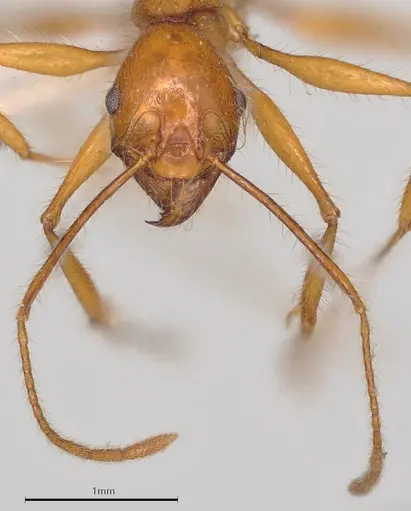
Literature
Loading distribution map...Loading products...