
Pheidole darwini
- Sci. Name
- Pheidole darwini
- Tribe
- Attini
- Subfamily
- Myrmicinae
- Author
- Fischer <i>et al.</i>, 2012
- Distribution
- Found in 1 countries
Introduction
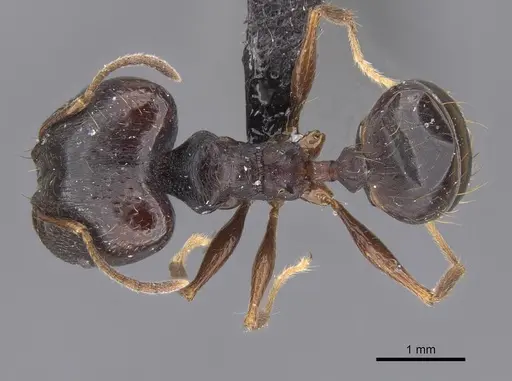
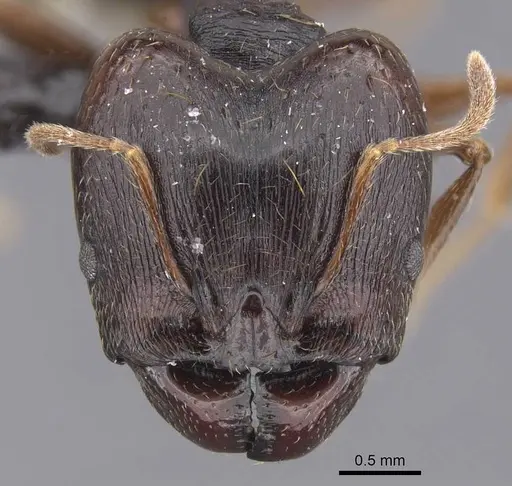
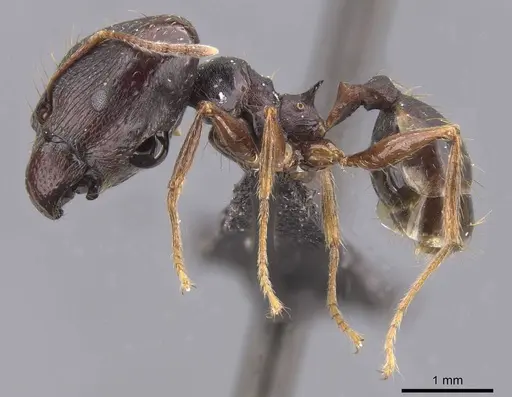
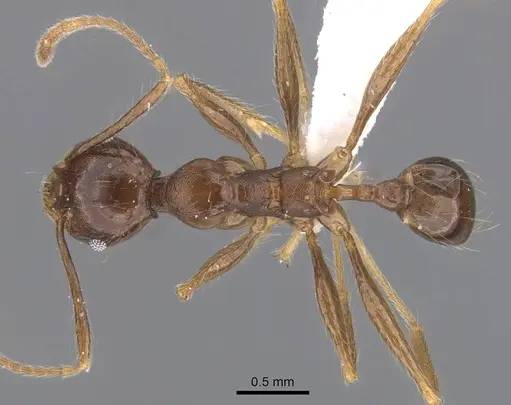
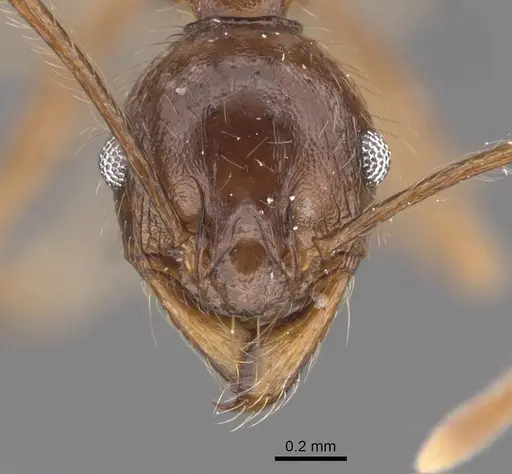
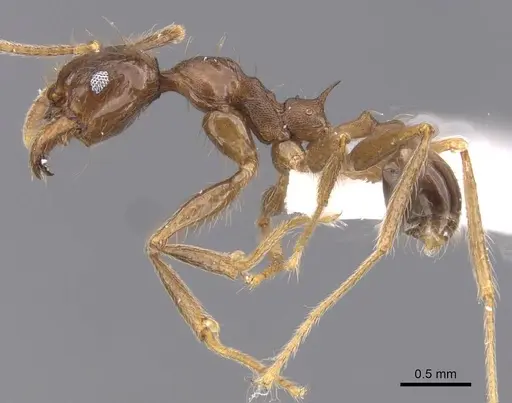
Pheidole darwini is a small African ant from the pulchella group, named after Charles Darwin. It occurs in Cameroon, Central African Republic, and Gabon, nesting in sifted leaf-litter and rotten logs on the forest floor . Minor workers are small with a distinctive elliptical head, while major workers are larger and have three to five erect hairs along the outer edge of the scape, a key identifying feature . The species is medium to dark brown with slightly lighter appendages . This ant is notable for its dimorphic colonies, where major workers serve as defenders and seed processors, a common trait in Pheidole species .
Quick Summary
- Difficulty: Medium
- Origin & Habitat: Rainforests of Cameroon, Central African Republic, and Gabon in West-Central Africa. They nest in sifted leaf-litter and rotten logs on the forest floor [1][2].
- Colony Type: Single-queen colonies (monogyne), inferred from genus patterns [1]. Colonies contain both minor and major workers.
- Size & Growth:
- Queen: Size data unavailable [1].
- Worker: Size data unavailable [1].
- Colony: Up to 2000 workers, estimated from genus patterns [1].
- Growth: Moderate, typical for tropical Pheidole [1].
- Development: Estimated 6-8 weeks, based on genus patterns [1]. (Development time is inferred from related tropical Pheidole species.)
- Antkeeping:
- Temperature: Keep warm and stable, roughly low-to-mid 20s°C, as inferred from tropical habitat [1].
- Humidity: Keep nest substrate consistently moist but not waterlogged, as they inhabit damp forest floor [2].
- Diapause: No, as a tropical species, they do not require hibernation [1].
- Nesting: Prefer dark, humid nests such as Y-tong, plaster, or soil nests, mimicking their natural habitat [2].
- Behavior: Pheidole darwini is non-aggressive and focuses on seed collection. They possess a sting as typical for Myrmicinae, but rarely use it. Escape risk is moderate due to the small size of minor workers, use standard barriers.
- Common Issues: mold growth due to high humidity requirements, ensure adequate ventilation, slow initial growth during founding phase, patience is needed, major workers need appropriately sized prey items for seed processing, wild-caught colonies may harbor parasites, quarantine new colonies
Nest Preferences and Housing
Pheidole darwini naturally nests in rotting logs and leaf-litter, indicating a preference for humid, dark environments [1][2]. For captive care, use Y-tong, plaster, or soil nests to maintain humidity. Provide a dark nest chamber and a connected outworld for foraging. Ensure connections are appropriately sized for minor workers [1].
Feeding and Diet
Diet is unconfirmed, but based on Pheidole genus patterns, they are likely omnivorous, collecting seeds and small insects [1]. Offer crushed seeds, small insects, and sugar water. Minor workers handle most foraging [1].
Temperature and Seasonal Care
As a tropical species, keep temperatures warm and stable, roughly low-to-mid 20s°C, with a slight gradient for self-regulation [1]. No hibernation is needed. Monitor for condensation to avoid overly humid conditions [1].
Colony Founding and Growth
Founding behavior is unconfirmed [1]. If attempting founding, keep queens in a quiet, dark location with high humidity and warm temperatures. Growth is moderate, with major workers appearing once the colony reaches several dozen workers [1].
Behavior and Colony Structure
Colonies are dimorphic with minor workers handling daily tasks and major workers specializing in defense and seed processing. Major workers have three to five erect hairs on the scape, a diagnostic character [1]. They are non-aggressive but possess a sting as typical for Myrmicinae.
Common Keeping Problems
Mold can develop due to high humidity, ensure ventilation. Founding colonies are vulnerable to disturbance. Slow growth may require patience. Wild-caught colonies may carry parasites, quarantine is recommended [1].
Frequently Asked Questions
How long does it take for Pheidole darwini to produce first workers?
Expect first workers in 6-8 weeks under optimal conditions, estimated from genus patterns [1].
Can I keep multiple Pheidole darwini queens together?
Not recommended, as this species is likely monogyne. Combining queens may result in fighting [1].
What do Pheidole darwini eat?
Diet is unconfirmed, but they are likely omnivorous, feeding on seeds and small insects [1].
What temperature is best for Pheidole darwini?
Keep them warm, roughly low-to-mid 20s°C, as inferred from their tropical habitat [1].
How big do Pheidole darwini colonies get?
Up to 2000 workers, estimated from genus patterns [1].
Are Pheidole darwini good for beginners?
They are rated Medium difficulty, mainly due to humidity management and patience during founding [1].
When should I move Pheidole darwini to a formicarium?
Keep them in a test tube during founding. Move to a larger nest once the colony has 50+ workers and shows signs of outgrowing the setup [1].
Do I need to hibernate Pheidole darwini?
No, as a tropical species, they do not require hibernation [1].
Why are my Pheidole darwini dying?
Common causes include low temperatures, low humidity, mold, or disturbance. Check environmental conditions first [1].
Report an Issue
The current care sheet is based fully on literature. See inconsistencies, or something that's incorrect? Please , it will be resolved after review from an admin. Contributing to the blogs tab also helps providing information, to make us be able to further improve the caresheets. Thank you for your support!
References

This caresheet is licensed under CC BY-SA 4.0 .
Community Blogs

Literature
Loading distribution map...Loading products...