
Parasyscia salimani
- Sci. Name
- Parasyscia salimani
- Subfamily
- Dorylinae
- Author
- Karavaiev, 1925
- Distribution
- Found in 0 countries
Introduction
Parasyscia salimani is a small ant species from the Dorylinae subfamily, originally described from Java, Indonesia. Workers measure approximately 4.5 mm in total length and have dark brown coloration with yellowish-brown mandibles, antennae, legs, and the tip of the abdomen . The species is part of the Oriental region ant fauna and was collected from Tjibodas in the highlands of West Java . This species was originally described as Cerapachys salimani in 1925 and transferred to Parasyscia in 2016 , and it is relatively rare in scientific collections with no established captive care data.
Quick Summary
- Difficulty: Unknown, limited captive data
- Origin & Habitat: Java, Indonesia, collected from Tjibodas at elevation in highland forest areas [1][3][2]
- Colony Type: Unconfirmed, no specific study exists for P. salimani
- Size & Growth:
- Antkeeping:
- Temperature: Estimated 22-28°C based on Java's tropical highland climate [1][2]. Start around 24-26°C and observe colony activity.
- Humidity: Estimated 70-85% based on Java's humid environment [1][2]. Keep nest substrate consistently moist but not waterlogged.
- Diapause: Unknown, Java has minimal seasonal temperature variation. Tropical ants often remain active year-round with slight slowdowns during cooler periods.
- Nesting: No specific nesting data exists. Based on general Dorylinae preferences, soil or rotting wood nests may work [4]. A naturalistic setup with moist substrate or a Y-tong/plaster nest is appropriate.
- Behavior: No specific behavioral studies exist for this species. Dorylinae ants are generally predatory and may form raiding columns. Workers are likely active foragers that hunt small invertebrates. Escape risk is moderate given their 4.5 mm size, use standard barrier precautions.
- Common Issues: no captive husbandry data exists, all care recommendations are estimates based on related species, tropical origin means temperature sensitivity, avoid cold conditions below 20°C, humidity needs are unconfirmed but likely high given Java habitat, predatory diet may be essential, may not accept sugar-only diets, very limited availability in antkeeping trade makes this an uncommon species
Distribution and Natural Habitat
Parasyscia salimani is known only from Java, Indonesia, specifically from the Tjibodas area in the highlands of West Java [1][3]. Tjibodas is located at elevation in a mountainous region known for its humid, tropical forest environment. The original specimens were collected in the early 1920s by Karawaiew. This species has not been widely documented in scientific literature since its initial description, suggesting it may have a limited distribution or has been overlooked in surveys [2].
Identification and Morphology
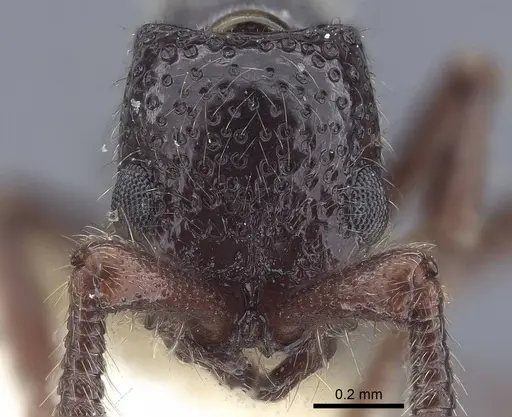
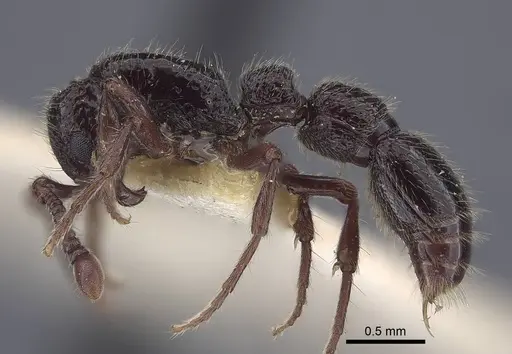
Workers of P. salimani measure approximately 4.5 mm in total length [1]. The head is slightly longer than broad with uniformly weakly curved sides. When viewed from the front, the posterior head margin is very weakly concave, appearing strongly excised from behind. The eyes are large, fairly flat, and oval-shaped, situated slightly anterior to the middle of the head sides. The mandibles are bent at the base and strongly curved toward the apex, with a weakly denticulate inner margin. The body is dark brown with yellowish-brown mandibles, antennae, legs, and the tip of the gaster. Pilosity is yellowish-white and fairly abundant with long erect hairs [1].
Taxonomic History
This species was originally described as Parasyscia salimani by Karavaiev in 1925 from worker specimens collected in Java [1]. The type material consists of syntype workers from Tjibodas, Java. The species remained in Cerapachys for many decades until the 2016 generic revision by Borowiec moved numerous Cerapachys-like species into the genus Parasyscia [3]. The current combination is Parasyscia salimani (Karavaiev,1925). The species is considered valid with no subsequent synonymy [3].
Keeping Considerations
This species is extremely rare in the antkeeping hobby and has no established captive care protocols. All recommendations must be considered estimates based on the species' tropical Java origin and general Dorylinae biology. Provide a warm, humid environment with temperatures around 24-26°C and humidity in the 70-85% range [1][2]. As a Dorylinae ant, it is likely predatory and should be offered small live prey such as fruit flies or pinhead crickets. Nesting preferences are unknown but likely involve soil or rotting wood, a naturalistic setup with moist substrate or a plaster/Y-tong nest would be appropriate. Due to the complete lack of captive data, this species is not recommended for beginners and should only be kept by experienced antkeepers willing to experiment [4].
Frequently Asked Questions
How long does it take for Parasyscia salimani to develop from egg to worker?
This is unknown, no published development data exists for this species [1].
What do Parasyscia salimani ants eat?
No specific dietary data exists. As a Dorylinae ant, they are likely predatory on small invertebrates. Offer small live prey like fruit flies or springtails [4].
Are Parasyscia salimani good for beginners?
No, this species has no established captive care protocols and is extremely rare in the antkeeping hobby. All care is experimental. This is not a species for beginners.
What temperature should I keep Parasyscia salimani at?
No specific data exists. Based on their Java origin, estimate 22-28°C with an ideal around 24-26°C [1][2].
Do Parasyscia salimani need hibernation?
Unknown, Java has minimal seasonal temperature variation. Tropical ants often remain active year-round. No diapause requirement has been documented.
How big do Parasyscia salimani colonies get?
Unknown, no colony size data exists in scientific literature [1].
Can I keep multiple Parasyscia salimani queens together?
Unknown, colony structure has not been studied. Dorylinae species vary between single-queen and multi-queen colonies. Do not attempt combining unrelated queens without documented evidence of success.
What type of nest should I use for Parasyscia salimani?
No specific data exists. Based on typical Dorylinae preferences, a naturalistic setup with moist substrate or a Y-tong/plaster nest would be appropriate [4].
Where does Parasyscia salimani come from?
This species is known only from Java, Indonesia, specifically the Tjibodas area in the highlands of West Java [1][3].
Report an Issue
The current care sheet is based fully on literature. See inconsistencies, or something that's incorrect? Please , it will be resolved after review from an admin. Contributing to the blogs tab also helps providing information, to make us be able to further improve the caresheets. Thank you for your support!
References

This caresheet is licensed under CC BY-SA 4.0 .
Community Blogs
CASENT0916792
View on AntWeb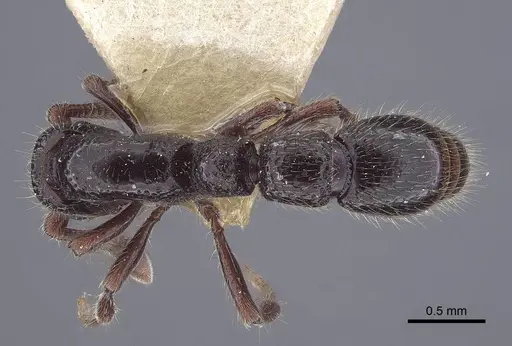
Literature
Loading distribution map...Loading products...