
Paraparatrechina myops
- Sci. Name
- Paraparatrechina myops
- Tribe
- Lasiini
- Subfamily
- Formicinae
- Author
- LaPolla & Fisher, 2010
- Distribution
- Found in 1 countries
Introduction
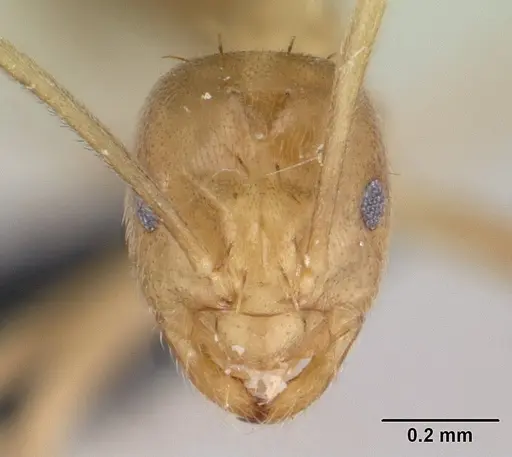
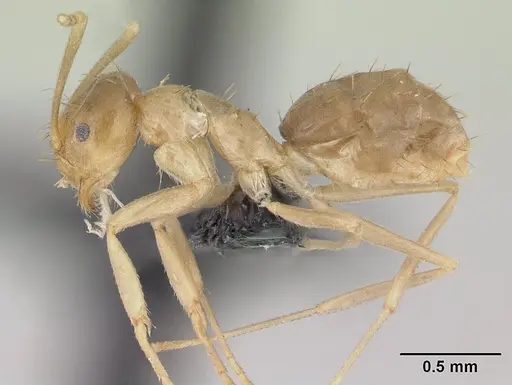
Paraparatrechina myops is a tiny yellow ant native to the mountainous regions of Madagascar. Workers measure just 1.8–2.4 mm in length and are entirely yellow, including the head, antennae, mesosoma, legs, and gaster . The species gets its name from the Greek word for 'mouse eye' because of its unusually small eyes compared to related species . This is a montane species found at elevations between 875–1565 m in Manongarivo, Marojejy, and Anjanaharibe‑Sud national parks . The cuticular surface is shining with long, shaggy pubescence giving the head a distinctive fuzzy appearance . Only the worker caste has been described – queens and males remain unknown to science .
Quick Summary
- Difficulty: Expert
- Origin & Habitat: Madagascar montane forest and rainforest at elevations 875–1565 m [1][2]. Found in three protected areas: Manongarivo, Marojejy, and Anjanaharibe‑Sud in northern Madagascar [1].
- Colony Type: Unknown – only workers have been collected. No queens or males have been described in scientific literature [1]. Colony structure cannot be determined from available data.
- Size & Growth:
- Queen: Unknown – queen caste has not been described [1]
- Worker: 1.8–2.4 mm [1][2]
- Colony: Unknown – only single workers have been collected, no colony samples studied [1]
- Growth: Unknown
- Development: Unknown – no development data exists for this species. Based on typical Formicinae patterns, estimate 6–10 weeks at optimal temperature, but this is a rough guess. (Development timeline is completely unstudied. Related Paraparatrechina species suggest moderate development speed, but this is speculative.)
- Antkeeping:
- Temperature: Based on montane habitat, likely prefers cooler temperatures than typical tropical ants. Aim for 20–24 °C with a gradient. Start in the low‑mid 20s and observe colony behavior.
- Humidity: Montane rainforest environment suggests moderate to high humidity needs. Keep the nest substrate consistently moist (but not waterlogged) and provide a water source. Mist the outworld regularly to maintain ambient humidity. A humidity gradient (one dry area, one moist) is ideal.
- Diapause: Unknown – no seasonal data available. Given the montane origin, a cool period during the local winter may be beneficial. If attempted, provide a mild cooling to around 15–18 °C for 2–3 months. This is speculative.
- Nesting: Nesting habits are unconfirmed. Based on related Lasiini, they likely nest in soil, under stones, or in rotting wood in humid forest floor microhabitats. A naturalistic setup with moist substrate or a Y‑tong/plaster nest works well for small Formicinae.
- Behavior: Behavior is unstudied. As a tiny yellow Formicinae, they likely have modest foraging ranges and may tend honeydew‑producing insects. Their small size (under 2.5 mm) makes escape prevention critical – they can squeeze through standard test tube cotton if gaps exist. Use fine mesh barriers and ensure all connections are sealed. Temperament is likely non‑aggressive given their small size and montane forest origin. No stinging capability has been documented, but any sting would be negligible to humans.
- Common Issues: queen unavailability – no queens have ever been described, making captive breeding essentially impossible., complete care data absence – all husbandry parameters are estimates based on related species., escape risk – tiny workers can slip through standard barriers meant for larger ants., montane temperature requirements – may not thrive in typical room temperature conditions., humidity sensitivity – montane species may be prone to mold in poorly ventilated setups., protected status – only known from national parks in Madagascar, collecting without permits is illegal.
Why This Species Is Extremely Difficult to Keep
Paraparatrechina myops presents an extraordinary challenge for antkeepers: it may be impossible to keep at all. Only the worker caste has ever been collected and described in scientific literature – no queens, males, or colony samples have ever been documented [1]. This means we do not know what a mated queen looks like, when nuptial flights occur, or how colonies are structured in the wild. Without queens, captive breeding is fundamentally impossible. Any specimens available to hobbyists would need to be wild‑caught workers, which would not establish colonies. This species remains a scientific curiosity rather than a viable antkeeping project. Related species in the genus Paraparatrechina are similarly poorly studied, offering no reliable care parallels.
Distribution and Habitat
This species is endemic to the mountainous regions of northern Madagascar. Specimens have been collected from three locations: Manongarivo, Marojejy, and Anjanaharibe‑Sud, all within protected national parks [1]. Elevation range spans 875–1565 meters above sea level [2]. The habitat is described as montane forest and rainforest – cool, humid, and densely vegetated environments [3]. These locations experience significant rainfall and moderate temperatures year‑round due to their elevation. The species appears closely related to Paraparatrechina ocellatula, and both are considered montane specialists [1]. The small eye size may be an adaptation to darker understory conditions on the forest floor [1].
Identification and Morphology
Workers are tiny at just 1.8–2.4 mm total length, making them some of the smallest ants in the hobby [1]. The entire body is yellow – head, antennae, mesosoma, legs, and gaster all share a yellowish coloration [1]. The most distinctive feature is the very small eye size, which gives the species its name 'myops' meaning 'mouse eye' in Greek [1]. The cuticular surface is shining, but the head is covered in long, shaggy pubescence that lies flat against the surface [1]. Antennae are relatively long, surpassing the posterior head margin by approximately the length of the first three to four funicular segments [1]. The mesosoma is compact with a distinct metanotal area and prominent mesonotal spiracles [1]. These morphological details are important for identification but have limited relevance to captive care.
Related Species and Taxonomic Context
Paraparatrechina myops belongs to the tribe Lasiini within the subfamily Formicinae. The genus Paraparatrechina contains fewer than 20 described species, all distributed in Africa and Madagascar [1]. This species is closely related to Paraparatrechina ocellatula, another montane species from Madagascar [1]. These two can be differentiated by size (P. myops is larger) and by pubescence on the scapes (decumbent in P. myops versus appressed in P. ocellatula) [1]. The entire genus remains poorly studied, with basic biology including colony structure, diet, and behavior largely undocumented. Keeping any Paraparatrechina species would require significant experimentation and careful documentation to advance our knowledge.
What We Would Need to Know to Keep This Species
If a dedicated researcher wanted to attempt husbandry, several fundamental questions need answering. Where are the queens? Have they simply not been collected, or do they have unusual morphology? What is the colony structure – single‑queen, multi‑queen, or something else? When and how do nuptial flights occur? What are the exact temperature and humidity preferences? And what do they eat in the wild – do they tend aphids, hunt small prey, or scavenge? Without this basic biological information, any attempt at keeping would be purely speculative [1]. The montane habitat suggests cooler temperatures and higher humidity than typical tropical ants, but these are educated guesses, not proven requirements.
Frequently Asked Questions
Can I keep Paraparatrechina myops as a pet ant?
No – this species cannot be kept because only workers have ever been described. No queens are known to science, making captive breeding impossible. Any wild‑caught workers cannot establish a colony.
Where can I get a Paraparatrechina myops queen?
Queens have never been described in scientific literature. It is unclear if they exist in a morphological form we would recognize as a queen, or if they have never been collected. There is no source for obtaining this species.
What do Paraparatrechina myops eat?
Diet is completely unstudied. As a Formicinae in the Lasiini tribe, they likely feed on honeydew from aphids and scale insects, plus small insects and nectar. However, this is speculative based on related genera.
What temperature do Paraparatrechina myops need?
Temperature requirements are unknown. Based on their montane forest habitat in Madagascar (elevations 875–1565 m), they likely prefer cooler conditions than typical tropical ants – possibly around 20–24 °C. This is an estimate, not confirmed data.
How big do Paraparatrechina myops colonies get?
Colony size is unknown. Only single workers have ever been collected – no colony samples exist in scientific collections. Maximum colony size cannot be estimated from available data.
Are Paraparatrechina myops good for beginners?
No. This species is not suitable for any antkeeper because queens have never been described. Even expert antkeepers cannot maintain this species.
Do Paraparatrechina myops need hibernation?
Diapause requirements are completely unknown. However, given their montane origin in Madagascar, a mild cool period during winter months may be beneficial. This is speculative based on habitat type.
What makes Paraparatrechina myops different from other ants?
This species has the smallest eyes of any Paraparatrechina species, giving it the common name 'mouse eye ant.' It is also one of the least‑studied ant species in the world, with basic biology completely unknown.
Why is Paraparatrechina myops so hard to find?
The species has a very restricted distribution in northern Madagascar at elevations 875–1565 m. It is only known from three mountain locations in protected national parks. Even professional entomologists have rarely collected it.
Report an Issue
The current care sheet is based fully on literature. See inconsistencies, or something that's incorrect? Please , it will be resolved after review from an admin. Contributing to the blogs tab also helps providing information, to make us be able to further improve the caresheets. Thank you for your support!
References

This caresheet is licensed under CC BY-SA 4.0 .
Community Blogs
CASENT0042527
View on AntWeb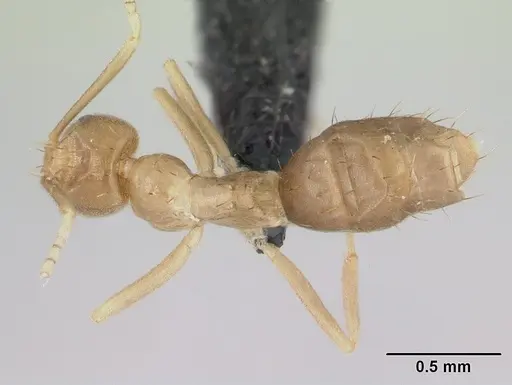
Literature
Loading distribution map...Loading products...