
Oxyopomyrmex emeryi
- Sci. Name
- Oxyopomyrmex emeryi
- Tribe
- Stenammini
- Subfamily
- Myrmicinae
- Author
- Santschi, 1908
- Distribution
- Found in 2 countries
Introduction
Oxyopomyrmex emeryi is a small ant native to North Africa, specifically Tunisia and Algeria . Workers are very small, with a total length of approximately 0.57 mm . They have a dark brown head and abdomen, with brown to brick-red thorax and legs . This species inhabits sandy dune environments and clay soils, nesting in humid sand between dunes or under stones . A notable behavior is their nocturnal foraging, where workers carry cuttings and debris from Helianthemum lippii, suggesting a specialized relationship with this desert plant .
Quick Summary
- Difficulty: Medium
- Origin & Habitat: Native to North Africa (Tunisia and Algeria) in the Palaearctic region. Found in humid sand between dunes and under stones in sandy or clay soil [1][2][3].
- Colony Type: Colony structure is unconfirmed. Based on related Stenammini genera, likely single-queen colonies, but this requires verification.
- Size & Growth:
- Queen: Unconfirmed, queen measurements not available in primary literature [2].
- Worker: Workers have a total length of approximately 0.57 mm [2].
- Colony: Unknown, no colony size data available. Nests have 5-10 chambers, but worker count is unconfirmed [2].
- Growth: Unconfirmed, no development timing data available.
- Development: Unknown, no direct development data exists for this species. (Development timeline has not been studied for this species.)
- Antkeeping:
- Temperature: Keep at room temperature around 20-26°C. Based on their geographic range, likely warm temperatures are suitable [1][2].
- Humidity: Provide moderate humidity. In nature, they nest in humid sand between dunes, so the nest substrate should be kept moist but not waterlogged [2][3].
- Diapause: Unknown, no research on overwintering requirements. As a North African species, they may have reduced activity in cooler months, but true hibernation is unconfirmed.
- Nesting: Naturalistic setup with sand substrate works well, or a Y-tong/plaster nest with moderate humidity. They nest deep in the wild (40-50 cm), so provide adequate depth [2][3].
- Behavior: Workers are nocturnal, actively foraging at night [2]. They are not aggressive and typically flee from disturbance. Their tiny size means escape risk is high, excellent escape prevention is essential [2].
- Common Issues: tiny size means escapes are likely without fine mesh barriers and tight-fitting lids [2]., colony size is unknown, wild colonies may be small, limiting growth expectations [2]., no development data means you cannot predict growth timeline accurately., humidity requirements are based on natural habitat, keep nest substrate moist but not waterlogged [2]., north African origin means they may be sensitive to cold and excessive moisture.
Natural History and Distribution
Oxyopomyrmex emeryi is found exclusively in North Africa, specifically Tunisia and Algeria [1][2]. This species occupies the Palaearctic biogeographic region and is adapted to arid to semi-arid conditions. They nest in distinctive locations, either in humid sand between dunes or under stones in sandy or clay soil [2]. The nest entrance is always single and narrow, surrounded by a regular crater-shaped mound 5-8 centimeters in diameter. Nests extend to at least 40-50 centimeters depth and consist of one enormous central gallery connected to 5-10 smaller chambers [2]. This deep nesting behavior is likely an adaptation to escape surface heat and maintain stable humidity in their harsh desert environment.
Identification and Appearance
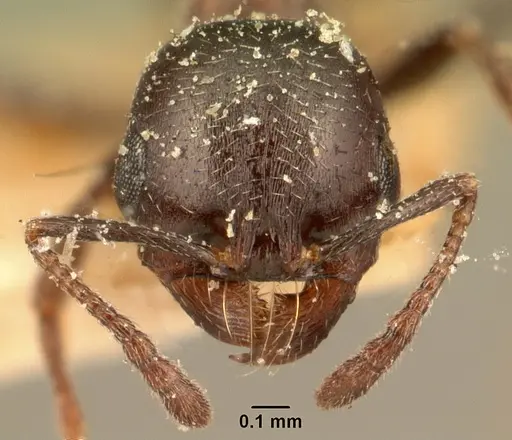
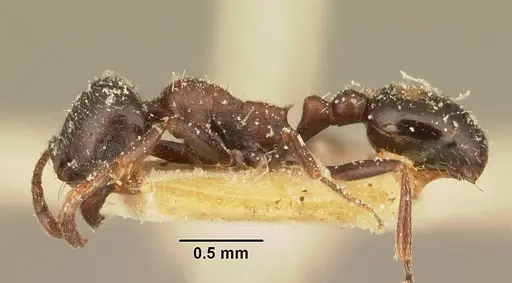
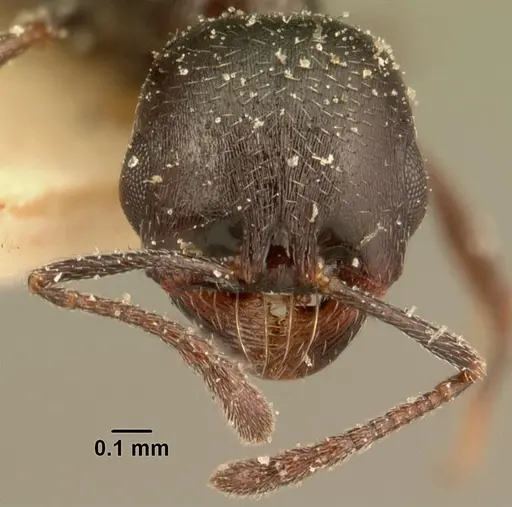
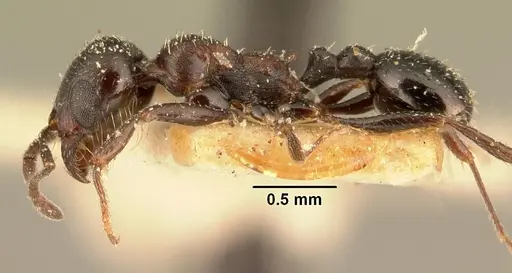
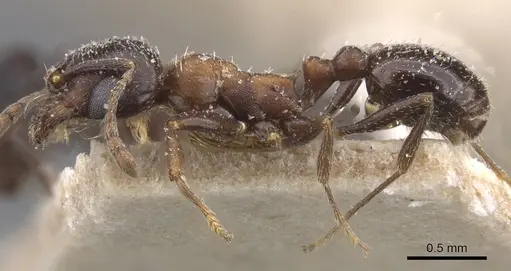
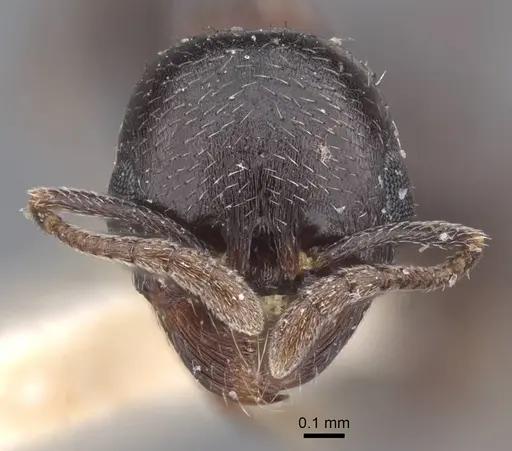
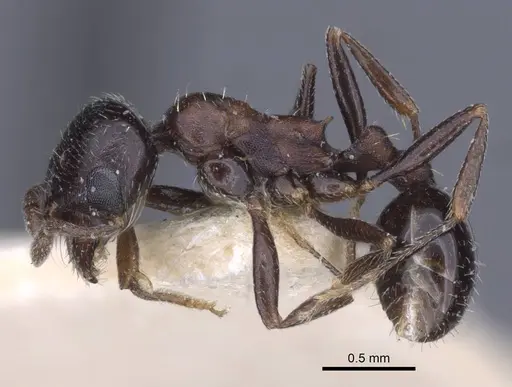
Workers are tiny ants with a total length of approximately 0.57 mm, making them among the smaller ant species kept in captivity [2]. They have a distinctive color pattern: the head and abdomen are dark brown, while the thorax and legs are brown to brick-red. The antennae are dark brown with only the apex of the scapes and first funiculus segments being paler [2]. The head is oval and longer than wide, with elongated eyes that narrow downward. The propodeal spines are short, triangular, and thin, rising obliquely upward. The promesonotum is gently and regularly convex in profile view. These ants belong to the magnus species group and can be distinguished from related species by their finely punctate pronotum lacking rugosity or longitudinal striae on the dorsal surface [3].
Foraging Behavior and Diet
Oxyopomyrmex emeryi workers are strictly nocturnal, becoming active after dark to forage and tend to their nests [2]. A notable behavior is their association with the plant Helianthemum lippii, a desert shrub. Workers can be observed carrying cuttings and debris from this plant, suggesting they may harvest plant material or tend to aphids that feed on it. This specialized foraging behavior is unusual among ants and may indicate a preference for plant-based food sources. In captivity, you should likely offer both protein (small insects) and plant-based foods (honey, seeds) to determine their preferences. Their nocturnal activity pattern means they will be most active in the evening and night hours, do not be concerned if they ignore food offered during the day.
Housing and Nest Setup
Given their natural nesting habits, these ants do best in a naturalistic setup with a sandy substrate that allows them to dig their characteristic deep nests. Provide at least 10-15 cm of substrate depth to allow natural tunnel construction. A test tube setup can work for founding colonies, but be prepared to move them to a larger naturalistic setup as the colony grows. The nest entrance should be narrow, mimicking their natural single narrow entrance surrounded by a crater. Because they are nocturnal and prefer dark, humid conditions deep underground, the nest should be in a shaded area away from direct light. Escape prevention is critical, their tiny size means they can squeeze through gaps that would hold larger ants. Use fine mesh on all ventilation holes and ensure any connections between outworld and nest are secure. [2][3]
Temperature and Seasonal Care
As a species from Tunisia and Algeria, Oxyopomyrmex emeryi is adapted to warm, arid conditions. Keep them at room temperature in the low-to-mid 20s Celsius (around 20-26°C). Based on their geographic range, they likely tolerate higher temperatures well. A temperature gradient allows the ants to choose their preferred spot. During winter, you may notice reduced activity, this is normal for North African species. A slight cool period around 15-18°C during winter months may be beneficial but is not required. Avoid keeping them too cold or too wet, as this could cause colony decline. [1][2]
Feeding Recommendations
Based on their natural behavior of carrying Helianthemum lippii cuttings, these ants likely accept plant material in addition to protein. Offer a varied diet including small live or frozen insects (fruit flies, small mealworms, pinhead crickets) as protein sources. Also provide sugar water, honey, or diluted syrup regularly. Their nocturnal foraging means you should offer food in the evening and remove uneaten portions in the morning. Start with small amounts and observe what gets consumed. The plant debris they carry in the wild may indicate they harvest seeds or plant matter, you could experiment with tiny seed offerings, though acceptance is uncertain. Always provide fresh water. [2]
Frequently Asked Questions
How long does it take for Oxyopomyrmex emeryi to raise first workers?
The egg-to-worker development timeline is unknown, no scientific research has documented their development time. Based on related Stenammini species, expect approximately 6-10 weeks at warm temperatures, but this is an estimate rather than a confirmed timeline.
Can I keep Oxyopomyrmex emeryi in a test tube?
Yes, test tubes work for founding colonies. However, these ants naturally nest 40-50 cm deep in the wild, so be prepared to move them to a deeper naturalistic setup as the colony develops. The test tube should have a water reservoir but keep the nest area relatively dry.
Do Oxyopomyrmex emeryi ants sting?
Their sting is not documented, but given their tiny size, any sting would likely be imperceptible to humans. They are not aggressive and will flee from threats rather than engage.
What do Oxyopomyrmex emeryi eat?
They likely accept both protein (small insects) and plant-based foods (honey, sugar water). Their natural behavior of carrying Helianthemum lippii debris suggests they may also harvest plant material or seeds. Offer a varied diet and observe preferences.
Are Oxyopomyrmex emeryi good for beginners?
This species is rated as medium difficulty. While not aggressive, their tiny size creates significant escape prevention challenges, and their specific humidity and dietary requirements are not well documented. They are best suited for keepers with some experience who can experiment with care conditions.
How big do Oxyopomyrmex emeryi colonies get?
Maximum colony size is unknown. Nests consist of one central gallery and 5-10 chambers, suggesting moderate-sized colonies. Expect smaller colonies compared to common pest ants like Lasius or Formica.
Do Oxyopomyrmex emeryi need hibernation?
Hibernation requirements are unconfirmed. As a North African species, they likely have reduced winter activity but may not require true hibernation. A cool period around 15-18°C during winter may be beneficial but is probably not mandatory.
When are Oxyopomyrmex emeryi most active?
Workers are strictly nocturnal, becoming active after dark [2]. Expect to see most foraging and activity in the evening and night hours. This is normal behavior, not a sign of problems.
Can I keep multiple Oxyopomyrmex emeryi queens together?
Colony structure is unconfirmed. Combining unrelated queens has not been documented and is not recommended. Single-queen colonies are safest until more is known about their social structure.
Why are my Oxyopomyrmex emeryi escaping?
Their tiny size means they can squeeze through very small gaps. Use fine mesh (at least 0.5 mm or smaller), check all connections and lid seams, and consider using fluon or other barriers on container edges. Escape prevention must be excellent with this species.
Report an Issue
The current care sheet is based fully on literature. See inconsistencies, or something that's incorrect? Please , it will be resolved after review from an admin. Contributing to the blogs tab also helps providing information, to make us be able to further improve the caresheets. Thank you for your support!
References

This caresheet is licensed under CC BY-SA 4.0 .
Community Blogs
CASENT0101199
View on AntWeb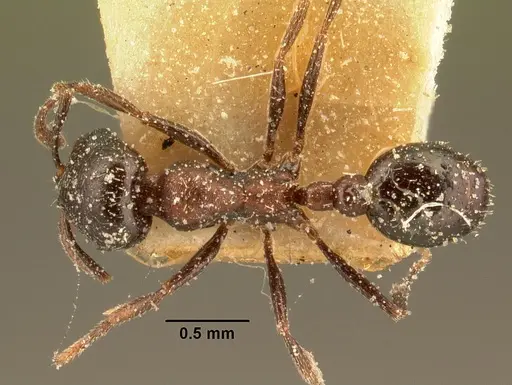
CASENT0101200
View on AntWeb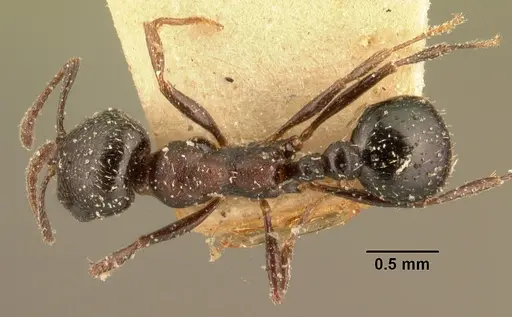
CASENT0913240
View on AntWeb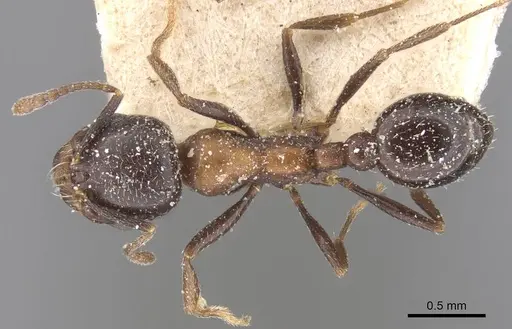
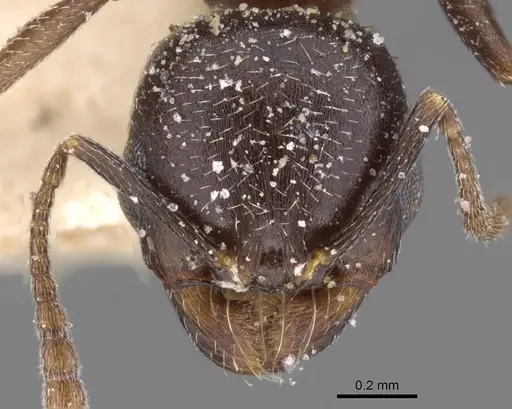
CASENT0916947
View on AntWeb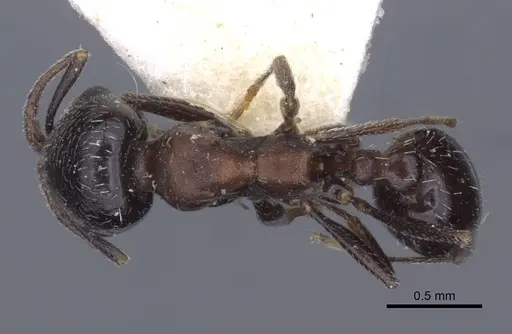
Literature
Loading distribution map...Loading products...