
Odontomachus mormo
- Sci. Name
- Odontomachus mormo
- Tribe
- Ponerini
- Subfamily
- Ponerinae
- Author
- Brown, 1976
- Distribution
- Found in 2 countries
Introduction
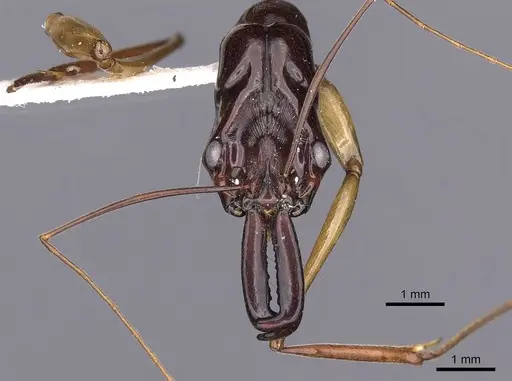
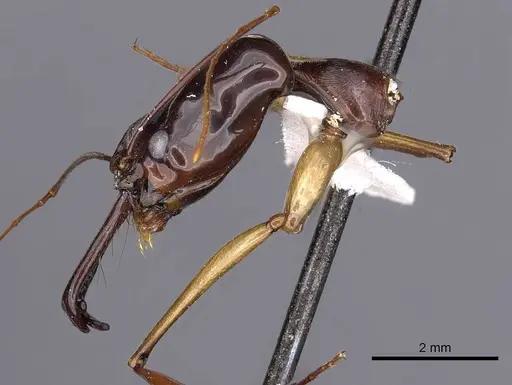
Odontomachus mormo is one of the largest trap-jaw ants in the Americas, with workers reaching up to 19.5mm in total length . These striking ants have a dark reddish-brown body with distinctive dull yellow coxae and femora, and display a subtle bluish iridescence on their smooth, shining body surface. Originally described from Ecuador in 1976,this species is now known to range through the Andean foothills of western Ecuador and Colombia, where it inhabits wet forest ravines at elevations between 515 and 1,700 meters . This rare species stands out among trap-jaw ants for its impressive size and almost hairless body, unlike many related species, most of its body has no erect hairs, with only a few scattered long hairs on the head and the tip of the gaster . It was originally mistaken in the field for a large specimen of Odontomachus chelifer, before being recognized as distinct . The species is considered rare with specialized feeding habits and may be sensitive to habitat disturbance .
Quick Summary
- Difficulty: Medium
- Origin & Habitat: Wet forest ravines in the Andean foothills of Colombia and Ecuador, at elevations from 515 to 1,700 meters [2][3]. Found in humid, shaded ravine environments with deep leaf litter.
- Colony Type: Colony structure is unconfirmed. Based on related Odontomachus species, likely single-queen (monogyne) colonies.
- Size & Growth:
- Queen: Undescribed, workers are 18.5-19.5mm total length [1]
- Worker: 18.5-19.5mm total length [1]
- Colony: Unknown, likely moderate sized colonies based on related species
- Growth: Moderate, estimated based on genus patterns
- Development: Estimated 8-12 weeks at optimal temperature based on related Odontomachus species (Development time inferred from genus patterns, direct data not available for this species)
- Antkeeping:
- Temperature: Based on its natural habitat in moderate-altitude Andean foothills, aim for 22-26°C [2]. Provide a temperature gradient allowing workers to choose their preferred zone.
- Humidity: Keep the nest substrate consistently moist but not waterlogged. The natural habitat is wet forest ravines, so aim for high ambient humidity. Provide a moist nesting area with good drainage.
- Diapause: Likely a mild winter slowdown. Reduce feeding and temperatures slightly during cooler months, but full hibernation is probably unnecessary given the tropical/subtropical range.
- Nesting: Ground-nesting species that requires a moist, well-drained substrate. A naturalistic setup with deep soil or a plaster/Ytong nest with water reservoir works well. Provide a water source in the outworld.
- Behavior: Trap-jaw ants with powerful mandibles used to capture prey. Workers are relatively slow-moving compared to many ants, which matches their ground-hunting predatory lifestyle. They are primarily predatory, hunting small invertebrates in the leaf litter. Their defense includes a painful sting (typical of Ponerines) and a strong bite from their trap-jaw mandibles. They are not aggressive toward keepers but will defend if handled. Escape prevention should be moderate, their large size makes them easier to contain than tiny ants, but they are capable climbers. This species is rare in the wild, so captive colonies are difficult to obtain and should be propagated responsibly.
- Common Issues: rare species in the wild, captive colonies are difficult to obtain and should be propagated responsibly, sensitive to dry conditions, colonies fail quickly if humidity drops too low, slow growth compared to many common ant species, requires patience, predatory feeding requirements mean they need a constant supply of live prey, habitat disturbance sensitive, wild-caught colonies may struggle in captivity
Natural History and Distribution
Odontomachus mormo is a rare trap-jaw ant found only in the Neotropical region of Colombia and Ecuador. The species was first described in 1976 by William L. Brown from specimens collected in wet forest ravines in the Andean foothills. In Colombia, it has been recorded in the departments of Valle del Cauca, Caldas, Tolima, and Antioquia, at elevations ranging from 515 to 1,700 meters above sea level [2][7]. The species prefers humid ravine environments in wet forests, where it forages slowly along the ground in shaded areas. It is one of the largest ant species in Colombia and one of the largest trap-jaw ants in the entire Americas, rivaled only by Odontomachus chelifer and the recently described Odontomachus davidsoni [5][2]. The species appears to have specialized feeding habits and may be sensitive to habitat disturbance, making it vulnerable to environmental changes [6].
Identification and Morphology
This is an unmistakable species due to its large size and distinctive appearance. Workers measure 18.5-19.5mm in total length, making them among the largest Odontomachus workers in the world [1]. The head is broad with long, powerful mandibles equipped with the trap-jaw mechanism. The body is mostly dark reddish-brown, with the gaster being darker (piceous), while the coxae and femora are a distinctive dull yellow. One of the most distinguishing features is the almost complete lack of erect hairs on most of the body, unlike its relative Odontomachus hastatus, which has abundant fine hairs, O. mormo is nearly hairless except for a few long hairs on the head and at the tip of the gaster [4][5]. The body surface is smooth and shining with a subtle bluish iridescence. The petiole has a distinctive shape with a concave anterior face and a blunt projection at the node [1].
Housing and Nesting
As a ground-dwelling species from wet forest habitats, O. mormo requires a moist, humid nest environment. A naturalistic setup with a deep soil layer works well, or you can use a plaster or Ytong formicarium with a water reservoir to maintain humidity. The nest should have chambers large enough for the colony to move freely, these are large ants that need space. Provide a water tube for drinking access. The outworld should be spacious enough for hunting and foraging. Since they are ground-nesters [2], ensure the substrate or nest material can retain moisture without becoming waterlogged. A layer of leaf litter in the outworld mimics their natural forest floor habitat and gives them surfaces to explore.
Feeding and Diet
Like all Odontomachus species, O. mormo is primarily predatory. They hunt small invertebrates including springtails, small beetles, and other tiny arthropods found in leaf litter. In captivity, offer a variety of small live prey such as fruit flies, small crickets, mealworms, and other appropriately sized insects. They are not sugar-dependent like some ants, though they may occasionally accept honey or sugar water. Feed them 2-3 times per week, offering prey items roughly smaller than their head width. Remove any uneaten prey after 24 hours to prevent mold. Freshly killed insects are often accepted if they are still moving or if you wiggle them to simulate live prey.
Temperature and Seasonal Care
Based on its natural habitat in the Andean foothills [2], maintain temperatures around 22-26°C. They do not need extreme heat, room temperature in this range is ideal. A slight temperature gradient in the setup allows workers to regulate their own body temperature. During cooler months, a slight reduction in temperature (by a few degrees) and reduced feeding mimics their natural seasonal cycle. However, given their tropical/subtropical origin, they likely do not require a true hibernation period. Monitor colony activity, if workers become less active and cluster together, this indicates they are entering a rest period.
Behavior and Handling
Odontomachus mormo workers are relatively slow-moving compared to many ant species, which reflects their ambush hunting strategy. They do not form raiding columns or exhibit aggressive swarming behavior. Their primary defense is their powerful trap-jaw mandibles, which they use to snap shut on threats, this can deliver a painful pinch. They also possess a functional sting typical of Ponerine ants. They are not aggressive toward keepers and will typically retreat rather than attack, but provoked individuals may bite or sting. Always handle with care and avoid provoking defensive responses. Their large size makes them relatively easy to contain, but ensure enclosures are secure as they are capable climbers.
Frequently Asked Questions
How long does it take for Odontomachus mormo to produce first workers?
The exact timeline is unconfirmed for this species, but based on related Odontomachus species, expect 8-12 weeks from egg to first worker at optimal temperature (around 24°C). Growth is moderate, these are large ants that take time to develop.
Can I keep multiple queens together?
Combining unrelated queens of this species has not been documented. Based on typical Odontomachus behavior, it is likely single-queen colonies. It is not recommended to house multiple foundresses together as they may fight.
What do Odontomachus mormo ants eat?
They are primarily predatory, eating small live invertebrates. Offer small insects like fruit flies, small crickets, and mealworms. They may accept sugar water occasionally but do not rely on it as a food source.
Are Odontomachus mormo good for beginners?
This species is rated as medium difficulty. While not the most challenging ant to keep, it requires specific conditions (high humidity, live prey) that make it less ideal for complete beginners. Their rarity also makes them a species for more experienced keepers.
What temperature and humidity do they need?
Keep temperatures at 22-26°C with high ambient humidity, keep the nest substrate consistently moist but not waterlogged. They come from wet Andean forests, so the nest must stay moist. Provide a humidity gradient if possible.
How big do Odontomachus mormo colonies get?
Colony size is not well documented for this rare species. Based on related species, colonies likely reach several hundred workers at maximum. They are not known for supercolony formation.
Where is Odontomachus mormo found in the wild?
This is a rare species found only in the Andean foothills of Colombia and Ecuador, at elevations between 515 and 1,700 meters. They inhabit wet forest ravines in humid, shaded areas.
Report an Issue
The current care sheet is based fully on literature. See inconsistencies, or something that's incorrect? Please , it will be resolved after review from an admin. Contributing to the blogs tab also helps providing information, to make us be able to further improve the caresheets. Thank you for your support!
References

This caresheet is licensed under CC BY-SA 4.0 .
Community Blogs
CASENT0900608
View on AntWeb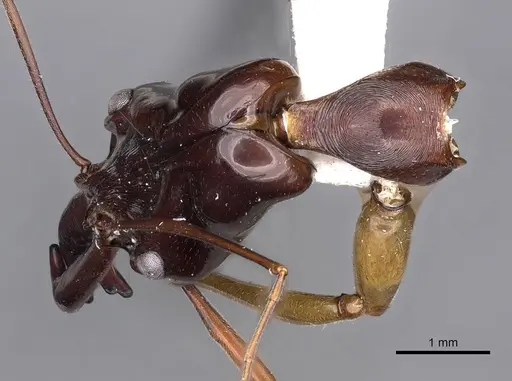
Literature
Loading distribution map...Loading products...