
Nesomyrmex simoni
- Sci. Name
- Nesomyrmex simoni
- Tribe
- Crematogastrini
- Subfamily
- Myrmicinae
- Author
- Emery, 1895
- Distribution
- Found in 1 countries
Introduction
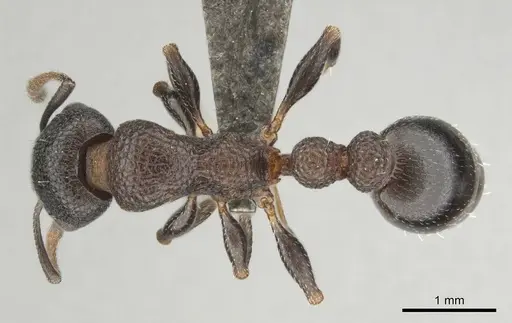
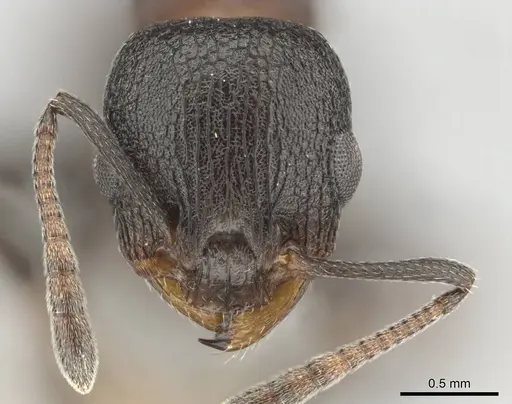
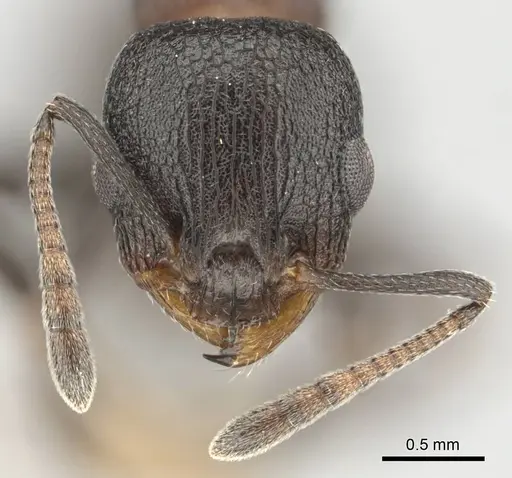
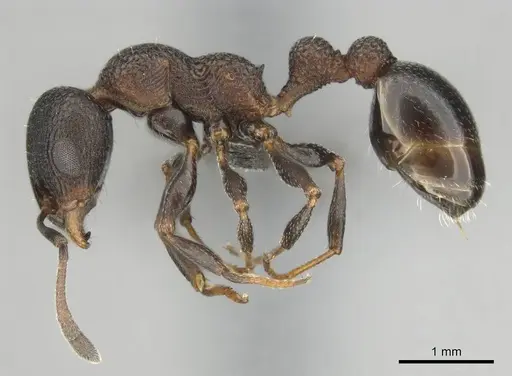
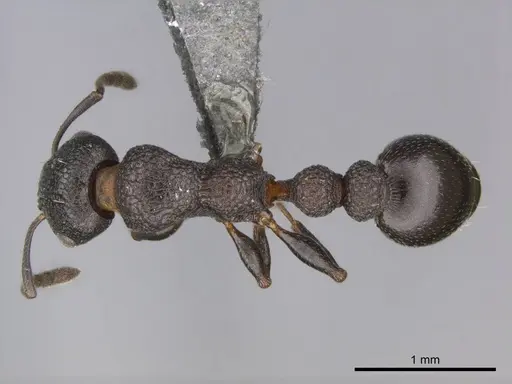
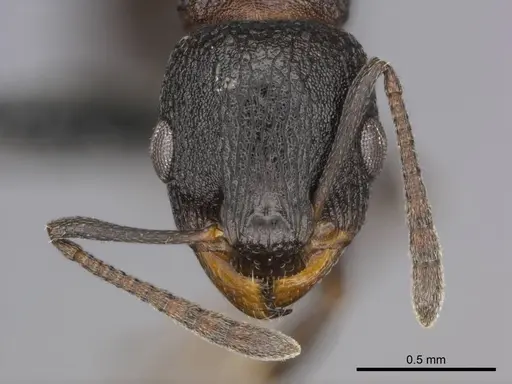
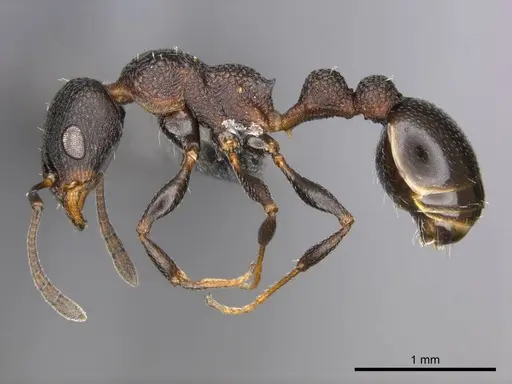
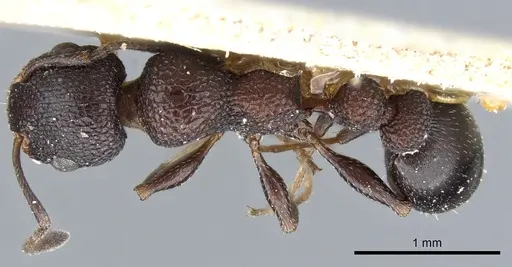
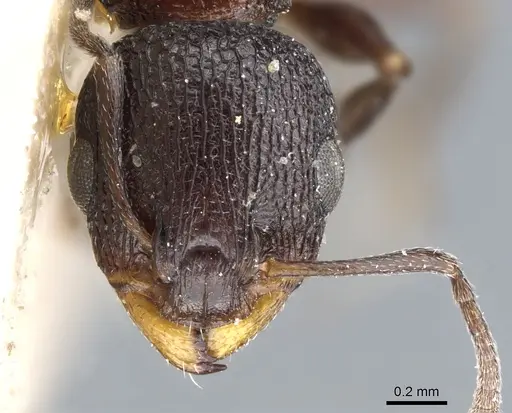
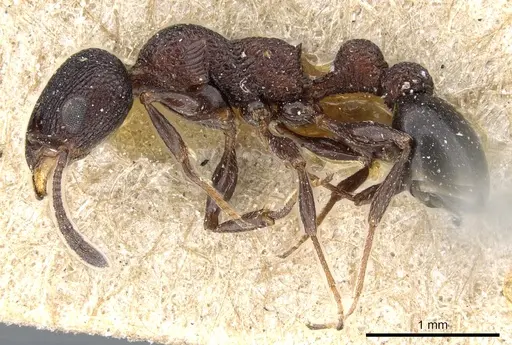
Nesomyrmex simoni is a medium-sized Myrmicine ant that's native to South Africa and belongs to the N. simoni species group. Workers are about 4.7 mm long , making them relatively large for the genus. They have a depressed propodeum armed with short teeth or spines, large eyes, and a rough, net-like (rugo-reticulate) sculpture on the head, body, and waist segment . Their color is dark brown with a reddish shine on the body, and the mandibles are yellow. This ant lives in savanna habitats, specifically the Pilanesberg Mountain Bushveld, and nests in the ground . It is endemic to South Africa and is the type species for the N. simoni group .
Quick Summary
- Difficulty: Unknown, likely Medium to Hard due to limited availability and data
- Origin & Habitat: South Africa (Afrotropical region), specifically Pilanesberg Mountain Bushveld savanna habitat [2][3]
- Colony Type: Colony structure is unconfirmed, no data on queen number or colony size in the wild
- Size & Growth:
- Queen: Unknown, queen size has not been documented in available literature
- Worker: 4.7 mm total length [1], Note: This measurement comes from Bolton (1982) and is the only full body length data available.
- Colony: Unknown, no colony size data available
- Growth: Unknown, no development data available
- Development: Unconfirmed, no direct measurements, typically Myrmicinae take around 6-10 weeks at optimal temperatures, but this is only a guess. (Development has not been studied for this species. Estimates based on related genera may not be accurate.)
- Antkeeping:
- Temperature: Keep around 22-26°C based on their South African savanna home. Provide a gentle temperature gradient so the colony can choose, and adjust based on activity.
- Humidity: Keep the nesting substrate moderately moist but allow some drying between waterings, aim for a moist but not soaked feel. [3]
- Diapause: Unknown, likely minimal or no true diapause given the subtropical climate of their range, but a slight winter rest might help.
- Nesting: Ground-nesting species [3]. Naturalistic setups with soil or sand substrate work well. Y-tong or plaster nests with moisture chambers are suitable. Provide moderate nesting humidity.
- Behavior: Temperament is not well documented, but related Nesomyrmex species are generally non‑aggressive and moderate in activity. They are ground‑nesting and likely forage individually or in small groups. Escape risk is moderate given their size – standard barrier methods work. As a member of the Myrmicinae subfamily (tribe Crematogastrini), their primary defense is a 'smear' venom: they wipe venom onto enemies with a flattened stinger rather than injecting it.
- Common Issues: very limited availability – this species is rarely in the hobby due to its restricted South African range, lack of captive care data means keepers must rely on inference from related species, ground‑nesting requires a suitable setup – test tubes alone may not work for established colonies, queen founding behavior is unconfirmed – you'll have to observe and adapt, wild‑caught colonies might carry parasites or suffer stress from collection and transport
Natural History and Distribution
Nesomyrmex simoni is endemic to South Africa, where it lives in savanna, specifically the Pilanesberg Mountain Bushveld vegetation [2]. It's a ground‑nesting species [3], and specimens have been collected using pitfall traps, which means it forages on the ground. The species was first described by Emery in 1895 as Nesomyrmex simoni, then moved through several genera (Tetramyrma, Leptothorax) before being placed in Nesomyrmex by Bolton in 2003 [1]. It belongs to the N. simoni species group and is the type species for that group [3]. Its closest relative is Nesomyrmex braunsi, which is larger and has unarmed propodeum [2].
Identification and Morphology
Workers of N. simoni are about 4.7 mm in total length [1]. Key features include a depressed propodeum (flattened compared to the front part of the body), short propodeal teeth/spines, large eyes (about 17-18 ommatidia in the longest row), and strong rugo‑reticulate (net‑like) sculpture on the head, body, and waist segment [2]. The petiolar node is massive and domed, with a small tooth‑like process underneath. The first gastral (abdominal) tergite lacks standing hairs, which helps separate it from similar species. Color is dark brown with a reddish tinge on the middle body and waist, and the mandibles are yellow [1].
Housing and Nesting
Because N. simoni nests in the ground [3], a naturalistic setup with a soil or sand substrate that lets them dig is best. A mix of soil and sand gives good structure for tunneling. For formicariums, plaster or Y‑tong nests with a moisture chamber work well – they let you control humidity and provide dark chambers. Given their size (4.7 mm), standard chamber sizes are fine. Keep part of the substrate moist but allow some to dry out to avoid waterlogging. The outworld should have enough substrate depth for digging, and you can add rocks or plants for a more natural look [3].
Feeding and Diet
There's no direct information on what N. simoni eats, but based on typical Myrmicinae behavior and related Nesomyrmex species, they're probably omnivorous. They likely eat small insects and other arthropods for protein, plus honeydew or sugary drinks. In captivity, offer a variety: small insects (fruit flies, tiny crickets, mealworms), sugar water or honey, and maybe seeds if they show interest. Give protein 2‑3 times a week and keep sugar water available. Remove uneaten prey after a day or two to stop mold. Because they forage on the ground, put food on the substrate in the foraging area.
Temperature and Seasonal Care
Based on their South African savanna home, N. simoni probably likes warmth around 22‑26°C. Give them a temperature gradient so they can choose – a heating cable on one side creating a warm zone near 26°C and cooler areas around 22°C works well. Watch what they do: if workers crowd around the heat, raise it a little, if they avoid it, turn it down. Their native range has mild winters, so a true deep diapause probably isn't needed. But you could try a slight winter cool‑down (about 18‑20°C for 2‑3 months) to match natural cycles. Cut back feeding during that time.
Colony Establishment and Founding
How queens start colonies is unknown for this species. Based on typical Myrmicinae patterns, they probably do claustral founding – the queen seals herself in a chamber and lives off her stored fat until the first workers appear. But that's not confirmed. If you get a founding queen, put her in a small test‑tube setup with moist (not wet) cotton, keep it dark, and don't disturb her for at least 4‑6 weeks. Once the first tiny workers (nanitics) show up, start offering small protein foods little by little. Move them to a bigger nest only when the colony has maybe 20‑30 workers and seems to be outgrowing the tube.
Frequently Asked Questions
How do I identify Nesomyrmex simoni ants?
Workers are about 4.7 mm long, with a depressed propodeum that has short spines, large eyes, and coarse net‑like sculpture on the head, body, and waist. They lack standing hairs on the first gastral tergite. Color is dark brown with a reddish shine on the middle body, mandibles are yellow. [2][1]
Where is Nesomyrmex simoni found in the wild?
It's only found in South Africa, specifically in the Pilanesberg Mountain Bushveld savanna. It nests in the ground. [2][3]
Is Nesomyrmex simoni available for antkeepers?
This species is very rare in the hobby. It has a small range in South Africa and isn't commonly collected or exported. If you want to keep it, you'd likely need to find wild‑caught queens during their nuptial flights, but the flight timing isn't documented. [4]
What temperature should I keep Nesomyrmex simoni at?
Aim for 22‑26°C, with a gradient so they can pick their spot. A heating cable on one side making a warm zone ~26°C and cooler ~22°C area is a good start. Watch how they react and adjust.
What do Nesomyrmex simoni ants eat?
There's no specific data, but they're probably omnivorous like most Myrmicinae. Offer small insects (fruit flies, tiny crickets, mealworms) 2‑3 times a week and keep sugar water or honey available. Remove uneaten prey after 24‑48 hours.
How long does it take for Nesomyrmex simoni to raise first workers?
The development time hasn't been studied. Based on general Myrmicinae patterns, it might take 6‑10 weeks from egg to first worker at good temperature, but that's just an estimate. Actual timing could be different.
What type of nest should I use for Nesomyrmex simoni?
Since they nest in the ground [3], a naturalistic setup with soil or sand substrate works great. Plaster or Y‑tong nests with moisture chambers are also suitable. Give them enough depth to dig and keep the substrate moderately moist but not waterlogged. [3]
Do Nesomyrmex simoni ants sting?
Sting data isn't recorded for this species. As Myrmicinae, they can sting, but they use a 'smear' defense – they wipe venom onto enemies with a flattened stinger rather than stabbing. The venom is likely not significant to humans. Use normal caution when handling.
Can I keep multiple Nesomyrmex simoni queens together?
It's unknown if they are monogyne or polygyne. Without data on natural colony structure, it's risky to combine unrelated queens. If you get multiple founding queens, house them separately until you learn more about their behavior.
Does Nesomyrmex simoni need hibernation?
Diapause needs are unknown. Since their native South Africa has mild winters, a true deep hibernation may not be needed. But a slight winter cool‑down to around 18‑20°C for 2‑3 months might be helpful to mimic natural cycles. Reduce feeding during that time.
Report an Issue
The current care sheet is based fully on literature. See inconsistencies, or something that's incorrect? Please , it will be resolved after review from an admin. Contributing to the blogs tab also helps providing information, to make us be able to further improve the caresheets. Thank you for your support!
References

This caresheet is licensed under CC BY-SA 4.0 .
Community Blogs
Literature
Loading distribution map...Loading products...