
Myrmoteras bakeri
- Sci. Name
- Myrmoteras bakeri
- Subgenus
- Myagroteras
- Tribe
- Myrmoteratini
- Subfamily
- Formicinae
- Author
- Wheeler, 1919
- Distribution
- Found in 2 countries
Introduction
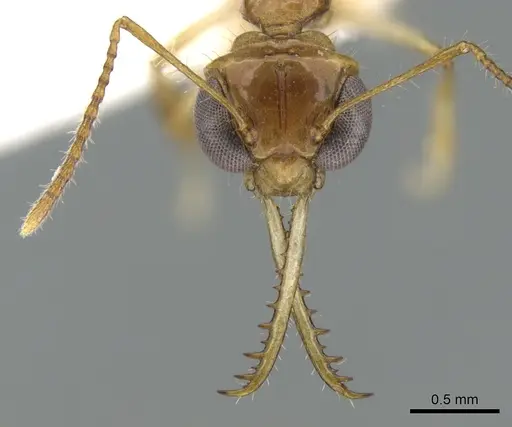
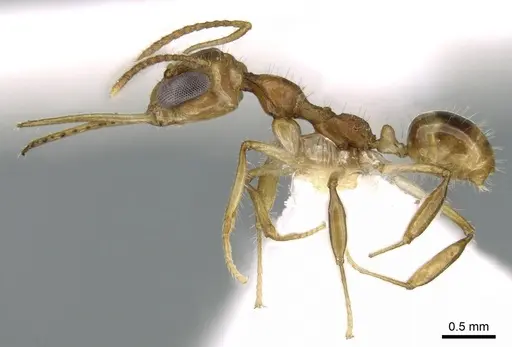
Myrmoteras bakeri is a small ant species belonging to the subfamily Formicinae. Workers measure approximately 4.6mm in total length, with a distinctive yellowish-orange coloration throughout the body, while the gaster appears darker. The legs are notably pale with femora and coxae nearly white. This species is distinguished by its strongly dilated tibiae and mandibles bearing 11-12 teeth with two tiny apical denticles. The species is native to Southeast Asia, specifically found in Borneo, Indonesia, Malaysia, and Singapore, where it inhabits rainforest and wet forest environments . The genus Myrmoteras belongs to the tribe Myrmoteratini and is known for its specialized mandible structure. This species is part of the bakeri group, characterized by the absence of a wide sulcus between the clypeus and frons, and relatively dilated tibiae. Despite being described nearly a century ago, Myrmoteras bakeri remains one of the lesser-studied ant species in Southeast Asia, with limited information available on its colony structure, behavior, and captive care requirements.
Quick Summary
- Difficulty: Expert
- Origin & Habitat: Native to Borneo, Indonesia, Malaysia, and Singapore in the Indomalaya region. Inhabits rainforest and wet forest environments [1].
- Colony Type: Colony structure is unconfirmed. No data available on whether this species is monogyne or polygyne.
- Size & Growth:
- Queen: Approximately 4.2mm total length [1].
- Worker: Workers measure approximately 4.6mm total length [1].
- Colony: Unknown. No colony size data available for this species.
- Growth: Unknown. No development timing data exists for this species.
- Development: Unconfirmed. No direct measurements exist. (Development timeline has not been studied for this species.)
- Antkeeping:
- Temperature: Unconfirmed. Based on its rainforest/wet forest habitat in tropical Southeast Asia, likely requires warm, stable conditions around 24-28°C. This is an inference from habitat, not direct thermal studies.
- Humidity: Unconfirmed. Rainforest species typically require high humidity. Keep nest substrate consistently moist but not waterlogged. This is inferred from habitat description, not direct studies.
- Diapause: Unknown. Tropical rainforest ants may not require a true diapause, but seasonal activity patterns have not been studied.
- Nesting: Unconfirmed. Based on habitat, likely nests in soil, rotting wood, or under stones in damp substrates. A naturalistic setup with moist substrate or a Y-tong/plaster nest with good humidity retention would be appropriate.
- Behavior: Behavior is largely unstudied. As a Formicinae ant, they can produce formic acid as a defense. The genus Myrmoteras is not well-documented in terms of aggression or foraging behavior. Workers are approximately 4.6mm, standard escape barriers should work.
- Common Issues: lack of species-specific care information makes proper husbandry challenging, humidity requirements are inferred rather than confirmed, no data on acceptable food items, tropical species may be sensitive to temperature fluctuations, extremely limited availability in the antkeeping hobby
Species Identification and Appearance
Myrmoteras bakeri workers are small ants measuring approximately 4.6mm in total length. They have a distinctive appearance with a uniform yellowish-orange coloration throughout the body, while the gaster appears darker. The legs are notably pale, femora and coxae are virtually white, while the tibiae are strongly dilated, which is a key identifying feature of this species. The mandibles possess 11-12 teeth along with two tiny apical denticles at the tip. Queens measure approximately 4.2mm. The species can be distinguished from other Myrmoteras in the bakeri group by the absence of a wide sulcus between the clypeus and frons, and the relatively dilated tibiae [1].
Distribution and Natural Habitat
This species is found across the Indomalaya region, specifically in Borneo, Indonesia, Malaysia, and Singapore. Specimens have been collected from rainforest and wet forest environments, indicating a preference for humid, shaded tropical habitats. The distribution data comes from regional taxon records and specimen collections, though the species is not considered common in ant surveys. A single individual was recorded in a 2021 survey in the Biological Education and Research Forest of Universitas Andalas in Indonesia, suggesting low population density or specialized microhabitat preferences [2].
Current State of Knowledge
Myrmoteras bakeri represents one of the many ant species for which basic biological information remains undocumented. The species was first described by Wheeler in 1919 based on specimens from Borneo, and subsequent taxonomic work by Moffett in 1985 and Agosti in 1992 has refined our understanding of its identification and distribution. However, fundamental aspects of its biology, including colony structure, founding behavior, development timeline, diet preferences, and behavioral patterns, have not been the subject of scientific study. This is not unusual for many tropical ant species, which often receive less research attention than more widespread or economically significant species. For antkeepers, this means starting from a position of limited direct evidence and relying heavily on inference from related species and general ant biology. [1]
Inferred Care Requirements
Given the lack of species-specific data, care recommendations must be based on inference from the species' known habitat and what is understood about related Formicinae ants. The rainforest and wet forest habitat suggests this species requires high humidity and stable warm temperatures. Nesting preferences are unknown but likely include soil or rotting wood in damp conditions. As a Formicinae, this species can produce formic acid for defense, though the potency and likelihood of use is unstudied. Feeding preferences are entirely unknown. Any captive care should be considered experimental and documented carefully to contribute to our understanding of this species.
Availability and Collection
Myrmoteras bakeri is not commonly available in the antkeeping hobby. The species is rarely encountered in surveys and appears to have a limited distribution within Southeast Asia. There are no documented cases of this species being kept in captivity by hobbyists, and no commercial sources are known. For those interested in keeping this species, acquisition would likely require field collection in its native range, which would require appropriate permits and permissions. The lack of availability also means there is no established body of husbandry knowledge within the antkeeping community.
Frequently Asked Questions
Is Myrmoteras bakeri available for purchase in the antkeeping hobby?
No, Myrmoteras bakeri is not known to be available in the antkeeping hobby. This species has never been documented as being kept in captivity and is rarely collected even in scientific surveys. Its limited distribution in Borneo, Indonesia, Malaysia, and Singapore and the single individual recorded in recent surveys suggest wild colonies are difficult to locate.
What do Myrmoteras bakeri ants eat?
The diet of Myrmoteras bakeri has not been documented. As a Formicinae ant, they may have varied dietary preferences similar to other ants in this subfamily, but no specific observations exist. Feeding in captivity would be entirely experimental.
How do I care for Myrmoteras bakeri ants?
Care requirements are unconfirmed for this species. Based on its rainforest habitat, provide high humidity and warm temperatures around 24-28°C. Use a naturalistic setup with moist substrate or a plaster/Y-tong nest that retains humidity. This represents informed speculation rather than established husbandry practices.
What is the colony size of Myrmoteras bakeri?
Colony size is unknown. No data exists on typical or maximum colony sizes for this species in the wild or in captivity.
Does Myrmoteras bakeri need hibernation or diapause?
Diapause requirements are unknown. As a tropical rainforest species from Southeast Asia, it likely does not require a true hibernation period, though activity may reduce during drier seasons. This is unconfirmed.
How long does it take for Myrmoteras bakeri to develop from egg to worker?
Development timeline is unconfirmed. No direct measurements exist for this species.
Can I keep multiple Myrmoteras bakeri queens together?
Colony structure is unconfirmed for this species. No data exists on whether single-queen or multi-queen colonies occur naturally, or whether multiple foundress queens can be combined successfully.
What is the queen size of Myrmoteras bakeri?
Queens measure approximately 4.2mm in total length, based on the original species description. This is similar in size to the workers, which is unusual as queens are typically larger than workers in most ant species [1].
Is Myrmoteras bakeri suitable for beginners?
No. This species is not suitable for beginners due to the complete lack of established husbandry information. The extreme scarcity of this species in the wild and hobby also means there are no experienced keepers to consult. This would be an expert-level experimental species at best.
What temperature should I keep Myrmoteras bakeri at?
Temperature requirements are unconfirmed. Based on its tropical rainforest habitat in Southeast Asia, aim for warm, stable conditions around 24-28°C. This is an inference from habitat, not direct thermal studies.
Where does Myrmoteras bakeri live?
Myrmoteras bakeri is found in Borneo, Indonesia, Malaysia, and Singapore. It inhabits rainforest and wet forest environments, indicating preference for humid, shaded tropical habitats at ground level [1].
Report an Issue
The current care sheet is based fully on literature. See inconsistencies, or something that's incorrect? Please , it will be resolved after review from an admin. Contributing to the blogs tab also helps providing information, to make us be able to further improve the caresheets. Thank you for your support!
References

This caresheet is licensed under CC BY-SA 4.0 .
Community Blogs
CASENT0906285
View on AntWeb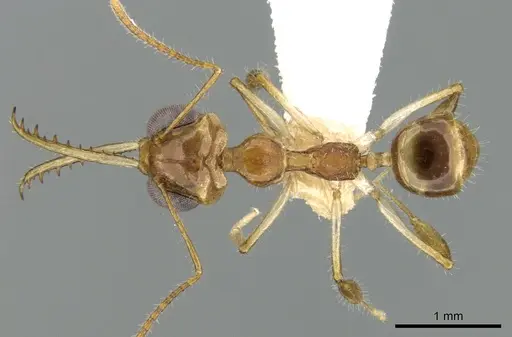
Literature
Loading distribution map...Loading products...