
Myopias shivalikensis
- Sci. Name
- Myopias shivalikensis
- Tribe
- Ponerini
- Subfamily
- Ponerinae
- Author
- Bharti & Wachkoo, 2012
- Distribution
- Found in 1 countries
Introduction
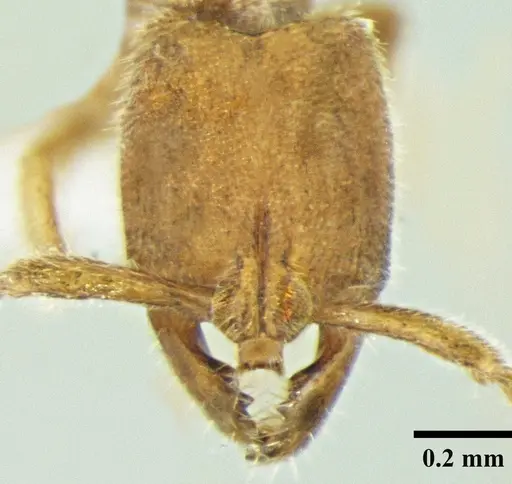
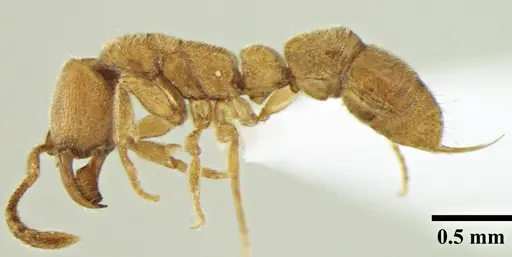
Myopias shivalikensis is a tiny, blind ponerine ant that lives only in the Shivalik range of Northwest Himalaya in India. Workers are just 2.9 mm long and have a brownish orange color . This species never comes to the surface – it spends its whole life underground. Its eyes have shrunk to tiny black dots that don't work . The head is shaped like a rounded rectangle with a deep notch at the back, and the jaws have four teeth with the front tooth the longest . The only known worker was found in loose, moist soil next to a shady lake at 700 m in Jammu and Kashmir . Because only one specimen has ever been collected (in 2009), this is one of the rarest and least‑studied ants in the world.
Quick Summary
- Difficulty: Expert
- Origin & Habitat: Endemic to the Shivalik range of Northwest Himalaya in India, recorded only from Jammu and Kashmir, Surinsar (32.7009°N,75.1512°E) at 700 m elevation [1][3]. The single specimen was found in loose, moist soil along a shady lakeside – this ant lives entirely underground (hypogaeic) [1].
- Colony Type: Unconfirmed. Only one worker has ever been found. Based on related Myopias species and general ponerine biology, colonies are probably small, with one queen.
- Size & Growth:
- Queen: Unknown – no queen specimens exist [1].
- Worker: 2.9 mm total length (TL) [1].
- Colony: Unknown – only one worker ever collected. Based on related small ponerines, likely under 100 workers.
- Growth: Unknown – no captive data. Estimated slow due to cryptic lifestyle and small body size.
- Development: Unknown. Based on typical ponerine development at warm temperatures, roughly 8–12 weeks. (No direct info. Ponerines generally develop slower than many formicines. Temperature likely plays a big role.)
- Antkeeping:
- Temperature: Estimated 22–26°C based on related Myopias and the warm temperate climate of its range. Provide a gentle thermal gradient so the colony can choose.
- Humidity: Requires high humidity – the natural habitat is loose, moist soil [1]. Keep the nesting area consistently damp but not waterlogged. Offer a moisture gradient with damp substrate on one side.
- Diapause: Likely yes. Found at 700 m in northern India, which has distinct winters. Estimated 2–3 months of reduced activity at 10–15°C during winter.
- Nesting: Hypogaeic (ground‑dwelling) species that nests in loose, moist soil [1]. In captivity, use a naturalistic setup with moist soil or a plaster/Y‑tong/3D‑printed nest with high humidity chambers. Avoid dry conditions. Chambers must be small and tight to match the ant’s tiny size [1].
- Behavior: This blind, cryptobiotic ant forages and lives entirely underground [1]. Workers are likely slow‑moving and rely on chemical cues, not sight. Temperament is unknown, but most ponerines are predatory and may sting if handled. The worker has a long, sharp, up‑curved sting [1]. Escape risk is HIGH because workers are tiny (2.9 mm) and can slip through very small gaps – extra care is needed to seal all openings. Because they rarely come to the surface, you might not notice an escape until it's too late. Handle with extreme caution due to their specialized needs and extreme rarity [1].
- Common Issues: extreme rarity – only one specimen ever found, practically impossible to obtain [1]., no captive breeding data – expect heavy trial and error to raise a colony., hypogaeic lifestyle means they almost never come to the surface, making feeding and observation difficult., blind species – prey may need to be placed directly in nest chambers because they won't hunt by sight., high humidity requirements promote mold – you must balance ventilation carefully., slow growth and tiny colony size make them very fragile and sensitive to disturbance., tiny size (2.9 mm) makes escape very easy – the smallest gaps must be sealed.
Species Discovery and Rarity
Myopias shivalikensis was described in 2012 from a single worker collected in Jammu and Kashmir, India [1]. This makes it one of the world's rarest ant species – no captive population exists. The specimen was found during intensive ant surveys using the soil core method, the only way to detect these deeply underground ants [1]. The name 'shivalikensis' honors the Shivalik mountain range where it was found. This discovery was important because it extended the known range of the genus Myopias to mainland India (the genus had only been known from Southeast Asia) [1]. Because only one specimen exists, keeping this ant in captivity is purely theoretical – there are no queens, no colonies, and no specimens available to antkeepers.
Identification and Morphology
Workers are tiny at just 2.9 mm total length [1]. The most striking feature is the loss of functional eyes – they appear as tiny black dots with no visible facets, making this a blind species [1]. The head is longer than wide, with a deep notch at the back (strongly emarginate occiput) [1]. The jaws (mandibles) project forward and have four teeth: a long front tooth, a second tooth, and two blunt teeth further back [1]. The middle of the face (clypeus) has a trapezoidal lobe with a distinctive protruding tooth at each front corner – this helps tell it apart from the similar M. nops [1]. Antennae have 12 segments with a 4‑segmented club [1]. The waist segment (petiole) is rectangular and has a large downward‑pointing process [1]. The rear body (gaster) is elongated, and the sting is long, sharp, and curves upward – a typical ponerine weapon [1]. The whole body is brownish orange [1].
Natural Habitat and Ecology
The only known specimen was found at 700 m elevation in the Shivalik range of Northwest Himalaya [1]. The collection site was Surinsar in Jammu and Kashmir, beside a small shady lake with loose, moist soil [1]. This microhabitat points to a preference for damp, shaded underground places – typical of hypogaeic ants [1]. The loose, moist soil likely allows this species to tunnel and forage below the surface. Being cryptobiotic (hidden‑living), the ant never appears above ground, which explains its extreme eye reduction [1]. The species is probably rare, both because of its specialized habitat and because it's so hard to find [1].
Care Requirements and Challenges
Keeping Myopias shivalikensis in captivity is extremely hard because there is no captive breeding data and the species has very specialized needs. Based on related Myopias and general ponerine biology, give them a naturalistic setup with loose, moist soil or a high‑humidity nest made of plaster, Y‑tong, or 3D‑printed material [1]. Keep the temperature around 22–26°C with a gentle gradient. Humidity must stay high – the natural habitat is moist lakeside soil [1]. They are predators, so they will likely need small live prey like springtails, micro‑arthropods, or tiny insects. Because they are blind and live underground, they probably won't come to the surface to hunt – you may need to place prey directly in their nest chambers. A winter diapause (2–3 months at 10–15°C) is probably necessary given their temperate origin. This species is absolutely not for beginners – no care protocols exist and specimens are effectively unavailable [1].
Comparison with Similar Species
Myopias shivalikensis is most like Myopias nops, another cryptobiotic species with tiny eyes and small body size [1]. They differ in several ways: M. shivalikensis has two protruding teeth on the front corners of the clypeus (M. nops lacks these), a strongly notched occipital margin, eyes that appear as clear black dots (M. nops has barely visible eyes hidden in the surface sculpture), longer mandibles (0.53 mm vs. 0.42 mm), and sharp front teeth (M. nops has a blunt second tooth) [1]. The genus Myopias has about 10 known species across Southeast Asia and India, all of them cryptic, ground‑dwelling predators [1][2].
Frequently Asked Questions
Is Myopias shivalikensis available for purchase?
No. Only one specimen has ever been found (in 2009). There are no captive‑bred colonies and no suppliers. This species is essentially impossible to obtain [1].
How do I keep Myopias shivalikensis?
No established care guides exist. Based on related species, use a moist soil or plaster nest at 22–26°C with high humidity. Offer small live prey directly in the nest. This species should not be attempted – no specimens are available and the biology is unknown.
Does Myopias shivalikensis have eyes?
No. The eyes are reduced to non‑functional black dots. This is a completely blind species [1].
What does Myopias shivalikensis eat?
Unknown for this species, but based on related Myopias and ponerines, they are predators of small soil arthropods. In captivity they would likely accept springtails, micro‑arthropods, and tiny insects.
How big do Myopias shivalikensis colonies get?
Unknown. Only one worker has ever been found. Related small ponerines usually have fewer than 100 workers.
Where is Myopias shivalikensis found?
This species is endemic to the Shivalik range of Northwest Himalaya in India, recorded only from Jammu and Kashmir at Surinsar,700 m elevation [1][3].
Is Myopias shivalikensis a good species for beginners?
No. It is not suitable for anyone – there are no specimens, no captive breeding data, and the species has highly specialized, unstudied requirements [1].
Does Myopias shivalikensis need hibernation?
Likely yes. The species lives at 700 m in northern India, where winters are cool. A 2–3 month diapause at 10–15°C is estimated based on the climate.
Why is Myopias shivalikensis so rare?
It lives entirely underground (hypogaeic) and can only be found by soil core sampling [1]. It also seems to have a very restricted range in the Shivalik mountains [1].
Report an Issue
The current care sheet is based fully on literature. See inconsistencies, or something that's incorrect? Please , it will be resolved after review from an admin. Contributing to the blogs tab also helps providing information, to make us be able to further improve the caresheets. Thank you for your support!
References

This caresheet is licensed under CC BY-SA 4.0 .
Community Blogs
ANTWEB1008035
View on AntWeb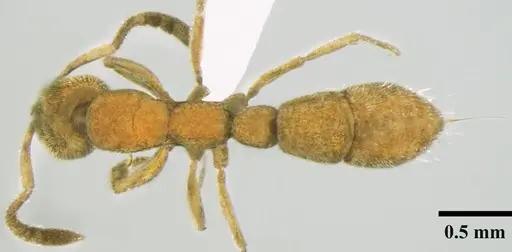
Literature
Loading distribution map...Loading products...