
Mycetomoellerius holmgreni
- Sci. Name
- Mycetomoellerius holmgreni
- Tribe
- Attini
- Subfamily
- Myrmicinae
- Author
- Wheeler, 1925
- Distribution
- Found in 2 countries
Introduction
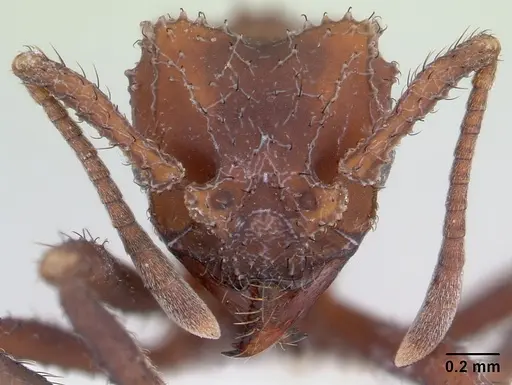
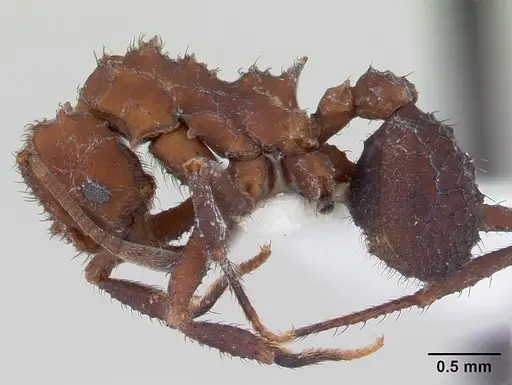
Mycetomoellerius holmgreni is a fungus-growing ant native to the southern Neotropics, ranging from Argentina's Misiones Province through Bolivia, Paraguay, and into northern Brazil . Workers measure 4.1-4.5mm and queens reach 5.6-5.9mm in total length . This species belongs to the Iheringi group and is distinguished by the shape of lobes on their antennal scapes and specific spine arrangements on their petiolar node . Unlike typical ants, these fungus farmers cultivate a lower-attine fungus for food, using grass clippings and other plant material as substrate . Their nests feature a distinctive turret built from grass, straw, and sand at the entrance . What makes M. holmgreni particularly interesting is their seasonal investment strategy: colonies produce more winged reproductives in autumn for nuptial flights, then shift to building fungus chambers and immature numbers in spring to fuel growth through summer . They are considered agricultural pests in some areas because they cut fresh grass leaves for their fungal gardens . This is an expert-level species because, like all Attini, they require a living fungal culture rather than conventional ant food.
Quick Summary
- Difficulty: Expert
- Origin & Habitat: Native to the southern Neotropics, Argentina, Bolivia, Brazil, and Paraguay. Found in diverse habitats including savanna, forest, restinga (coastal sand dunes), and dune environments [1].
- Colony Type: Single-queen colonies (monogyne). Colonies contain 294-581 workers with 20-107 pupae,8-41 larvae, and 4-54 alate females [1].
- Size & Growth:
- Queen: 5.6-5.9mm [1]
- Worker: 4.1-4.5mm [1]
- Colony: Up to ~600 workers [1]
- Growth: Moderate, seasonal investment patterns with faster growth in spring/summer [1]
- Development: Development timeline unconfirmed, likely several months given typical Attini patterns (Development is temperature-dependent. Seasonal patterns show more immature individuals in spring.)
- Antkeeping:
- Temperature: Keep at 24-28°C. These are Neotropical ants from warm regions, provide a temperature gradient allowing workers to regulate
- Humidity: Require moderate to high humidity. Keep nest substrate consistently moist but not waterlogged. The fungus garden needs damp conditions to thrive
- Diapause: Unknown, no specific diapause research. However, seasonal data suggests reduced activity in winter months when colonies invest in nest establishment rather than growth [1]
- Nesting: Soil nests in sandy substrates. In captivity, use a naturalistic setup with sandy soil mix. Provide grass clippings or similar plant material for fungus substrate [2]
- Behavior: Generally non-aggressive and not known for stinging. Workers do not feign death when disturbed, unlike many related species [1]. They are active foragers that cut fresh grass and collect other plant material to cultivate their fungal gardens. Escape risk is moderate, standard barrier methods work well for workers in the 4-5mm range. They are daytime foragers and maintain fungus gardens in multiple underground chambers [1].
- Common Issues: Fungus garden collapse is the biggest risk, without healthy fungus, the colony will starve. Never let the fungus dry out or mold over., Colonies often fail because keepers try to feed them conventional ant food. They need living fungus, not sugar water or protein insects., Overheating or drying out kills both the ants and their fungus quickly. Maintain consistent moisture., Wild-caught colonies may carry parasites that can devastate captive colonies., Slow growth frustrates beginners, colonies invest heavily in fungus chambers before expanding population.
The Fungus-Growing Lifestyle
Mycetomoellerius holmgreni belongs to the tribe Attini, a group of ants that abandoned hunting and now cultivate fungi for food. This is one of the most complex agricultural systems in the animal kingdom. Unlike typical ants that eat protein and sugar, these ants feed their colony almost exclusively on the fungal garden they tend [2]. The workers cut fresh grass leaves (particularly Paspalum ancylocarpum) and other plant material, then carefully cultivate it into a fuzzy white mat that serves as the colony's primary food source [3][2]. The fungus breaks down the plant material into nutrients the ants can digest. This means you cannot keep M. holmgreni like regular ants, they need their fungus garden to survive. In captivity, you must provide fresh plant material regularly and maintain conditions that allow the fungus to thrive.
Nest Architecture and Housing
In the wild, M. holmgreni builds small soil nests in sandy areas with distinctive turreted entrances made from grass, straw, and sand [1]. A typical nest has 7 vertically arranged chambers, going from about 5cm deep down to 60cm. The fungus gardens are laminated and set vertically, with the queen typically residing in the fourth chamber [1]. For captivity, a naturalistic setup with a sandy soil mix works best. The nest should have multiple chambers connected vertically to mimic their natural architecture. A moisture reservoir or drip system helps maintain the damp conditions both the ants and their fungus need. Avoid completely dry environments, these ants come from habitats with moderate humidity.
Feeding and Fungus Care
This is the most critical aspect of keeping M. holmgreni. The colony needs a constant supply of fresh plant material for the fungus garden. Offer small pieces of fresh grass, leaves, or other plant matter regularly, roughly every few days [2]. The ants will cut these into smaller pieces and incorporate them into the fungal garden. Beyond plant material, they also collect herbivorous insect frass (droppings), grass seeds, and small flowers in the wild [2]. Do NOT offer sugar water, honey, or conventional ant bait, these can harm the fungus and are not part of their natural diet. Some keepers report their colonies will accept very small amounts of protein once the fungus is established, but plant material must always be available.
Temperature and Seasonal Care
As a Neotropical species from Argentina to Brazil, M. holmgreni prefers warm conditions. Keep the nest area at 24-28°C with a slight gradient so workers can move between temperatures. A heating cable on one side of the nest can help maintain warmth, but avoid direct heat that could dry out the fungus garden. The species shows clear seasonal patterns in the wild: autumn colonies have fewer fungus chambers but many winged ants (reproductive investment), while spring colonies have more fungus chambers and numerous immatures (growth investment) [1]. This suggests reduced activity in winter months. While specific diapause requirements are unconfirmed, you may notice slower growth during winter, this is normal and mirrors their natural cycle.
Colony Dynamics and Growth
Mature colonies reach approximately 300-600 workers with significant numbers of pupae, larvae, and seasonal alates (winged reproductives) [1]. The colony invests heavily in fungus chamber development during growth seasons, with the queen typically residing in deeper chambers. Unlike some ants that produce workers quickly, M. holmgreni seems to prioritize fungus garden expansion before rapid population growth. This means colonies may appear to grow slowly at first as they establish their fungal agriculture, this is normal behavior, not a problem. Colonies produce alates seasonally, with more winged reproductives appearing in autumn [1].
Report an Issue
The current care sheet is based fully on literature. See inconsistencies, or something that's incorrect? Please , it will be resolved after review from an admin. Contributing to the blogs tab also helps providing information, to make us be able to further improve the caresheets. Thank you for your support!
References

This caresheet is licensed under CC BY-SA 4.0 .
Community Blogs
CASENT0178106
View on AntWeb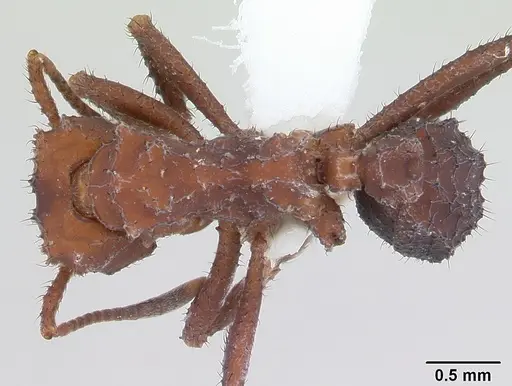
Literature
Loading distribution map...Loading products...