
Mycetomoellerius haytianus
- Sci. Name
- Mycetomoellerius haytianus
- Tribe
- Attini
- Subfamily
- Myrmicinae
- Author
- Wheeler & Mann, 1914
- Distribution
- Found in 2 countries
Introduction
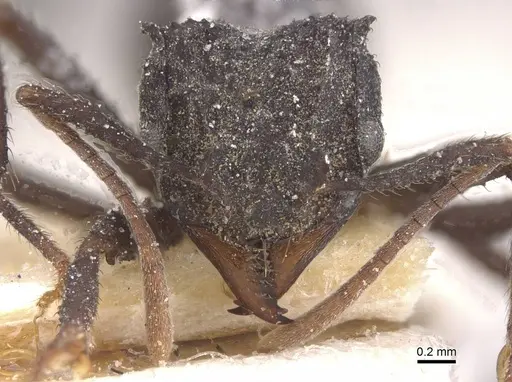
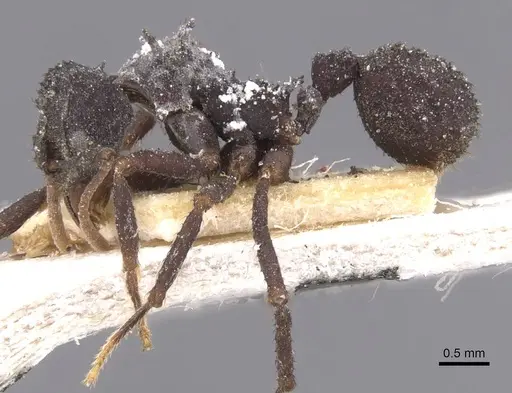
Mycetomoellerius haytianus is a small fungus-growing ant from the Caribbean islands Haiti and Jamaica. Workers measure 3.5 to 4.9 mm long and are dark ferruginous (rusty brown) or black, with lighter tips on their legs and antennae . Like all ants in the Attini tribe, they farm a specialized fungus as their main food source. This species belongs to the Jamaicensis group, which has a distinct 'open' look to the back of the head due to how the antennal grooves extend to the rear margin . Only workers have ever been found – queens and males remain unknown, making this one of the most mysterious ant species in the region. Their nest entrance is a simple hole in the ground without the usual crater rim .
Quick Summary
- Difficulty: Expert
- Origin & Habitat: Caribbean, only recorded from Haiti (Petionville) and Jamaica (St. Elizabeth, St. James) [1][4][5]. Collected in a canyon environment with the nest entrance directly on the ground surface, no crater [1].
- Colony Type: Unknown. Only workers have been collected, no information on queen number or social structure. Related Attini species are usually single-queen, but unconfirmed.
- Size & Growth:
- Queen: Unknown – queens have never been described [2]
- Worker: 3.5–4.9 mm [1][2]
- Colony: Unknown – only a single colony has ever been collected [1]. Related Trachymyrmex species can reach several hundred to a few thousand workers.
- Growth: Unknown
- Development: Unknown (No data. Tropical Attini species typically take 4–8 weeks at warm temperatures.)
- Antkeeping:
- Temperature: Keep warm,24–28°C. Inferred from Caribbean distribution and related species [6].
- Humidity: Moderate to high. Keep the nest substrate moist but not waterlogged, similar to tropical forest floor conditions.
- Diapause: No – Caribbean species do not need true hibernation. May slow down slightly in cooler months.
- Nesting: Natural nests have a simple ground entrance without a crater [1][4]. In captivity, use a moist soil or plaster nest with a chamber for the fungus garden. Test tubes with water reservoirs or Y-tong nests also work.
- Behavior: Typical fungus-farming ant. Not very aggressive but will defend the nest. Standard barriers are enough to prevent escapes at their size (around 4 mm). They spend most of their time tending the fungus garden and foraging for plant material.
- Common Issues: queen unknown – you cannot start a colony without a mated queen, and no queens have ever been found [2], obligate fungus farmer – they need a living fungal garden, they cannot survive on regular ant food [6], extremely rare – only a handful of worker specimens exist in scientific collections, so captive colonies are essentially impossible, care is inferred from related species, not directly studied – any advice is a best guess, needs stable tropical warmth – will not tolerate cold, and without proper heating the colony will die
Fungus-Growing Biology
Mycetomoellerius haytianus belongs to the 'higher attine' ants, which have one of the most advanced agricultural systems in the animal kingdom [6][5]. They cultivate a specific fungus inside their nest, feeding it with fresh plant material. In return, the fungus produces nutrient‑rich structures (gongylidia) that the ants eat. If you somehow obtained a colony, you would need to continuously supply leaf litter, grass clippings, or other organic matter for the fungus. The fungus is the colony’s only food source – these ants do not eat sugars or seeds.
Distribution and Habitat
This species is known from just two Caribbean islands: Haiti and Jamaica [1][4]. The type series was collected from a single colony in a canyon near Petionville, Haiti. The nest entrance was a simple hole in the ground without the usual crater rim [1][4]. Later collections from Jamaica (St. Elizabeth, St. James) found stray workers in scrub and riparian forest. No elevation data has been recorded [4][7]. The islands’ tropical climate means these ants live in warm, fairly humid conditions year‑round.
Identification and Morphology
Workers are small (3.5–4.9 mm) and have a dark ferruginous to black body with reddish tips on the legs and antenna clubs [1][2]. They belong to the Jamaicensis group, which is recognized by antennal scrobes that reach the back of the head and end as two separate ridges, giving the head corners an angular, 'open' look [3]. The body surface is dull and finely textured, with sparse, short hooked hairs on the spines and body projections [1]. They have well‑developed spines on the head, pronotum, and propodeum. Queens and males are unknown [2].
Defense
As a member of the Myrmicinae subfamily, this ant has a functional stinger that can inject venom, but it is not considered medically significant to humans. No specific studies on Mycetomoellerius haytianus venom exist.
Current Scientific Knowledge
Mycetomoellerius haytianus is one of the least‑studied ants in the Caribbean. Only workers have ever been collected – queens, males, and complete colony biology are completely unknown. It was originally described as a subspecies of Mycetomoellerius jamaicensis in 1914,then raised to full species in 2007 [1]. Despite being part of a well‑known genus for fungus agriculture, this specific species remains a mystery. Without queen specimens, establishing captive colonies is impossible [2].
Housing and Nesting
From the natural nest description (simple ground entrance without crater), captive colonies (if ever obtained) should be given a moist nest made of soil, plaster, or Y‑tong. Include a chamber large enough for the fungus garden. Maintain a humidity gradient from moist (near the fungus) to drier (foraging area). Keep temperatures warm (24–28°C). Standard escape prevention works for ants of this size. Do not use acrylic nests – they don't hold humidity well for fungus‑growers. [1][4]
Feeding and Nutrition
These ants are obligate fungus farmers. They need a steady supply of fresh plant material – leaves, grass, flower petals, or even small twigs – to feed their fungal garden. Remove any uneaten plant material before it rots. The fungus is their only food, they do not eat sugar water, honey, or seeds. Without a healthy fungal culture, the colony will starve [6].
Frequently Asked Questions
Can I keep Mycetomoellerius haytianus in captivity?
No. No one has ever kept this species because queens have never been found. Without a queen, you cannot start a colony. Even if you had workers, they would die without a fungus garden [2].
What do Mycetomoellerius haytianus eat?
They do not eat normal ant food. They are fungus‑farmers – they cultivate a special fungus inside the nest and eat the fungal structures it produces. You would need to provide fresh plant material (leaves, grass) for the ants to feed their fungus garden [6].
How big do Mycetomoellerius haytianus colonies get?
Unknown. Only a single colony was ever collected, and its size was not recorded [1]. Related Caribbean species in the same group form colonies of a few hundred to a few thousand workers.
What temperature do Mycetomoellerius haytianus need?
Keep them warm, around 24–28°C. This guess comes from their Caribbean home. Do not let the temperature drop below about 20°C for long [6].
Are Mycetomoellerius haytianus good for beginners?
No. This species is impossible to keep because no queen has ever been found. Even related fungus‑growing ants are only for experienced keepers [2].
Where does Mycetomoellerius haytianus live?
Only in Haiti (near Petionville) and Jamaica (St. Elizabeth and St. James). The original collection was from a canyon in Haiti [1][4].
How do I start a Mycetomoellerius haytianus colony?
You cannot. No queens have ever been found, so there is no way to start a new colony. The species is known only from worker specimens [2].
Do Mycetomoellerius haytianus need hibernation?
No – as a tropical Caribbean species, it does not hibernate. Keep warm year‑round. It may become less active in cooler months but does not need a cold rest.
What makes Mycetomoellerius haytianus different from other ants?
It is a fungus‑farmer (a 'higher attine') with a very advanced agricultural system. Also, it is one of the rarest ants – no queen or male has ever been described, over a century after its discovery [6][5][2].
Report an Issue
The current care sheet is based fully on literature. See inconsistencies, or something that's incorrect? Please , it will be resolved after review from an admin. Contributing to the blogs tab also helps providing information, to make us be able to further improve the caresheets. Thank you for your support!
References

This caresheet is licensed under CC BY-SA 4.0 .
Community Blogs
CASENT0912524
View on AntWeb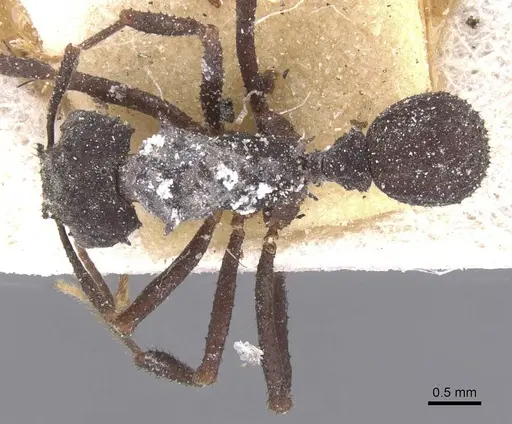
Literature
Loading distribution map...Loading products...