
Mycetarotes senticosus
- Sci. Name
- Mycetarotes senticosus
- Tribe
- Attini
- Subfamily
- Myrmicinae
- Author
- Kempf, 1960
- Distribution
- Found in 1 countries
Introduction
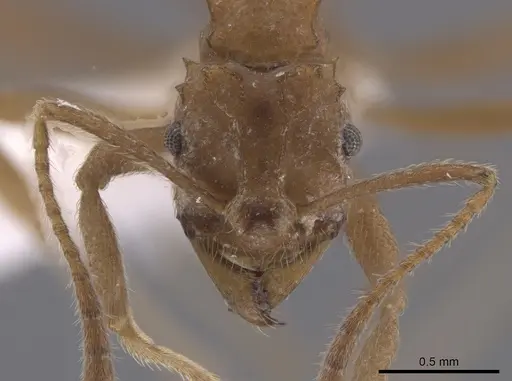
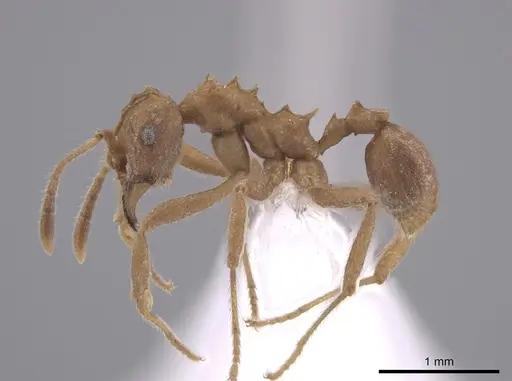
Mycetarotes senticosus is a tiny fungus-growing ant species native to the Atlantic Forest of Brazil. Workers measure just 3.7-4.0 mm and have a yellowish-brown coloration with an opaque, finely textured body . This species belongs to the Attini tribe, meaning it cultivates a fungal garden for food - a behavior shared with leafcutter ants and other fungus-growers. The workers have distinctive morphological features including a slightly elongated head, six teeth on their mandibles, and multiple spines and projections on the mesosoma and petiole . This is one of the rarest attine ants in existence, with very limited distribution in the wild and no established breeding populations among antkeepers.
Quick Summary
- Difficulty: Expert
- Origin & Habitat: Atlantic Forest of Brazil (Rio de Janeiro, Santa Catarina, São Paulo states), found exclusively in secondary forest above 650m altitude [1][2][3]
- Colony Type: Colony structure unconfirmed, gyne (queen) and male castes have not been described in scientific literature [1]
- Size & Growth:
- Queen: Unknown, queen caste has not been described [1]
- Worker: 3.7-4.0 mm [1]
- Colony: Unknown, only 0-2 nests have been excavated for study [2]
- Growth: Unknown, no captive colony data available
- Development: Unknown, no development studies exist for this species (No captive breeding has been documented. Related attine species typically take 6-10 weeks at optimal temperature, but this is purely an estimate.)
- Antkeeping:
- Temperature: Keep warm and stable, roughly low-to-mid 20s°C, no direct temperature data exists for this species
- Humidity: Provide a humidity gradient, Atlantic Forest is humid, so keep nest substrate consistently moist but not waterlogged
- Diapause: Unknown, no seasonal studies exist for this species. Atlantic Forest has mild winters, so a reduced activity period may occur.
- Nesting: Natural nesting is poorly documented. One excavated nest showed 1-2 chambers with a small dump mound (1-2 cm high) at the entrance [2]. In captivity, a small Y-tong or plaster nest with tight chambers scaled to their tiny size would be appropriate.
- Behavior: No behavioral studies exist for this species. As an attine, they are expected to be docile and focused on fungus cultivation. Workers likely forage for plant material to cultivate their fungal garden. Their tiny size (under 4mm) means escape prevention must be excellent, they can squeeze through standard mesh barriers. As a Myrmicinae member, they possess a stinger but it is less medically significant to humans than fire ants.
- Common Issues: No captive breeding established, this species is essentially unavailable in the antkeeping hobby, Fungal cultivation requirements are poorly understood and difficult to replicate, Extremely limited distribution and rarity in the wild, No queen or male descriptions means founding behavior is completely unknown, Tiny size creates significant escape risk with standard equipment
Species Overview and Distribution
Mycetarotes senticosus is one of the rarest fungus-growing ant species in the world. It is known only from a handful of localities in southern and southeastern Brazil, specifically in the states of Rio de Janeiro, Santa Catarina, and São Paulo [2]. The species was first described by Wilhelm Kempf in 1960 from specimens collected along the Federal Highway São Paulo-Curitiba at kilometer 40 in São Paulo state [1]. All recorded specimens have been collected above 650 meters altitude, and the species appears to be exclusively associated with secondary Atlantic Forest habitat [3]. Unlike many attines that have been spread by human activity, this species has never been recorded in plantation environments, including adjacent pine plantations [3]. The type series consists of workers collected as strays from the forest floor, and remarkably, no complete nests have ever been excavated for scientific study [2].
Fungal Cultivation and Diet
As a member of the Attini tribe, Mycetarotes senticosus is an obligate fungus farmer. Like all extant attine ants, this species depends on cultivated fungi as the exclusive diet for larvae and a partial diet for adults [4]. The queen carries the fungal cultivar from her parent nest when she establishes a new colony, this symbiotic relationship is obligate and cannot be broken [4]. In captivity, replicating this fungal cultivation is extremely challenging and has not been accomplished. Unlike some attines that can switch between fungal cultivars, Mycetarotes likely has a specialized relationship with its specific fungal symbiont. No data exists on what plant materials or substrates the workers collect to feed their fungus. Based on related species, they would likely forage for leaf litter, flower petals, or other organic material to cultivate their fungal garden. This makes them fundamentally different from most ant species kept in captivity, they cannot simply be fed protein and sugar like typical omnivorous ants.
Morphology and Identification
Workers of Mycetarotes senticosus are tiny, measuring only 3.7-4.0 mm in total length [1]. They have a yellowish-brown coloration with an opaque, finely textured body surface [1]. The head is slightly longer than broad. The mandibles have six teeth along the chewing border. The clypeus has a small notch in the median anterior border. The mesosoma bears multiple projections: the midpronotal spines are as long as the lateral ones, and the mesonotal dorsum has three pairs of projections with the first two being longer than the others [1]. The propodeal spines are slender and directed obliquely backwards. The petiole has a pair of spines directed upwards. The gaster has low ridges along the sides of the first segment. This species resembles Mycetarotes acutus but can be distinguished by its stouter body ridges and projections with blunt apices [1].
Nesting Biology
The nesting biology of Mycetarotes senticosus remains almost completely unknown. Only one nest has ever been partially documented, revealing a simple structure with just 1-2 chambers and a small dump mound at the entrance measuring 1-2 cm in height [2]. This is remarkably simple compared to some attine species that construct elaborate underground gardens. The species has been collected as strays from forest floor cover, suggesting they forage on the ground surface [1]. No queen, male, or brood has ever been described from any nest, making this one of the least understood attine species in existence [1]. The lack of nest excavation data means we have no information about colony size, development timeline, or any aspect of their social structure.
Captive Care Considerations
Mycetarotes senticosus is not currently available in the antkeeping hobby and should be considered essentially impossible to keep in captivity. This is not due to any difficulty in maintaining temperature or humidity, those parameters can be replicated. The fundamental challenge is the fungal cultivation requirement. Unlike honeydew-feeding or predatory ants where the keeper provides food directly, attine ants must be provided with substrate and conditions to grow their fungal garden, and the specific fungal symbiont for this species has never been identified or cultured. Additionally, no queen has ever been described, meaning we do not know how they found colonies or what the founding process looks like. Even if a wild queen were collected, the lack of any captive breeding success for this genus means there is no established protocol. For antkeepers interested in fungus-growing ants, better-documented species like Sericomyrmex or some Trachymyrmex species would be far more appropriate choices. [4][2][1]
Frequently Asked Questions
Can I keep Mycetarotes senticosus in captivity?
No, this species is not available in the antkeeping hobby and is considered impossible to keep in captivity. The fundamental challenge is that as an obligate fungus farmer, they require a specific fungal cultivar that has never been identified or cultured. Additionally, no queen has ever been described, so even if you found a wild colony, there would be no established protocol for captive breeding.
What do Mycetarotes senticosus eat?
As an attine fungus-growing ant, they eat cultivated fungi, this is their exclusive larval diet and partial adult diet. The workers forage for organic material (likely leaf litter or flower parts) to feed their fungal garden, not themselves. This is fundamentally different from typical ants that you can feed protein and sugar directly.
Where does Mycetarotes senticosus live?
This species is only known from Brazil's Atlantic Forest in the states of Rio de Janeiro, Santa Catarina, and São Paulo, always above 650 meters altitude. It is found exclusively in secondary forest habitat and has never been recorded in plantation environments.
How big are Mycetarotes senticosus workers?
Workers are tiny at just 3.7-4.0 mm total length [1]. This is among the smallest attine ants, making them difficult to study and potentially challenging to house even if captive breeding were possible.
What is the colony structure of Mycetarotes senticosus?
Unknown, the queen caste has never been described, and no complete colony has ever been excavated for study. We do not know if they are monogyne (single queen) or polygyne (multiple queens), or what their maximum colony size might be.
Are Mycetarotes senticosus good for beginners?
No, this species is not suitable for any level of antkeeping. It is not available in the hobby, and even if it were, the fungal cultivation requirements make them expert-level at minimum. For beginner-friendly fungus growers, consider Sericomyrmex or Trachymyrmex species instead.
Does Mycetarotes senticosus need hibernation?
Unknown, no seasonal studies exist for this species. They are found in the Atlantic Forest of Brazil, which has mild winters compared to temperate regions. A reduced activity period may occur but has not been documented.
How long does it take for eggs to develop into workers?
Unknown, no development studies exist for this species. Related attine species typically take 6-10 weeks from egg to worker at optimal temperature, but this is purely an estimate with no data specific to M. senticosus.
Report an Issue
The current care sheet is based fully on literature. See inconsistencies, or something that's incorrect? Please , it will be resolved after review from an admin. Contributing to the blogs tab also helps providing information, to make us be able to further improve the caresheets. Thank you for your support!
References

This caresheet is licensed under CC BY-SA 4.0 .
Community Blogs
CASENT0655262
View on AntWeb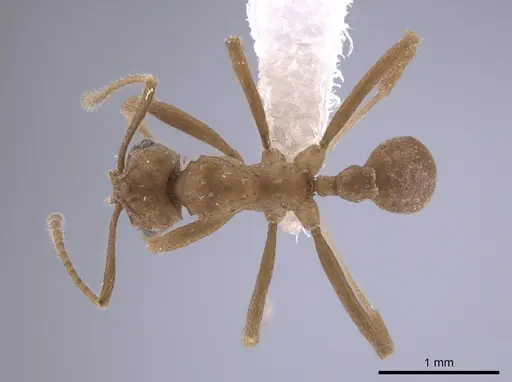
Literature
Loading distribution map...Loading products...