
Monomorium wilsoni
- Sci. Name
- Monomorium wilsoni
- Tribe
- Solenopsidini
- Subfamily
- Myrmicinae
- Author
- Espadaler, 2007
- Distribution
- Found in 1 countries
Introduction
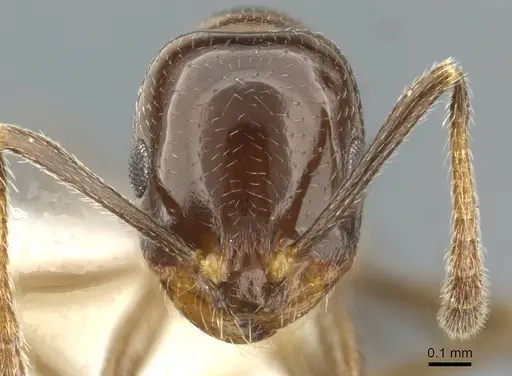
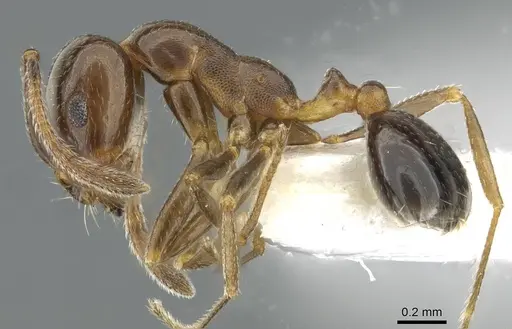
Monomorium wilsoni is a small but aggressive ant species endemic to El Hierro in the Canary Islands, Spain. Workers measure 2.4-2.7mm and are dark, shiny, and brown with reddish-brown mandibles, antennae, and lower body sections. Queens are larger at 4.7-5.1mm and are wingless (apterous), which is unusual among ants and related to their colony founding strategy. This species belongs to the salomonis-group and is one of the most abundant ants on El Hierro, found from sea level up to 1300m elevation. They nest under stones in both dry coastal areas and humid pine and laurel forests, showing remarkable ecological flexibility . What makes M. wilsoni stand out is their polygynous colony structure (multiple queens per colony) and their fierce defensive behavior. Workers attack and sting when threatened, though their sting causes no special skin reaction in humans. The wingless queens and their colony structure suggest they establish new colonies through budding rather than nuptial flights, an adaptation that works well for island colonization .
Quick Summary
- Difficulty: Medium
- Origin & Habitat: El Hierro, Canary Islands, Spain. Found from sea level to 1300m elevation, nesting under stones in open dry coastal habitats and humid pine and laurel forests [1].
- Colony Type: Polygynous, multiple queens per colony. Queens are apterous (wingless), suggesting colony founding through budding rather than nuptial flights [1].
- Size & Growth:
- Queen: 4.7-5.1mm [1]
- Worker: 2.4-2.7mm [1]
- Colony: Colonies reach huge numbers of workers, one of the most abundant ants on El Hierro [1].
- Growth: Moderate, inferred from typical Monomorium patterns
- Development: Unknown, no specific development data available for this species (Development timeline is unconfirmed. Estimates based on related species may be inaccurate.)
- Antkeeping:
- Temperature: Keep around 22-26°C. Given their elevation range (sea level to 1300m) and Canary Islands location, they tolerate a range from mild to warm conditions. Provide a temperature gradient if possible [1].
- Humidity: Moderate to high. Found in both dry coastal areas and humid forest habitats, suggesting they tolerate varied humidity. Keep nest substrate moderately moist but not waterlogged [1].
- Diapause: Unlikely, being from the Canary Islands (subtropical), they probably do not require a true hibernation. However, they may slow down during cooler winter months.
- Nesting: In nature they nest under stones. For captivity, a Y-tong (AAC) nest or plaster nest works well. Provide narrow chambers scaled to their small worker size (2.4-2.7mm). They do well with some dry areas and some moist areas to self-regulate [1].
- Behavior: Monomorium wilsoni is aggressive and defensive. Workers will attack and sting fiercely when their nest is disturbed. They are active foragers and likely scavenge for food. Their small size (under 3mm) means escape prevention is important, use fine mesh and tight-fitting barriers. Queens are wingless (apterous), which is unusual and suggests they establish colonies by budding rather than nuptial flights [1].
- Common Issues: escape prevention is critical due to their very small worker size (2.4-2.7mm)., aggressive stinging behavior means handling requires care, they will attack when threatened., limited availability as a species, may be difficult to source from reputable breeders., polygynous colonies may have complex dynamics when establishing in captivity., wild-caught colonies from their limited range may have parasites or not adapt well to captivity.
Housing and Nest Setup
Monomorium wilsoni is a small ant that needs appropriately scaled housing. Workers measure just 2.4-2.7mm, so escape prevention must be excellent, use fine mesh barriers and tightly fitting lids. They naturally nest under stones, so a Y-tong (AAC) nest or plaster nest with narrow chambers works well. Provide a temperature gradient across the nest so workers can self-regulate. Keep the nest substrate moderately moist, they are found in both dry coastal and humid forest habitats, so they can adapt to varied conditions. An outworld for foraging completes the setup. Because they are polygynous (multiple queens), they can be kept in slightly larger colonies from the start [1].
Feeding and Diet
Like other Monomorium species, M. wilsoni likely has an omnivorous diet. In nature, they probably scavenge for small insects, honeydew, and plant matter. In captivity, offer sugar water or honey as an energy source, and protein sources like small fruit flies, pinhead crickets, or other tiny insects. Their small size means prey items should be appropriately sized. They are active foragers, so food should be available in the outworld. Remove uneaten prey after 24-48 hours to prevent mold. Their aggressive hunting behavior suggests they are effective predators [1].
Temperature and Seasonal Care
Being from the Canary Islands (subtropical climate), M. wilsoni does not require hibernation. Keep temperatures in the range of 22-26°C for optimal activity and brood development. They are found from sea level to 1300m elevation, showing they can tolerate a range of conditions. A heating cable on one side of the nest can create a temperature gradient. During cooler winter months, they may naturally slow down but will remain active year-round. Avoid temperatures below 15°C or above 30°C. Their wide elevation range in the wild suggests they handle temperature variation better than many species [1].
Behavior and Defense
This species is known for its aggressive defensive behavior. Workers will attack and sting fiercely when the nest is threatened. While their sting causes no special skin reaction in humans, the sheer number of workers that may respond to disturbance can be intimidating. They are one of the most abundant ants on El Hierro, meaning colonies can reach very large sizes with thousands of workers. When keeping this species, work carefully around the nest and use caution during feeding and maintenance. Their small size (under 3mm) also means they can squeeze through tiny gaps, ensure your setup is escape-proof [1].
Colony Structure and Reproduction
Monomorium wilsoni has a polygynous colony structure, meaning colonies contain multiple queens. This is unusual among many ant species and contributes to their ability to form large colonies quickly. Queens are apterous (wingless), which is a distinctive trait. Unlike most ants that have winged queens for nuptial flights, these queens likely establish new colonies through budding, where a queen leaves with workers to start a new nest rather than flying away. This is supported by the absence of tegulae (wing hooks) in the queens. This colony structure is an adaptation that works well for island colonization, allowing the species to spread without needing nuptial flights [1].
Frequently Asked Questions
Is Monomorium wilsoni good for beginners?
This species is rated as medium difficulty. While not the most challenging, their aggressive stinging behavior and small size require careful handling and excellent escape prevention. They are also difficult to obtain since they are endemic to a small region. Beginners should ensure they are comfortable with escape-proof setups before trying this species.
How long does it take for Monomorium wilsoni to produce first workers?
Specific development data is not available for this species. The wingless queen condition may affect founding behavior, but exact timelines are unknown.
Can I keep multiple queens together in one colony?
Yes, this is actually their natural colony structure. M. wilsoni is polygynous, meaning colonies naturally have multiple queens. You can keep multiple founding queens together, though monitor for initial aggression. Established polygynous colonies should not be combined as they may fight.
What do Monomorium wilsoni eat?
They are omnivorous. Offer sugar sources like sugar water or honey for energy, and protein sources like small insects (fruit flies, pinhead crickets, tiny mealworms). Their small size means prey should be appropriately sized. Remove uneaten food promptly.
What temperature do Monomorium wilsoni need?
Keep them at 22-26°C. Being from the Canary Islands, they prefer warmer conditions but can tolerate a range. A temperature gradient allows workers to self-regulate. Avoid temperatures below 15°C or above 30°C.
Do Monomorium wilsoni need hibernation?
No, they do not require hibernation. Being from the subtropical Canary Islands, they remain active year-round. You may notice reduced activity during cooler winter months, but no formal diapause is needed.
How big do Monomorium wilsoni colonies get?
Colonies can reach very large sizes, this species is one of the most abundant ants on El Hierro, indicating colonies with thousands of workers. They are polygynous (multiple queens), which helps them build large colonies quickly.
Why are the queens wingless?
Queens are apterous (wingless), which is unusual but not rare in some Monomorium species. This is related to their colony founding strategy, instead of nuptial flights, they likely establish new colonies through budding (a queen leaves with workers to start a new nest). This adaptation works well for island species.
Where is Monomorium wilsoni found in the wild?
This species is endemic to El Hierro in the Canary Islands, Spain. It is found from sea level up to 1300m elevation, nesting under stones in both dry coastal habitats and humid pine and laurel forests. Their wide ecological range makes them adaptable to various conditions.
Are Monomorium wilsoni ants invasive?
No, they are not invasive. They are endemic to El Hierro in the Canary Islands and have not been introduced anywhere else.
How do I prevent escapes with Monomorium wilsoni?
Escape prevention is critical because workers are very small (2.4-2.7mm). Use fine mesh (at least 0.5mm or smaller), tight-fitting lids, and barrier bands (fluon or similar) on any connections. Check all seams and gaps regularly. Their small size means they can squeeze through the tiniest openings.
Report an Issue
The current care sheet is based fully on literature. See inconsistencies, or something that's incorrect? Please , it will be resolved after review from an admin. Contributing to the blogs tab also helps providing information, to make us be able to further improve the caresheets. Thank you for your support!
References

This caresheet is licensed under CC BY-SA 4.0 .
Community Blogs
CASENT0911200
View on AntWeb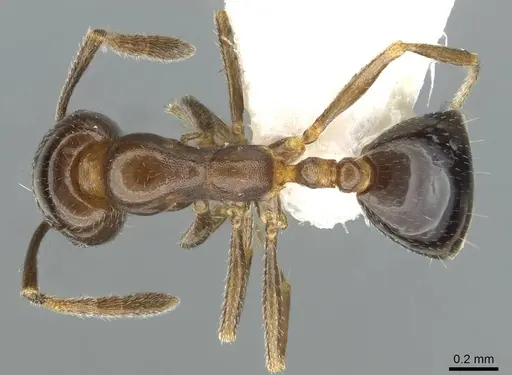
Literature
Loading distribution map...Loading products...