
Monomorium schultzei
- Sci. Name
- Monomorium schultzei
- Tribe
- Solenopsidini
- Subfamily
- Myrmicinae
- Author
- Forel, 1910
- Distribution
- Found in 1 countries
Introduction
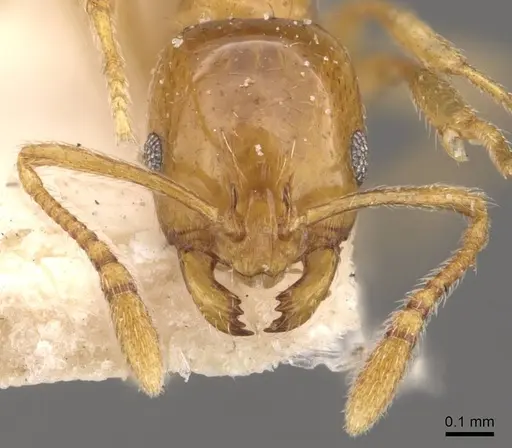
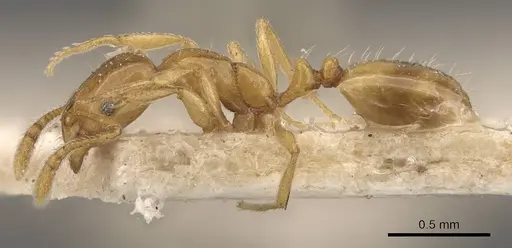
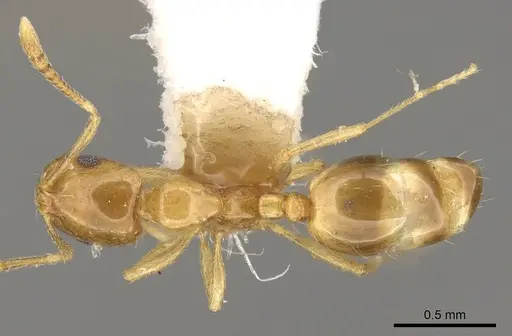
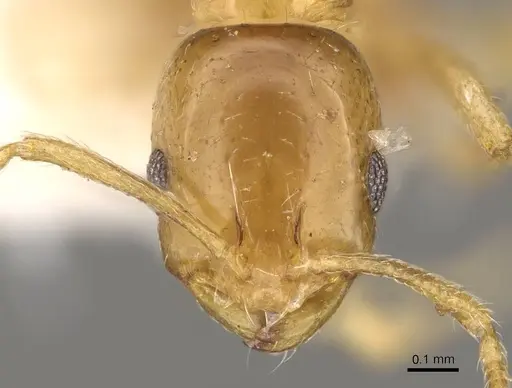
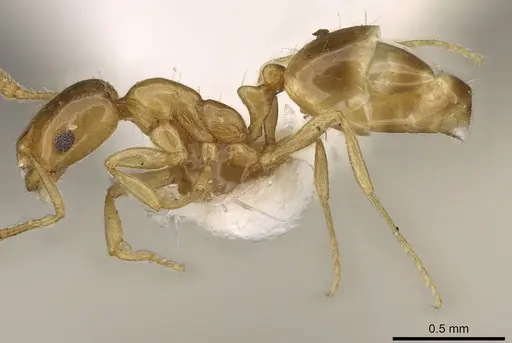
Monomorium schultzei is a tiny yellow ant species native to southern Africa, found in Lesotho, Namibia, and South Africa. Workers measure just 2.0-2.2mm in total length, making them one of the smaller ant species kept in captivity. They belong to the Monomorium monorium species group and are closely related to Monomorium excensurae and Monomorium bevisi, with the latter being larger and hairier. Workers are predominantly yellow with a duller, slightly brownish tint on the head and abdomen. They have relatively large eyes for their size and a narrow, conical petiole node. This species is part of the schultzei complex within the genus. Nothing is known about the specific biology of this species in the scientific literature, making it a challenging species to keep due to the lack of documented care information.
Quick Summary
- Difficulty: Expert
- Origin & Habitat: Native to the Afrotropical region, specifically Lesotho, Namibia, and South Africa [1]. Found in the Western Cape Province where they have been recorded foraging in vineyards [2]. The distribution spans from Saudi Arabia down to South Africa [3].
- Colony Type: Colony structure is unconfirmed. Based on genus-level patterns, likely single-queen colonies, though some Monomorium species can form multi-queen colonies.
- Size & Growth:
- Queen: Unconfirmed, only the syntype queen from the original description exists. No measurements are available.
- Worker: 2.0-2.2mm [1]
- Colony: Unknown, no colony size data exists for this species
- Growth: Unknown, no development data exists for this species
- Development: Unknown, no direct measurements exist (Development timeline is entirely unstudied.)
- Antkeeping:
- Temperature: Keep at room temperature, roughly 20-26°C. No specific thermal requirements have been documented for this species.
- Humidity: Moderate humidity is likely appropriate. Provide a moist nest chamber with access to drier areas. Avoid overly wet or waterlogged conditions.
- Diapause: Unknown, no data on overwintering requirements. Southern African populations may experience reduced activity during cooler months but true hibernation is unconfirmed.
- Nesting: In nature they likely nest in soil or under stones like other Monomorium species. In captivity, use small test tubes or nests with appropriately scaled chambers. Their tiny size requires tight-fitting connections and excellent escape prevention.
- Behavior: Behavior is unstudied. Based on genus patterns, they are likely generalist foragers that scavenge and collect honeydew. They are not aggressive and unlikely to sting humans due to their tiny size. Their small size makes them excellent escape artists, fine mesh and tight-fitting lids are essential. Workers are likely to be active foragers exploring their environment.
- Common Issues: completely unstudied biology means all care is experimental, no established protocols exist, tiny size makes escape prevention critical, they can squeeze through standard gaps, no documented feeding preferences, must experiment with various foods, colony may fail due to unknown requirements, no species-specific guidance available, slow growth or failure may occur because optimal conditions are unknown
Appearance and Identification
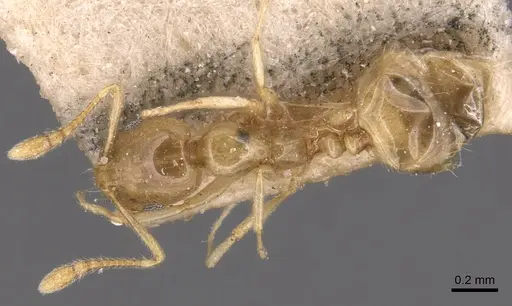
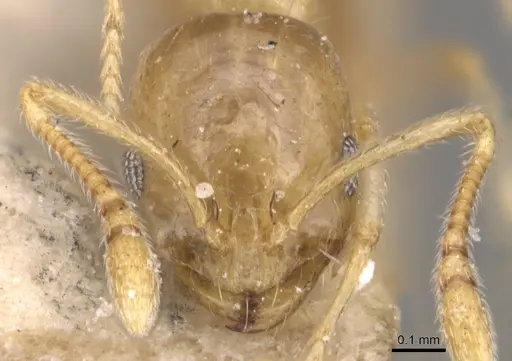
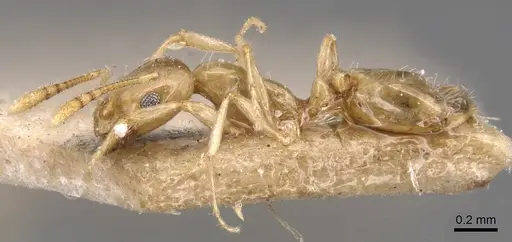
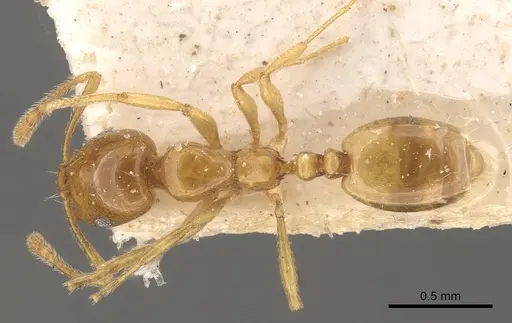
Monomorium schultzei workers are tiny at just 2.0-2.2mm in total length. They are predominantly yellow in color, though the head and gaster have a duller, pale brownish-yellow tint. They have relatively large eyes for their size. The clypeus has sharply developed carinae that are close together and nearly parallel. The petiole has an elongated narrow peduncle with a small process underneath, and the node is narrow and subconical. These ants are part of the schultzei complex within the Monomorium monorium species group and are closely related to Monomorium excensurae and Monomorium bevisi. The latter is larger, more hairy, and distinctly darker. [1]
Distribution and Habitat
This species is found across the southern African region, specifically in Lesotho, Namibia, and South Africa. The type localities include Little Namaland and Steinkopf in South Africa, and Prince of Wales Bay and Angra Pequena in Namibia. The distribution extends from Saudi Arabia down to South Africa [3]. They have been recorded in the Western Cape Province where they forage in vineyards [2]. In their natural habitat, they likely nest in soil or under stones like other Monomorium species in the region. The climate in their range ranges from semi-arid to more temperate coastal areas.
Challenges in Keeping This Species
Monomorium schultzei presents significant challenges for antkeepers because absolutely nothing has been documented about its biology in the scientific literature. The AntWiki explicitly states that nothing is known about the biology of this species. This means there are no established care protocols, no documented feeding preferences, no known temperature or humidity requirements, no development timeline, and no information about colony structure or growth. Every aspect of keeping this species will be experimental. You will need to observe your colony carefully and adjust conditions based on their behavior and survival. This makes the species suitable only for experienced antkeepers who are comfortable with trial-and-error approaches and who can afford to lose a colony while learning its requirements. [1]
Housing and Nest Setup
Given their tiny size of just 2.0-2.2mm, housing must be carefully scaled. Use small test tubes for founding colonies or very small nests with appropriately sized chambers. The connections between outworld and nest must be tight, these small ants are excellent escape artists and can squeeze through gaps that would hold back larger species. Use fine mesh on any ventilation holes. For the founding chamber, a standard test tube setup with a water reservoir works well. Ensure the setup allows for both humid and drier areas so the ants can self-regulate. Because nothing is known about their natural nesting preferences, you may need to experiment with different nest materials and moisture levels. Start with moderate humidity and adjust based on colony behavior.
Feeding and Diet
Feeding preferences are completely unstudied for this species. Based on genus-level patterns, they are likely generalist scavengers that accept both sugar sources and protein. Offer sugar water or honey water as a constant sugar source. For protein, start with small prey items like fruit flies, pinhead crickets, or other appropriately sized insects. They may also tend aphids for honeydew, so offering a sugar source is important. Given their tiny size, prey items must be very small. Start with very small portions and observe what they accept. Remove uneaten food promptly to prevent mold.
Temperature and Seasonal Care
No specific temperature requirements have been documented for this species. Use room temperature as a starting point, roughly 20-26°C. Southern African species often tolerate warmer conditions, so a range up to 28°C may be acceptable. Watch for behavioral cues, if workers cluster together, they may want more warmth, if they avoid certain areas, those areas may be too warm or too cold. Regarding diapause or hibernation, nothing is known about their seasonal requirements. The species occurs in regions with distinct seasons, so they likely experience some form of reduced activity in winter. Start with a mild diapause period at reduced temperatures around 15-18°C for a few months and observe how the colony responds. Never attempt a harsh diapause with an unknown species.
Frequently Asked Questions
How long does it take for Monomorium schultzei to go from egg to worker?
The development timeline is completely unknown, no research exists on this species. Based on similar small Myrmicinae ants, you can expect roughly 6-10 weeks at optimal temperature, but this is entirely an estimate. The first workers will likely be smaller than normal workers.
What do Monomorium schultzei ants eat?
Feeding preferences are unstudied. Based on genus patterns, offer sugar water or honey as a constant energy source, and small protein sources like fruit flies, tiny crickets, or other small insects. They may accept honeydew if you keep aphids. Start with small portions and observe what they take.
Are Monomorium schultzei good for beginners?
No. This is an expert-level species because absolutely nothing is known about its biology. There are no established care protocols, every aspect of keeping them requires experimentation. Only experienced antkeepers should attempt this species.
What temperature should I keep Monomorium schultzei at?
No specific requirements are documented. Start with room temperature around 20-26°C and observe colony behavior. Related species from southern Africa suggest they can tolerate warmer conditions up to 28°C. Adjust based on how the colony responds.
How big do Monomorium schultzei colonies get?
Colony size is completely unstudied. Related Monomorium species typically reach several hundred workers. Your colony may reach similar sizes, but there is no data to confirm this.
Can I keep multiple queens together?
Colony structure is unconfirmed. Nothing is known about whether this species is single-queen or multi-queen. Based on genus patterns, they are likely single-queen, but this is an inference, not a certainty. Do not combine unrelated queens unless you are prepared to lose them.
Do Monomorium schultzei need hibernation?
Diapause requirements are completely unknown. They occur in regions with seasonal variation, so they likely experience some reduced activity in winter. If you choose to diapause, start with a mild period at 15-18°C for a few months and monitor the colony closely.
Why is my Monomorium schultzei colony dying?
Without any documented care requirements, colony failure is very likely. Common issues may include incorrect temperature, humidity, or food. Their tiny size also makes escape prevention critical, ensure all connections are tight. Consider trying different conditions systematically to find what works.
What is the best nest type for Monomorium schultzei?
Nothing is known about their natural nesting. Use small test tubes for founding colonies or small nests with appropriately sized chambers. The key is ensuring chambers and connections are scaled to their tiny 2mm size. Escape prevention is critical.
Report an Issue
The current care sheet is based fully on literature. See inconsistencies, or something that's incorrect? Please , it will be resolved after review from an admin. Contributing to the blogs tab also helps providing information, to make us be able to further improve the caresheets. Thank you for your support!
References

This caresheet is licensed under CC BY-SA 4.0 .
Community Blogs
Literature
Loading distribution map...Loading products...