
Metapone mjobergi
- Sci. Name
- Metapone mjobergi
- Tribe
- Crematogastrini
- Subfamily
- Myrmicinae
- Author
- Forel, 1915
- Distribution
- Found in 1 countries
Introduction
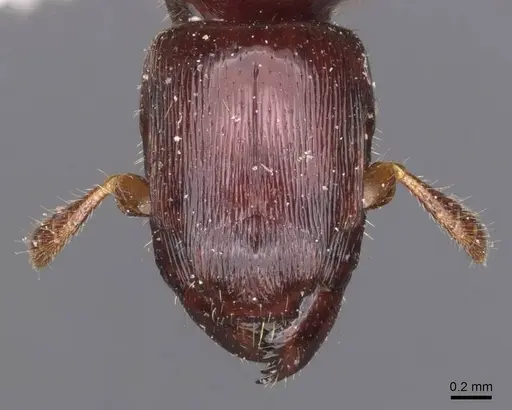
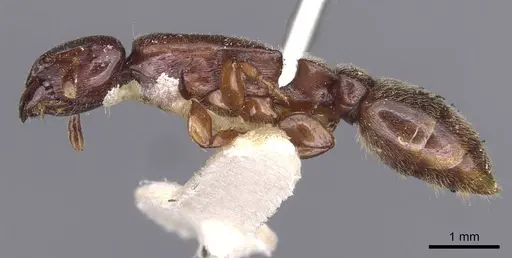
Metapone mjobergi is a small to medium-sized ant from the Myrmicinae subfamily, found only in the mountains and tablelands of northeast Queensland's wet tropics in Australia . Workers measure 5.4-6.9mm in total length, queens 8.0-9.0mm . Workers have vestigial eyes with only 3-5 tiny, indistinct facets, making them nearly blind . The clypeus has a distinctive stepped anterior border, and the petiolar node is about twice as wide as long when viewed from above . This species is notable for its likely ecological specialization: mated queens have been collected from pitfall traps, suggesting they search on foot for termite host nests rather than flying . This indicates Metapone mjobergi may be a social parasite that invades termite colonies. The genus Metapone remains poorly studied, and this species is known only from a handful of high-elevation localities in a biodiverse region of Australia.
Quick Summary
- Difficulty: Expert
- Origin & Habitat: Endemic to wet tropics of northeast Queensland, Australia, at elevations 450-1000m in mountain and tableland rainforest [1][2]
- Colony Type: Colony structure is unconfirmed. Based on queen foraging behavior, it likely lives as a social parasite inside termite nests [2].
- Size & Growth:
- Antkeeping:
- Temperature: Likely needs warm, humid conditions similar to its wet tropics habitat (450-1000m). Aim for 22-26°C, but this is an estimate since no captive data exists [1][2].
- Humidity: High humidity expected from origin. Keep substrate consistently moist but not waterlogged. Provide a humidity gradient.
- Diapause: Unknown, likely not required given the tropical location without harsh winters.
- Nesting: No captive data. In the wild, likely nests inside termite nests. For captivity, a naturalistic setup with soil and decaying wood might be appropriate, but requires live termite hosts.
- Behavior: Behavior is poorly documented. Workers are nearly blind, relying on chemical and tactile cues [1]. As a member of the Myrmicinae tribe Crematogastrini, this species uses a smear venom defense: a flattened, spatulate stinger that wipes venom onto enemies rather than piercing. Escape risk is moderate given worker size (5-7mm).
- Common Issues: This species is virtually unknown in the antkeeping hobby with no established care protocols., Social parasitism on termites means captive colonies may require live termite hosts, which is extremely difficult to provide., Extremely limited availability, this species has never been cultured in captivity., No development or growth data makes proper care nearly impossible to determine., Vestigial eyes suggest unusual sensory requirements we cannot currently meet.
Discovery and Taxonomy
Metapone mjobergi was first described by Auguste Forel in 1915 from specimens collected at Malanda in northeast Queensland, Australia [1]. The species was named after Eric Mjöberg, the Swedish entomologist who collected the type specimens. For many decades this ant remained known only from the original collection. In 2016,Taylor and Alpert published a comprehensive taxonomic review of Metapone, providing detailed measurements and diagnostic features that allow identification of M. mjobergi from related species [1]. The species is diagnosed by its unique clypeal shape, vestigial eyes with only 3-5 facets, and the shape of the subpetiolar extension [1]. It is sympatric with Metapone tecklini on Mt Sampson and Windsor Tableland, and with Metapone hoelldobleri near Kuranda [1].
Distribution and Habitat
Metapone mjobergi is endemic to a small range in the wet tropics of northeast Queensland, Australia [2]. All known specimens come from between 450 and 1000 meters elevation in mountain and tableland habitats [1]. This restricted distribution makes it one of the most limited ant species in Australia. The region is wet tropical rainforest with high humidity and stable warm temperatures year-round. Modern specimens have been collected using flight intercept or pitfall traps, indicating that queens search for host nests on foot after mating [2].
Unique Physical Characteristics
Workers of Metapone mjobergi have vestigial eyes with only 3-5 tiny, irregular, and indistinct facets, rendering them nearly blind [1]. This is unusual among ants. The eye condition is consistent across workers, unlike the related Metapone tillyardi which shows variation in eye size [1]. The clypeus has a distinctive shape with a stepped anterior border that angles inward at each corner, and the border ranges from feebly concave to feebly convex [1]. The petiolar node is about twice as wide as long when viewed from above, and the subpetiolar extension is shallowly sub-semicircular to triangular with its apex inclined forward [1]. Queens are larger (8.0-9.0mm) but share the reduced eye condition [1].
Ecological Specialization
Metapone mjobergi appears to be a social parasite of termites. Mated queens have been collected walking on the ground in pitfall traps, not from aerial flight intercepts, suggesting they search on foot for termite host nests [2]. Once inside a termite nest, they likely take over the colony. This parasitic lifestyle explains why M. mjobergi is so rarely encountered: it spends its entire colony cycle hidden within termite nests.
Captive Care Considerations
Metapone mjobergi is not recommended for antkeeping. This species has never been kept in captivity, and its specialized parasitic lifestyle makes captive husbandry extremely difficult. The primary obstacle is that M. mjobergi likely requires live termite hosts to establish and maintain colonies. Without access to the appropriate termite species (which themselves need specialized care), a colony cannot survive. Additionally, no information exists on what specific termite species serves as host, what the colony structure looks like, or how the ants feed. For these reasons, Metapone mjobergi is best appreciated in scientific literature rather than in ant farms. Those interested in keeping Australian Myrmicinae should consider more established genera like Crematogaster, Tetramorium, or Pheidole.
Frequently Asked Questions
Can I keep Metapone mjobergi as a pet ant?
No. Metapone mjobergi is not suitable for antkeeping. It has never been kept in captivity, and its likely parasitic lifestyle on termites makes captive husbandry essentially impossible. No care protocols exist, and the required host termite species is unknown.
What does Metapone mjobergi eat?
Unknown. As a likely social parasite of termites, the species probably relies on its termite hosts for nutrition, either being fed by termite workers or consuming termite brood. No direct observations of feeding exist in scientific literature.
How big do Metapone mjobergi colonies get?
Unknown. No data exists on wild or captive colony sizes for this species. The restricted distribution and parasitic lifestyle suggest colonies may remain small, but this is speculative.
Does Metapone mjobergi sting?
This species belongs to the Myrmicinae tribe Crematogastrini, which uses a smear venom mechanism: a flattened, spatulate stinger that wipes venom onto enemies rather than piercing. No direct observations exist for M. mjobergi, but this is the expected defense.
Where is Metapone mjobergi found?
Endemic to northeast Queensland, Australia, in mountain and tableland areas at 450-1000m elevation [1]. Known localities include Malanda, Kuranda, Lake Eacham, Lake Barrine, and Windsor Tableland.
Why does Metapone mjobergi have such small eyes?
Workers have vestigial eyes with only 3-5 tiny facets [1]. This reduction is likely an adaptation to life inside dark termite nests, where vision provides little benefit. The species relies on chemical and tactile senses.
Is Metapone mjobergi a parasite?
Strongly likely. Mated queens have been collected walking on the ground in pitfall traps, indicating they search for termite host nests on foot [2]. This behavior is characteristic of social parasites.
How long do Metapone mjobergi queens live?
Unknown. No data exists on queen lifespan or colony longevity. The parasitic lifestyle may differ significantly from independently founding ants.
Do Metapone mjobergi workers have eyes?
Workers have vestigial eyes with only 3-5 tiny, irregular, and indistinct facets [1]. They are essentially blind, relying on chemical cues.
Can I find Metapone mjobergi in the wild?
Extremely unlikely. The species has a very restricted range in remote Australian wet tropics and is known only from a handful of scientific collections. As it likely lives inside termite nests, it is virtually impossible to find.
Report an Issue
The current care sheet is based fully on literature. See inconsistencies, or something that's incorrect? Please , it will be resolved after review from an admin. Contributing to the blogs tab also helps providing information, to make us be able to further improve the caresheets. Thank you for your support!
References

This caresheet is licensed under CC BY-SA 4.0 .
Community Blogs
CASENT0907446
View on AntWeb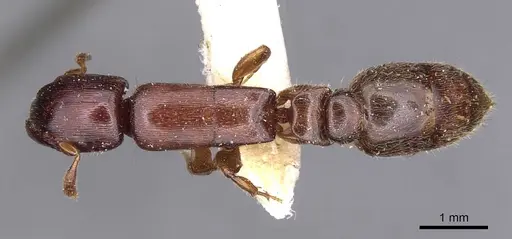
Literature
Loading distribution map...Loading products...