
Meranoplus arcuatus
- Sci. Name
- Meranoplus arcuatus
- Tribe
- Crematogastrini
- Subfamily
- Myrmicinae
- Author
- Schödl, 2007
- Distribution
- Found in 1 countries
Introduction
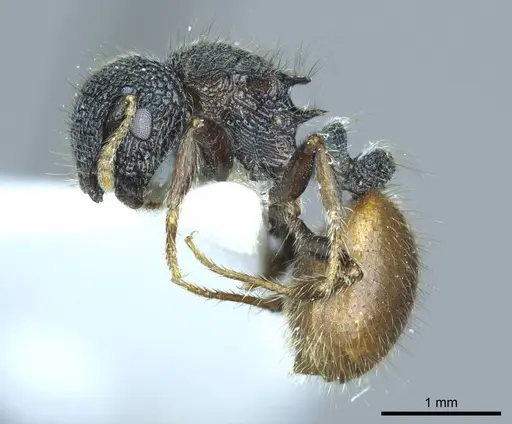
Meranoplus arcuatus is a small myrmicine ant native to Australia, found in Western Australia (Lake Marmion region) and northeastern South Australia . Workers measure 4.80-5.25 mm in total length and have a distinctly bicolored appearance . They nest in the ground and are granivorous, collecting seeds as food . This species is identified by its uniquely incurved propodeal spines that curve toward the petiole, a feature referenced in its species name 'arcuatus' meaning 'arched' .
Quick Summary
- Difficulty: Hard
- Origin & Habitat: Endemic to arid and semi-arid regions of Western Australia and South Australia, specifically around Lake Marmion and northeastern South Australia. They nest in the ground in typical Australian arid zone habitats [1].
- Colony Type: Colony structure is unconfirmed, no data on queen number or colony organization available for this specific species.
- Size & Growth:
- Antkeeping:
- Temperature: Estimated: Keep around 24-28°C based on typical Australian arid-zone patterns.
- Humidity: Estimated: Keep nest substrate dry to slightly moist, as they are arid-adapted.
- Diapause: Unknown, Australian arid-zone species may have reduced activity during extreme summer heat rather than winter diapause.
- Nesting: Ground-nesting species, provide a naturalistic setup with sandy/soil substrate or a Y-tong/plaster nest with dry to slightly moist conditions [1].
- Behavior: Granivorous ants that collect seeds as their primary food source [1]. They are ground-nesting and likely form moderate-sized colonies. Workers are moderately sized and should be manageable in captivity. Escape prevention should be standard. Defense mechanism: As members of subfamily Myrmicinae, they have a smear defense using a modified stinger.
- Common Issues: limited species-specific care data makes accurate husbandry challenging, granivorous diet requires appropriate seed offerings not always standard in ant husbandry, wild-caught colonies may have difficulty adapting to captive conditions, arid-adapted species may be sensitive to overwatering and high humidity, distribution gap between Western Australia and South Australia suggests specialized habitat requirements
Species Overview and Identification
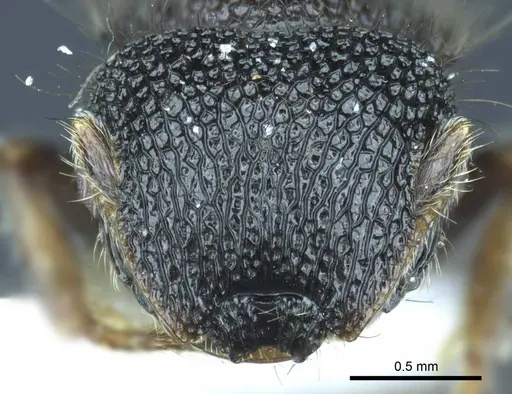
Meranoplus arcuatus is a distinctive Australian ant species described by Schödl in 2007 [1]. It belongs to the M. taurus complex and is characterized by its uniquely incurved propodeal spines [1]. Workers are 4.80-5.25 mm in length with a distinctly bicolored appearance [1]. The promesonotal shield overhangs the lateral sides of the mesosoma, and the first gastral tergite has a characteristic microreticulate texture [1]. This species has only been collected from Lake Marmion in Western Australia and a few locations in northeastern South Australia [1][2].
Natural History and Biology
Meranoplus arcuatus is a ground-nesting ant that is granivorous, meaning it collects and consumes seeds as a primary food source [1]. This dietary preference places it among the seed-harvesting ants, a common ecological niche in arid Australian environments [1]. The species is part of the Meranoplus diversus group and the M. taurus complex [3][1]. Beyond these details, the specific biology including colony structure, founding behavior, and seasonal activity patterns remains poorly documented in scientific literature.
Housing and Nesting
In captivity, provide a naturalistic setup that mimics their ground-nesting habitat. Use a sandy to loamy soil substrate of at least 5-10 cm depth to allow brood chambers [1]. Alternatively, a Y-tong or plaster nest with narrow chambers can work, but include a section of loose substrate in the outworld for seed storage [1]. Since they are arid-adapted, keep the nest relatively dry, substrate should be moist but not waterlogged, with some drier areas available. Ensure the setup has an escape-proof barrier and a secure foraging area.
Feeding and Diet
As granivorous ants, Meranoplus arcuatus primarily collects and consumes seeds [1]. In captivity, offer a variety of small seeds appropriate for their size, such as grass seeds, millet, sesame, or small bird seed mixes [1]. They will also likely accept other protein sources like small insects (e.g., fruit flies, crickets) as supplementary protein. Provide fresh water at all times.
Temperature and Seasonal Care
Based on their Australian arid-zone distribution, these ants likely prefer warmer temperatures in the range of 24-28°C. Provide a temperature gradient within the enclosure so workers can regulate their body temperature by moving between warmer and cooler areas. Regarding seasonal patterns, Australian arid-zone ants often reduce activity during extreme summer heat rather than undergoing winter diapause. Monitor colony behavior, if workers become less active, this may indicate temperature stress.
Challenges and Considerations
This species presents significant challenges for antkeepers due to the limited scientific data available [1]. No published information exists on colony size, development timeline, or specific humidity requirements. Keepers interested in this species should be prepared for experimental husbandry and document their observations carefully. When acquiring colonies, wild-caught specimens may have difficulty adapting to captive conditions, so obtaining established colonies from experienced keepers is preferable if available.
Frequently Asked Questions
What do Meranoplus arcuatus ants eat?
They are granivorous ants that primarily eat seeds [1]. Offer small seeds like grass seeds, millet, sesame, or small bird seed mixes [1]. They will also accept protein sources like small insects.
How big do Meranoplus arcuatus colonies get?
Colony size is unknown, no published data exists on maximum colony size for this species [1].
What size are Meranoplus arcuatus workers?
Workers measure 4.80-5.25 mm in total length, making them a small but not tiny ant species [1].
Where is Meranoplus arcuatus found?
This species is only known from Western Australia (Lake Marmion area) and northeastern South Australia, with a significant geographic gap between these regions [1][2].
How do I house Meranoplus arcuatus?
Use a naturalistic setup with sandy/soil substrate for ground-nesting, or a Y-tong/plaster nest with a section of loose substrate [1]. Keep the nest relatively dry, mimicking arid Australian conditions.
Do Meranoplus arcuatus ants sting?
Sting severity is not documented for this species. As members of subfamily Myrmicinae, they have a smear defense using a modified stinger, which is generally minimal risk to keepers.
What temperature do Meranoplus arcuatus need?
Estimated at 24-28°C based on their Australian arid-zone distribution. Provide a temperature gradient for self-regulation.
How long does it take for Meranoplus arcuatus to develop from egg to worker?
Development timeline is unconfirmed, no published data exists [1]. Estimates based on related species suggest several months, but this is speculative.
Is Meranoplus arcuatus good for beginners?
Not recommended for beginners due to limited species-specific care data [1]. This species requires experimental husbandry and careful observation.
Do Meranoplus arcuatus need hibernation?
Diapause requirements are unknown. As an Australian arid-zone species, they may reduce activity during extreme summer heat rather than requiring winter dormancy.
Report an Issue
The current care sheet is based fully on literature. See inconsistencies, or something that's incorrect? Please , it will be resolved after review from an admin. Contributing to the blogs tab also helps providing information, to make us be able to further improve the caresheets. Thank you for your support!
References

This caresheet is licensed under CC BY-SA 4.0 .
Community Blogs
CASENT0919715
View on AntWeb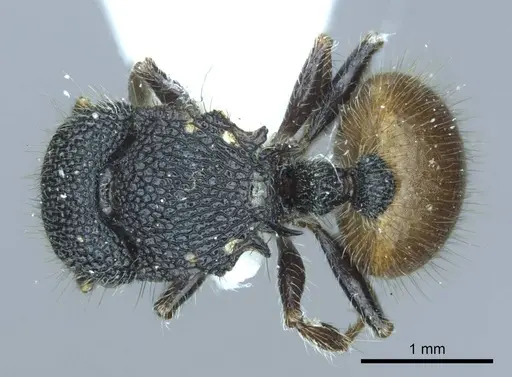
Literature
Loading distribution map...Loading products...