
Melophorus macroschismus
- Sci. Name
- Melophorus macroschismus
- Tribe
- Melophorini
- Subfamily
- Formicinae
- Author
- Heterick <i>et al.</i>, 2017
- Distribution
- Found in 1 countries
Introduction
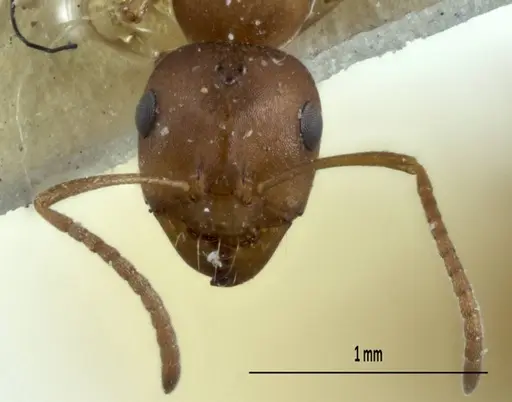
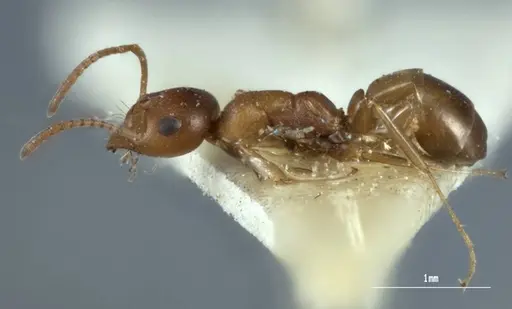
Melophorus macroschismus is a small Australian ant from the potteri species group, described in 2017. Only minor workers are known, with a matt appearance and oval head capsule. The species is native to inland Western Australia, specifically the eastern wheatbelt and eastern goldfields, where it nests in salt-affected remnant bushland .
Quick Summary
- Difficulty: Hard
- Origin & Habitat: Eastern wheatbelt and eastern goldfields, Western Australia, also Wilgena Station, South Australia. Found in salt-affected remnant bushland [2][1].
- Colony Type: Unconfirmed, only minor workers known, queen and major worker caste undocumented [1][2].
- Size & Growth:
- Queen: Unknown, queen has not been described [1][2].
- Worker: Size data unavailable, full body length not documented [1][2].
- Colony: Unknown, only a few specimens have been collected [2].
- Growth: Unknown, no colony development data exists [1][2].
- Development: Unknown, no direct observations [1][2]. (This species has no published data on development timeline.)
- Antkeeping:
- Temperature: Unknown, no specific data. Based on inland Australian habitat, keep warm, roughly 24-28°C, but this is inferred [2].
- Humidity: Unknown, no specific data. Provide a humidity gradient based on semi-arid habitat [2].
- Diapause: Unknown, no data on diapause requirements [1][2].
- Nesting: Natural nesting in soil in bushland [2]. In captivity, use test tube for founding, Y-tong or plaster nest for established colonies, but this is inferred from genus patterns.
- Behavior: Behavior is undocumented. Based on related Melophorus, they may be moderate foragers. Escape risk is moderate due to small size.
- Common Issues: limited species data means care is inferred from genus patterns [1][2]., no documented founding behavior, queens have never been collected [1][2]., growth rate and development timeline unknown, making it hard to assess colony progress [1][2]., newly described species with no established husbandry protocols [1][2]., specific soil chemistry needs from salt-affected habitat may be difficult to replicate [2].
Species Discovery and Identification
Melophorus macroschismus was described in 2017 and belongs to the Melophorus potteri species group. It is distinguished by a palp formula of 6,4,matt general appearance, oval head capsule, and conventional five-toothed mandibles [1]. Only minor workers have been collected, the major worker caste and queen remain unknown [1][2].
Natural Habitat and Distribution
This species is known from the eastern wheatbelt and eastern goldfields regions of Western Australia, with additional records from Wilgena Station in South Australia. It nests in salt-affected remnant bushland, indicating adaptation to semi-arid inland conditions [2][1].
Housing and Nesting
No specific housing data exists for this species. Natural nesting occurs in soil in bushland [2]. In captivity, a test tube setup can be used for founding colonies, and Y-tong or plaster nests for established colonies, but this is inferred from related Melophorus species.
Feeding and Diet
The specific diet is undocumented. Like most Melophorus, they are likely generalist omnivores, but no data exists for this species.
Temperature and Seasonal Care
No temperature data exists. Based on inland Australian habitat, keep warm, roughly 24-28°C, but this is inferred [2]. Diapause requirements are unknown [1][2].
Challenges and Considerations
This species presents challenges due to limited data. Only minor workers are known, and no care protocols exist. Keepers must adapt based on observation [1][2].
Frequently Asked Questions
How do I keep Melophorus macroschismus?
No specific care data exists. Use a test tube for founding and Y-tong or plaster nests for established colonies, based on related species. Keep at warm temperatures and provide a humidity gradient.
Where does Melophorus macroschismus live?
This species is native to inland Western Australia and South Australia, nesting in salt-affected remnant bushland [2][1].
What do Melophorus macroschismus ants eat?
Their specific diet is undocumented, but they are likely generalist omnivores.
How big do Melophorus macroschismus colonies get?
Unknown, only a few specimens have been collected [2].
How long does it take for Melophorus macroschismus to develop from egg to worker?
Can I keep multiple Melophorus macroschismus queens together?
Unknown, colony structure is undocumented. Most Melophorus are single-queen, but no data exists for this species.
Is Melophorus macroschismus a good species for beginners?
No, this species has no established care protocols and is not recommended for beginners [1].
Where can I get a Melophorus macroschismus queen?
Very unlikely, only minor workers have been collected, and the queen is unknown [1][2].
What makes Melophorus macroschismus different from other Melophorus?
It belongs to the potteri species group, with a palp formula of 6,4,matt appearance, and oval head capsule. Only minor workers are known [1].
What temperature should I keep Melophorus macroschismus at?
Unknown, no specific data. Based on habitat, keep warm, roughly 24-28°C [2].
Report an Issue
The current care sheet is based fully on literature. See inconsistencies, or something that's incorrect? Please , it will be resolved after review from an admin. Contributing to the blogs tab also helps providing information, to make us be able to further improve the caresheets. Thank you for your support!
References

This caresheet is licensed under CC BY-SA 4.0 .
Community Blogs
ANIC32-900028
View on AntWeb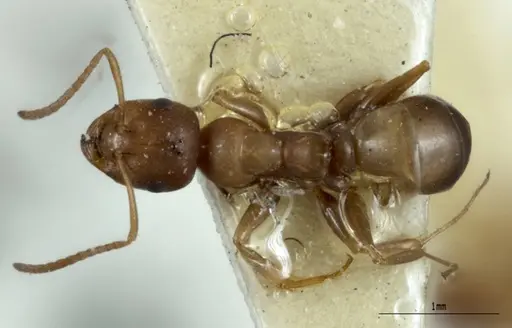
Literature
Loading distribution map...Loading products...