
Melophorus fulvihirtus
- Sci. Name
- Melophorus fulvihirtus
- Tribe
- Melophorini
- Subfamily
- Formicinae
- Author
- Clark, 1941
- Distribution
- Found in 1 countries
Introduction
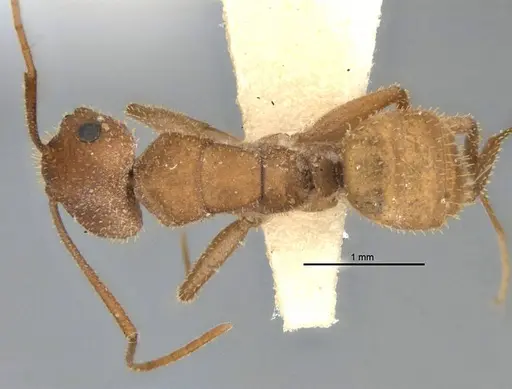
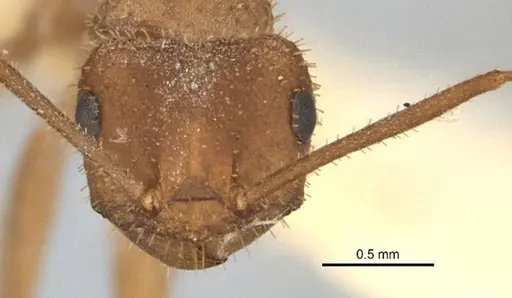
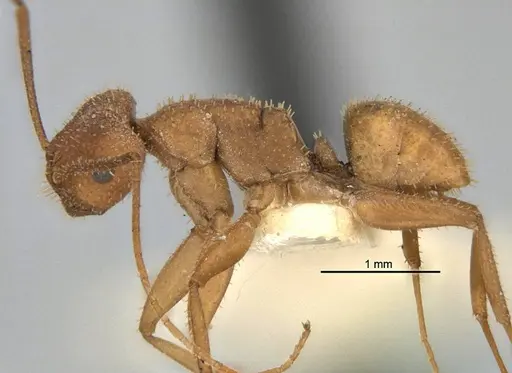
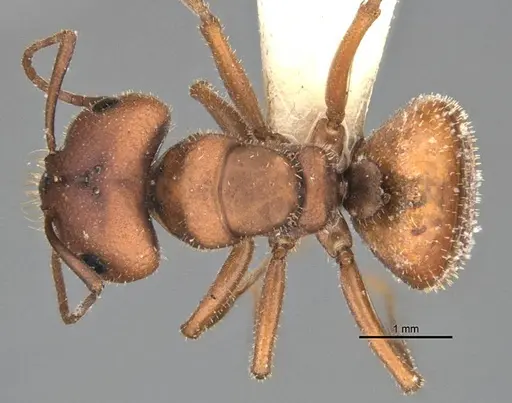
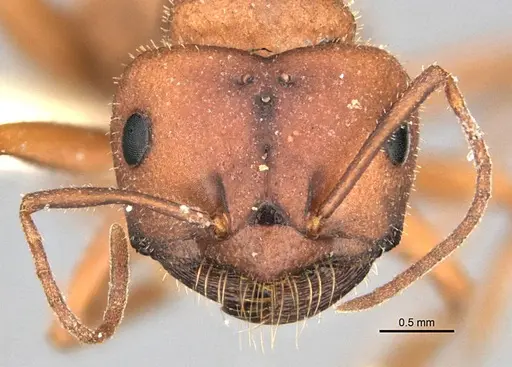
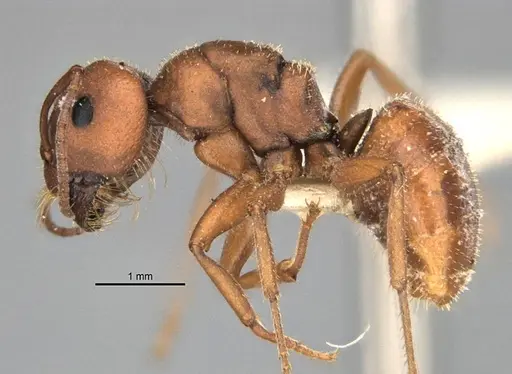
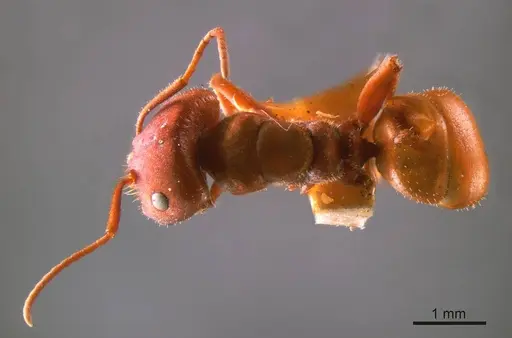
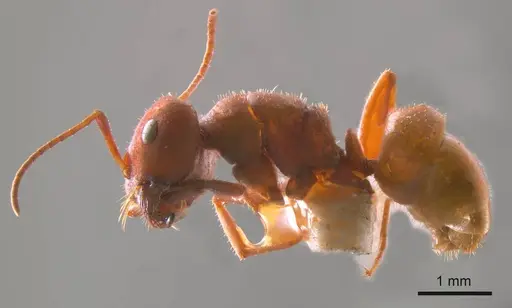
Melophorus fulvihirtus is a small Australian ant from the Formicinae subfamily. Workers are unmistakable because they're covered in short, stout, peg-like bristles and have a matt, leathery (coriaceous) cuticle . The back of the head is broadly concave, and the pronotum and mesonotum look flattened from above. Color varies: minor workers are tan with brown markings, while majors have orange foreparts and a brown gaster. This species is famous for its specialized raiding behavior, it actively raids the nests of meat ants (Iridomyrmex purpureus species-group) to steal brood, making it a specialist predator of ant larvae and pupae . The ant seems to be confined to southeastern Australia, with records from New South Wales, South Australia, and Victoria.
Quick Summary
- Difficulty: Medium
- Origin & Habitat: Southeastern Australia, found in New South Wales, South Australia, and Victoria. It lives in arid to temperate regions, typically in open habitats. Label data show specimens collected from Iridomyrmex purpureus (meat ant) mounds, indicating it associates with these aggressive species [1][2].
- Colony Type: Colony structure is unconfirmed. Based on typical Melophorus patterns, likely single queen. No documented ergatoid (wingless replacement queen) system for this species.
- Size & Growth:
- Queen: Total length data unavailable, no measurements exist in the literature.
- Worker: Total length data unavailable. Workers are polymorphic: minors smaller, majors with distinctly enlarged heads [1].
- Colony: Unknown, no colony size data available.
- Growth: Unknown, no development data available.
- Development: Unconfirmed, no direct measurements exist. Based on related Melophorus and temperate climate, very roughly 6–10 weeks at optimal temperature. (No published development data exists for this species. The estimate is speculative.)
- Antkeeping:
- Temperature: Keep at room temperature, roughly 20–26°C. No specific thermal studies exist, but being from temperate southeastern Australia, they likely tolerate a range. A heating cable on one side can create a gradient.
- Humidity: Prefers dry to moderate conditions. Their natural habitat is arid to temperate, so avoid excessive moisture. Keep the nest substrate lightly moist but allow portions to dry out completely.
- Diapause: Likely requires winter dormancy given the temperate distribution. Reduce temperature to 10–15°C during austral winter (roughly May–August). Exact duration is unknown, start with 3–4 months of cool rest.
- Nesting: Natural nesting habits are poorly documented. Based on genus patterns, likely nests in soil under stones. In captivity, a Y-tong (AAC) or plaster nest with small chambers works well. Make sure barriers are tight, these ants are small and can slip through gaps.
- Behavior: Aggressive and predatory. Workers actively raid the nests of larger ants, especially meat ants (Iridomyrmex purpureus-group), to steal brood [1][2]. They are fast and likely forage for prey. The distinctive bristle-like setae may offer protection during raids. Minor workers do the raiding while majors probably stay back. Escape risk is moderate, their small size means standard test tube setups need tight barriers.
- Common Issues: specialized diet, needs live ant brood or small prey, not just sugar water, no captive breeding data exists, wild-caught colonies may struggle, wild populations may be declining, this species is hard to source, winter dormancy requirements are poorly understood but likely necessary, raiding behavior means they may attack or be attacked by other ants in multi-species setups
Distribution and Natural History
Melophorus fulvihirtus is endemic to southeastern Australia, with confirmed records from New South Wales, South Australia, and Victoria [1]. The ant seems to have become rarer in recent decades, no specimens have been collected since 1974,even though earlier collections came from areas that are now highly urbanized (like Campbelltown, Sydney). Researchers don't know why it's declining, especially since its host, Iridomyrmex purpureus (meat ants), remains common [1]. This species is one of only two in the Melophorus fulvihirtus species-group, which is defined by the dense covering of short, peg-like bristles and the flattened pronotum and mesonotum [1].
Raiding Behavior and Diet
The most distinctive thing about Melophorus fulvihirtus is that it is a specialized predator that raids the nests of other ants, especially the aggressive meat ants (Iridomyrmex purpureus species-group) [1][2]. The original description by Clark in 1941 mentioned raiding but frustratingly didn't say what the workers were carrying, eggs, larvae, pupae, or food [1]. Later studies confirm it's a brood predator, stealing the immature offspring of other colonies to eat [2][3]. In captivity, you'll need to provide live ant brood or small live prey.
Identification and Morphology
Melophorus fulvihirtus workers are unmistakable due to their dense covering of short, stout, peg-like bristles on the head and body, combined with a matt, leathery cuticle [1]. The back of the head is broadly concave in both minor and major workers. The mandibles of minors are very finely striate, you can't see the lines without a strong microscope. The middle tibia has a stout but very short apical spur [1]. In side view, the pronotum and mesonotum are flattened. Color: minor workers tan with brown infuscation, major workers orange on the front with a brown gaster. Workers are polymorphic: majors have a much larger head than minors [1].
Housing and Nesting
Wild nesting habits are not well described. Based on the genus Melophorus, they likely nest in soil under stones, often near Iridomyrmex purpureus mounds. In captivity, use a Y-tong (AAC) or plaster nest with small chambers scaled to their body size. Provide a water reservoir but keep most of the substrate dry, these ants prefer drier conditions. The outworld should let them forage actively since they hunt prey. Escape proofing is important: their small size means standard test tube cotton plugs may have gaps.
Feeding and Care Challenges
The biggest challenge is their specialized predatory diet. In the wild, they raid other ant colonies for brood, this is their main food source [1][2]. In captivity, you'll need live ant brood from feeder colonies, or small live prey like fruit flies, pinhead crickets, or springtails. They're unlikely to accept sugar water or honey as a primary food. This makes them tough to keep, not a beginner species. No captive breeding data exists, so wild-caught colonies may be hard to establish [1].
Temperature and Seasonal Care
No specific temperature studies exist for this species. Based on its temperate distribution, it likely tolerates 15–30°C. Room temperature (20–24°C) is probably fine. A heating cable on one side can create a gradient if your room runs cool. For winter, the temperate distribution suggests they need a cool rest period during austral winter (May–August). Reduce temperature to about 10–15°C and minimize feeding. The exact duration is unknown, try 3–4 months and watch for activity returning.
Frequently Asked Questions
Is Melophorus fulvihirtus a good beginner ant species?
No. This species is not recommended for beginners. It is a specialist predator that requires live ant brood or small live prey, which is difficult to provide. No captive breeding data exists, so long‑term care is challenging.
What do Melophorus fulvihirtus ants eat?
They are specialist predators of ant brood. In the wild, they raid Iridomyrmex purpureus (meat ant) nests to steal larvae and pupae [1][2]. In captivity, you'll need to provide live ant brood from feeder colonies, or small live prey like fruit flies, springtails, and tiny crickets. They are unlikely to accept sugar water.
How big do Melophorus fulvihirtus colonies get?
The maximum colony size is unknown. No published colony size data exists. Based on related Melophorus, colonies are likely moderate (dozens to a few hundred workers), but this is an educated guess.
Do Melophorus fulvihirtus ants need hibernation?
Likely yes, given their temperate distribution in southeastern Australia. They probably need a cool period during austral winter (roughly May–August). Reduce temperatures to 10–15°C and minimize feeding during this dormancy.
Can I keep multiple Melophorus fulvihirtus queens together?
Unknown. The colony structure (monogyne vs polygyne) is not documented. It's best to keep queens separately until more is known about their social organization.
How long does it take for Melophorus fulvihirtus to produce first workers?
Unknown. No published development timeline exists. Based on related Melophorus and temperate climate, very roughly 6–10 weeks from egg to worker at optimal temperature, but this is just a guess.
Where does Melophorus fulvihirtus live in the wild?
Southeastern Australia, specifically New South Wales, South Australia, and Victoria. They are found in arid to temperate regions, typically nesting under stones in areas where meat ants (Iridomyrmex purpureus) are present [1].
Is Melophorus fulvihirtus endangered?
The species may be declining. No specimens have been collected since 1974,even though earlier finds came from areas that are now urbanized [1]. It has not been formally assessed for conservation status. The continued presence of their host species makes this decline puzzling.
What makes Melophorus fulvihirtus different from other ants?
Its raiding behavior is unique, it is a specialist predator that raids aggressive meat ant colonies to steal brood [1][2]. Its appearance is also unusual among Australian ants, with a dense covering of short, stout, peg-like bristles and a matt, leathery cuticle [1].
Report an Issue
The current care sheet is based fully on literature. See inconsistencies, or something that's incorrect? Please , it will be resolved after review from an admin. Contributing to the blogs tab also helps providing information, to make us be able to further improve the caresheets. Thank you for your support!
References

This caresheet is licensed under CC BY-SA 4.0 .
Community Blogs
Literature
Loading distribution map...Loading products...