
Lordomyrma levifrons
- Sci. Name
- Lordomyrma levifrons
- Tribe
- Crematogastrini
- Subfamily
- Myrmicinae
- Author
- Mann, 1921
- Distribution
- Found in 1 countries
Introduction
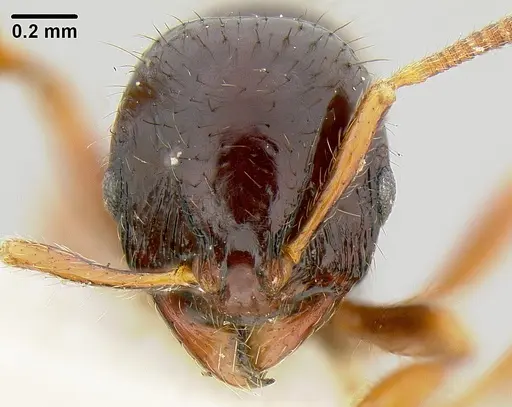
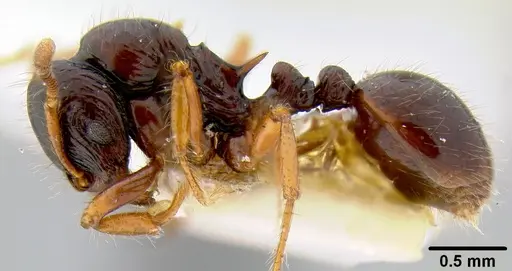
Lordomyrma levifrons is a large ant species measuring about 4.3mm in total length, known only from the mountains of Viti Levu in Fiji . This species is distinguished by its long straight propodeal spines, reddish-brown coloration, and an abundance of long fine-tipped yellowish hairs covering its face, mesosoma, petiole, and gaster - the longest hairs are as long as or longer than the eye . Originally described by W.M. Mann in 1921,it remains the only Lordomyrma species he described that has never been rediscovered in subsequent surveys . The stinger is present but weak with very reduced sides . This ant is extremely rare, with no confirmed sightings since Mann's original collections nearly a century ago .
Quick Summary
- Difficulty: Expert
- Origin & Habitat: Known only from the mountains of Viti Levu, Fiji. The original collection location was Nadarivatu [5][6]. No recent surveys have collected this species, suggesting it may be extremely rare or potentially extinct in the wild [3]. The genus Lordomyrma typically inhabits forest floor environments in tropical regions.
- Colony Type: Unknown. Colony structure has not been documented.
- Size & Growth:
- Queen: Unknown, no queen specimens have been described in the scientific literature
- Worker: 4.31mm total length (workers measured) [1][2]
- Colony: Unknown, no colony collections have been documented
- Growth: Unknown
- Development: Unknown, no development data exists for this species (Development timeline has not been studied.)
- Antkeeping:
- Temperature: Based on Fiji's tropical climate, likely requires warm conditions around 24-28°C. This is an estimate based on the species' origin, no specific temperature data exists.
- Humidity: Based on typical forest-floor habitat in Fiji, likely requires moderate to high humidity. Provide a moist nest substrate. This is an estimate.
- Diapause: Unknown, no seasonal data exists. Fiji has minimal seasonal temperature variation, so diapause may not be required.
- Nesting: No specific nesting data exists. Based on genus patterns, likely nests in soil, rotting wood, or under stones in shaded forest floor microhabitats. A naturalistic setup with moist substrate or a Y-tong/plaster nest would be appropriate.
- Behavior: Behavior has not been documented. Based on genus typical patterns, likely a generalist forager on the forest floor. The stinger is present but weak [4]. Escape risk is moderate given the worker size, standard barrier precautions recommended.
- Common Issues: this species may be extinct in the wild, availability is extremely uncertain, no captive breeding records exist, making established care protocols nonexistent, the complete lack of biological data means all care recommendations are educated guesses, wild-caught colonies may be impossible to obtain, limiting captive keeping to any surviving museum stock
Rarity and Conservation Status
Lordomyrma levifrons represents one of the most poorly known ant species in the world. Originally described by W.M. Mann in 1921 from collections in the mountains of Viti Levu, Fiji, this species has never been rediscovered despite multiple subsequent ant surveys of the Fiji Islands [1][3]. Recent comprehensive surveys by Sarnat and Economo in 2012 failed to locate any specimens, suggesting this species may be extremely rare, locally extinct, or perhaps only ever existed in very limited populations [3]. The type locality of Nadarivatu remains the only known collection site [5]. This extreme rarity makes captive keeping extremely difficult, as there are no established colonies and no confirmed source of wild-caught specimens.
Identification and Distinguishing Features
This is a large ant for the genus Lordomyrma, measuring approximately 4.3mm in total length [1]. The most distinctive features include long straight propodeal spines, and an abundance of long fine-tipped yellowish hairs covering the dorsal surfaces, the longest hairs are as long as or longer than the eye [1][2]. The body is reddish-brown with a lighter-colored gaster and appendages. The sculpturing is reduced compared to many related species, giving the ant a relatively smooth and shiny appearance. It can be distinguished from other Fijian Lordomyrma species by the combination of long propodeal spines and the long fine-tipped hairs present on the face, mesosoma, petiole, and gaster [3].
Stinger and Defense
Lordomyrma levifrons possesses a stinger, though it is described as weak with very reduced sides [4]. The sting apparatus shows typical Myrmicinae structure with a rectangular spiracular plate, tapered quadrate plate, and filamentous lancets [4]. Given the weak sting morphology, the defensive capability is likely limited. The ant would rely more on its spines and general ant behavior for defense rather than a painful sting. This is consistent with many forest-floor ant species that prioritize escape over direct confrontation.
Housing and Care Recommendations
Since no captive care records exist for this species, all recommendations are educated estimates based on the genus and origin. Provide a warm, humid environment consistent with Fijian forest floor conditions, aim for temperatures around 24-28°C and humidity in the 60-80% range. A naturalistic setup with moist soil substrate or a plaster/Y-tong nest with moisture chambers would be appropriate. Feed standard ant foods including protein sources (insects) and sugar water, though specific dietary preferences are unknown. Given the extreme rarity and lack of available specimens, this species is recommended only for expert antkeepers with specific research interests who may obtain specimens through museum or scientific channels. Standard escape prevention is advisable given the worker size.
Taxonomic History
Lordomyrma levifrons has a complex taxonomic history. It was originally described by Mann in 1921 as Rogeria (Irogeria) tortuosa levifrons, a subspecies of what was then classified as Rogeria [6][5]. The species was later transferred to the genus Lordomyrma by Kugler in 1994,and elevated to full species rank by Sarnat in 2006 [5]. The original description was based on worker specimens collected from Nadarivatu, Viti Levu, Fiji. This taxonomic history reflects the historical confusion between Lordomyrma and Rogeria genera, which were later separated.
Frequently Asked Questions
Is Lordomyrma levifrons available for purchase?
Almost certainly not. This species has not been collected since 1921 and was not found in recent comprehensive surveys of Fiji [3]. No commercial ant vendors have this species, and it may be extinct in the wild.
How do I care for Lordomyrma levifrons?
No established care protocol exists because this species has never been kept in captivity. Any recommendations would be educated guesses based on the genus and its Fiji origin, warm conditions around 24-28°C with standard ant foods. This species is not recommended for captive keeping due to its extreme rarity.
What does Lordomyrma levifrons look like?
It is a large robust ant about 4.3mm long with long straight propodeal spines, a reddish-brown body, and distinctive long yellowish hairs covering its head, body, and abdomen. The hairs are longer than the eye [1][2].
Where does Lordomyrma levifrons live?
Only known from the mountains of Viti Levu, Fiji. The type locality is Nadarivatu [5]. It has never been collected from any other location.
Does Lordomyrma levifrons sting?
Yes, it has a stinger, but it is described as weak with reduced sides [4]. The sting is likely not painful to humans.
How big do Lordomyrma levifrons colonies get?
Unknown. No colony collections have ever been documented.
Is Lordomyrma levifrons endangered?
The conservation status has not been formally assessed, but the complete absence of records since 1921 despite multiple surveys suggests it may be critically endangered or extinct [3].
Can I keep multiple queens of Lordomyrma levifrons together?
Unknown. Colony structure has never been documented for this species. No data exists on whether they are single-queen or multi-queen colonies.
What temperature does Lordomyrma levifrons need?
No specific data exists. Based on its origin in Fiji (tropical), likely requires warm conditions around 24-28°C. This is an estimate only.
How long does it take for Lordomyrma levifrons to develop from egg to worker?
Unknown. No development data exists for this species.
Report an Issue
The current care sheet is based fully on literature. See inconsistencies, or something that's incorrect? Please , it will be resolved after review from an admin. Contributing to the blogs tab also helps providing information, to make us be able to further improve the caresheets. Thank you for your support!
References

This caresheet is licensed under CC BY-SA 4.0 .
Community Blogs
CASENT0171004
View on AntWeb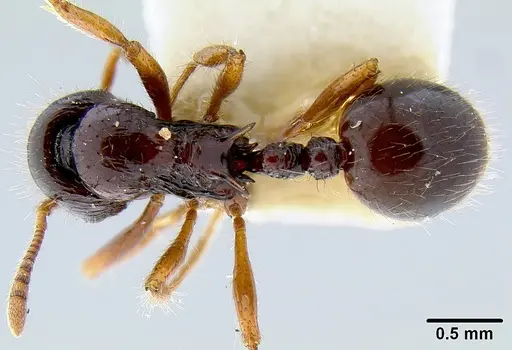
Literature
Loading distribution map...Loading products...