
Lophomyrmex terraceensis
- Sci. Name
- Lophomyrmex terraceensis
- Tribe
- Crematogastrini
- Subfamily
- Myrmicinae
- Author
- Bharti & Kumar, 2012
- Distribution
- Found in 1 countries
Introduction
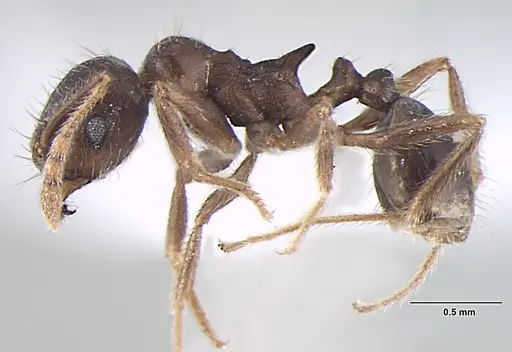
Lophomyrmex terraceensis is a small myrmicine ant endemic to the lower Shivalik range of north-western Himalayas in Himachal Pradesh, India . Workers measure 3.14-3.27 mm in total length and have thick, blunt, sub-parallel propodeal spines and a truncate petiolar node . The body is dark brown with numerous long erect hairs . This species was collected from leaf litter in an intact Eucalyptus forest at 420 m altitude near Terrace village . This ant belongs to the bedoti group and is distinguished by its unique propodeal spine shape and high mesonotal prominence .
Quick Summary
- Difficulty: Hard
- Origin & Habitat: Semi-arid Eucalyptus forest in the lower Shivalik range of north-western Himalayas, Himachal Pradesh, India at 420 m altitude. Collected from leaf litter using Winkler's extractor [1][2].
- Colony Type: Unconfirmed, colony structure has not been documented for this species [1].
- Size & Growth:
- Antkeeping:
- Temperature: Unknown, no thermal studies exist. Based on its Himalayan origin at 420 m altitude in a semi-arid region [1][2], expect moderate temperatures. Start around 22-26°C and observe colony activity.
- Humidity: Based on collection from leaf litter in a semi-arid area [1], likely prefers moderate humidity. Keep nest substrate slightly moist but allow some drying between waterings.
- Diapause: Unknown, no seasonal studies exist. Based on Himalayan distribution [2], a winter rest period may be beneficial, but this is unconfirmed.
- Nesting: In nature, they nest in leaf litter [1]. For captivity, a small test tube setup or Y-tong nest with chambers scaled to their 3 mm size would be appropriate.
- Behavior: Behavior is unstudied in captivity. Based on genus typical patterns, they are likely ground-dwelling ants that forage in leaf litter [1]. Their small size means escape prevention is important. They likely have a moderate temperament. As a myrmicine ant in the Crematogastrini tribe, they may have a smear defense mechanism, but this is based on general taxonomic knowledge and not specific to this species.
- Common Issues: no captive husbandry information exists, this is a newly described species with no established care protocols, extremely limited availability, likely not available in the antkeeping hobby, queen caste undescribed, founding behavior and colony establishment are unknown, small size requires excellent escape prevention despite being larger than many myrmicine ants, lack of data on diet, temperature preferences, and colony development makes successful keeping very challenging
Species Discovery and Taxonomy
Lophomyrmex terraceensis was described in 2012 by Bharti and Kumar from specimens collected in Himachal Pradesh, India [1]. It belongs to the bedoti group of the genus Lophomyrmex, characterized by pronota with lateral irregular marginations [1]. The species name refers to its type locality, Terrace village in Kangra District [1]. The holotype was collected on May 10,2004,and the paratype on May 25,2009,both from leaf litter in an intact Eucalyptus forest at 420 m altitude [1].
Identification and Physical Characteristics
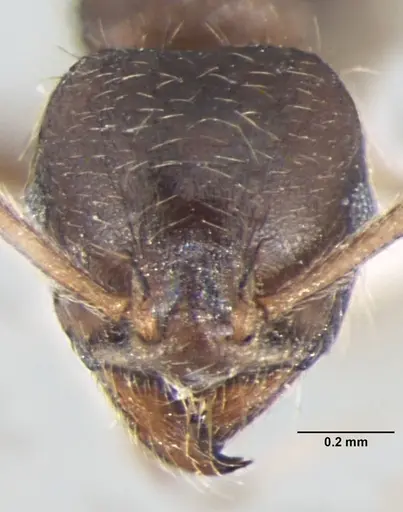
Workers of Lophomyrmex terraceensis measure 3.14-3.27 mm in total length [1]. The most distinctive features are the thick, blunt, sub-parallel propodeal spines of almost uniform diameter and the truncate petiolar node with a steep anterior face [1]. The body is dark brown with head, legs and sides being slightly paler, and numerous long erect hairs cover the head, mandibles, clypeus, pronotum, petiole, postpetiole and gaster [1]. The postpetiole is about 1.6 times wider than the petiole [1]. These ants have 11-segmented antennae with a distinct 3-segmented club [1].
Natural Habitat and Distribution
This species is endemic to India, known only from Himachal Pradesh state in the lower Shivalik range of the north-western Himalayas [2]. The type locality is Terrace village at coordinates 31.9234°N,75.9294°E, at an elevation of 420 m [1]. The area is semi-arid and the ants were collected from leaf litter in an intact Eucalyptus forest using a Winkler's extractor [1]. This forest has thick leaf litter, providing the moist, shaded microhabitat these ants prefer [1].
Current State of Knowledge and Care Challenges
Lophomyrmex terraceensis was described in 2012 [1], and there is no published research on its captive care, colony structure, founding behavior, diet, temperature requirements, or development timeline. The queen caste has not been described [1], meaning we don't know if they are claustral or semi-claustral. This makes keeping this species extremely challenging, as no established protocols exist.
Housing and Nesting Considerations
Based on collection method (leaf litter extraction) and the semi-arid Himalayan habitat [1], these ants likely prefer naturalistic setups with access to soil or leaf litter material. A small test tube setup would work for founding colonies, while established colonies might benefit from a naturalistic terrarium-type setup that mimics their leaf litter habitat. The small worker size means chambers and passages should be appropriately scaled. Escape prevention should be moderate, use fine mesh on any openings. Provide a small outworld area for foraging.
Feeding and Diet
The diet of Lophomyrmex terraceensis has not been documented in scientific literature. As a myrmicine ant in the Crematogastrini tribe, they likely have typical ant diets, accepting sugar sources and protein [1]. However, this is an inference from genus-level patterns, not confirmed for this species. Start with offering sugar water constantly and small protein sources several times per week.
Frequently Asked Questions
How do I keep Lophomyrmex terraceensis ants?
No established care protocols exist for this species. It was only described in 2012 and has never been kept in captivity [1]. You would need to experiment with temperature (start around 22-26°C based on habitat [1][2]), humidity (slightly moist substrate), and diet (sugar water + small insects). This species is extremely rare in the hobby and may not be available at all.
What do Lophomyrmex terraceensis ants eat?
Their diet has not been studied. Based on typical myrmicine ant behavior, they likely accept sugar sources and small insects [1]. Start with honey water or sugar water and offer small protein items like fruit flies or tiny mealworms.
How big do Lophomyrmex terraceensis colonies get?
Colony size is unknown. No data exists on maximum colony size for this species.
Do Lophomyrmex terraceensis ants sting?
Sting potency is unstudied. As a myrmicine ant with thick propodeal spines, they likely have a stinger, but given their small size, any sting would be minimal. Handle with normal antkeeping precautions.
What temperature do Lophomyrmex terraceensis ants need?
No thermal studies exist for this species. Based on its Himalayan origin at 420 m altitude in a semi-arid region [1][2], expect moderate temperatures. Start around 22-26°C and observe colony behavior.
Do Lophomyrmex terraceensis need hibernation?
Diapause requirements are unknown. The species comes from Himachal Pradesh, which has distinct seasons with cold winters [2], so a winter rest period may be beneficial. However, no research exists to confirm this.
Is Lophomyrmex terraceensis a good species for beginners?
No. This is one of the least suitable species for beginners due to complete lack of captive husbandry data. There are no established care protocols, no information on founding behavior, and no guidance on temperature, humidity, or diet preferences.
Where can I get Lophomyrmex terraceensis ants?
This species is extremely rare and likely not available in the antkeeping hobby. It is endemic to a small region in Himachal Pradesh, India [2], and was only described in 2012 [1].
How long does it take for Lophomyrmex terraceensis to develop from egg to worker?
The development timeline is completely unknown. No research has studied the brood development of this species.
Can I keep multiple Lophomyrmex terraceensis queens together?
Colony structure is unconfirmed. No research exists on whether this species is monogyne or polygyne. Without this basic information, combining queens is not recommended.
What type of nest is best for Lophomyrmex terraceensis?
Based on their leaf litter collection habitat [1], a naturalistic setup with soil or a small Y-tong/plaster nest would be appropriate. The chambers should be scaled to their 3 mm worker size.
Is Lophomyrmex terraceensis aggressive?
Temperament is unstudied. No behavioral observations have been published for this species. Based on genus typical patterns, they likely have moderate aggression similar to other small myrmicine ants.
Report an Issue
The current care sheet is based fully on literature. See inconsistencies, or something that's incorrect? Please , it will be resolved after review from an admin. Contributing to the blogs tab also helps providing information, to make us be able to further improve the caresheets. Thank you for your support!
References

This caresheet is licensed under CC BY-SA 4.0 .
Community Blogs
ANTWEB1008008
View on AntWeb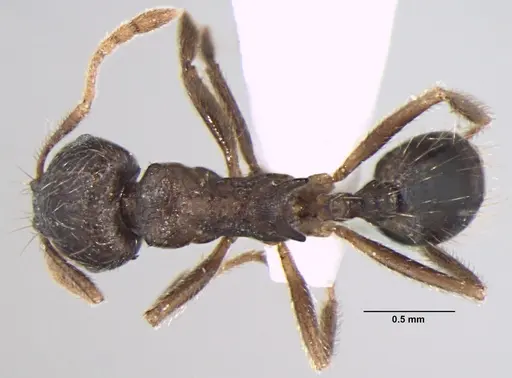
Literature
Loading distribution map...Loading products...