
Leptogenys modiglianii
- Sci. Name
- Leptogenys modiglianii
- Tribe
- Ponerini
- Subfamily
- Ponerinae
- Author
- Emery, 1900
- Distribution
- Found in 0 countries
Introduction
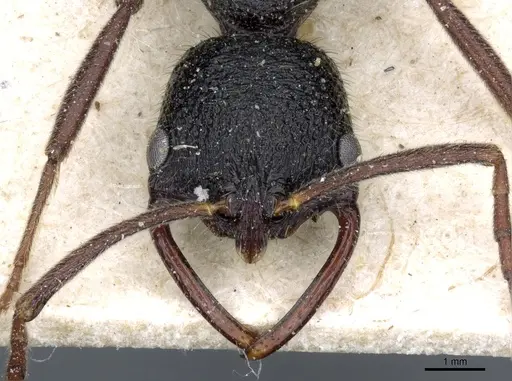
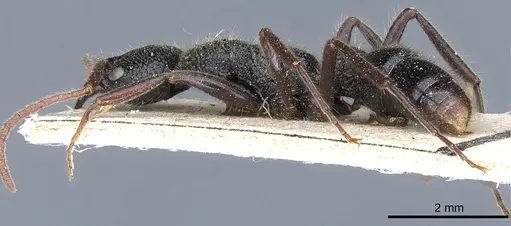
Leptogenys modiglianii is a medium-sized predatory ant belonging to the Ponerinae subfamily. Workers have a distinctly elongated head that is longer than wide, with curved mandibles that become straight toward the tip, and antennae that extend past the back of the head by about one-fifth to one-fourth of their length . The body is primarily black with a reddish tinge, featuring distinctive red coloration on the clypeus, mandibles, antennae, legs, and lower half of the petiole, while the tip of the abdomen shows red-brown segments . This species is endemic to Enggano Island, a small island off the west coast of Sumatra, Indonesia . The biology of this species remains completely undocumented in scientific literature - no observations on colony structure, founding behavior, diet, or any aspect of their natural history have been published . As a member of the Leptogenys genus, these ants are predatory hunters using their elongated mandibles to capture prey, but specific details about their care requirements must be inferred from related species.
Quick Summary
- Difficulty: Expert
- Origin & Habitat: Enggano Island, Indonesia, a tropical island off the west coast of Sumatra. The type locality is Malaconni on Enggano Island [1]. Nothing is known about their natural habitat preferences.
- Colony Type: Unknown, the colony structure has not been documented. Most Leptogenys species form small to medium colonies with single queens, but this has not been confirmed for Leptogenys modiglianii.
- Size & Growth:
- Queen: Unknown, queen caste has not been described [1]
- Worker: ~4-7mm total length, inferred from Leptogenys genus patterns
- Colony: Unknown, no colony size data exists for this species
- Growth: Unknown, no development data available
- Development: Unknown, no direct observations for this species (Related Leptogenys species typically have semi-claustral founding where the queen must hunt to feed herself and early brood.)
- Antkeeping:
- Temperature: Keep at 24-28°C, this matches their tropical Indonesian origin. A slight gradient allowing cooler areas (around 22°C) is beneficial
- Humidity: Maintain high humidity around 70-80%. These are forest-dwelling ants from a humid tropical island, keep the nest substrate consistently moist but not waterlogged
- Diapause: Unknown, no data on seasonal behavior. Given their tropical origin, they likely do not require a true diapause, but may have reduced activity periods
- Nesting: No specific data exists. Based on genus patterns, they likely nest in rotting wood, under stones, or in soil in shaded forest areas. A naturalistic setup with moist substrate or a Y-tong/plaster nest works well for Leptogenys species
- Behavior: No behavioral observations exist for this species. Based on genus characteristics, Leptogenys ants are typically active predators that hunt alone or in small groups, using their elongated mandibles to capture prey. They have a functional stinger as typical of Ponerinae ants. They are generally not aggressive toward humans but will defend their nest if threatened. Workers are medium-sized so standard barriers are usually sufficient.
- Common Issues: completely unknown biology makes captive care highly speculative, expect a steep learning curve, no confirmed colony structure means you cannot predict whether single or multiple queens are appropriate, queen caste unknown means finding a mated queen for captive breeding is extremely difficult, lack of documented diet means you must experiment with various prey items, no development data means you cannot track whether your colony is growing normally
Species Identification and Distribution
Leptogenys modiglianii was originally described by Carlo Emery in 1900 from specimens collected on Enggano Island, Indonesia [1]. The species belongs to the modiglianii species group within the genus Leptogenys, characterized by their distinctly elongated heads (cephalic index 88-90) and unique petiole shape where the dorsal face slopes distinctly forward [1]. The type specimens were collected by Elio Modigliani in June 1891,and the lectotype is housed at the Museo di Storia Naturale di Genova (MSNG) with specimen code ANTWEB CASENT 0903974 [1]. This species is known only from Enggano Island, making it a rare and geographically restricted ant species.
What We Do Not Know
This is one of the most poorly documented ant species in the hobby. Literally nothing has been published about the biology of Leptogenys modiglianii, no observations on colony size, queen behavior, founding, diet, nuptial flights, or any aspect of their natural history exist in scientific literature [2]. Even the queen caste has never been described, so we have no idea what a mated queen looks like or how large she might be [1]. This makes keeping this species an exercise in informed speculation rather than established husbandry. You will essentially be pioneering all aspects of their care, which requires significant experience with related Leptogenys species and a willingness to experiment.
Inferred Care from Related Species
Since direct data is unavailable, care must be inferred from other Leptogenys species and general Ponerinae biology. Leptogenys ants are predatory, using their elongated mandibles to capture prey, likely isopods and other small arthropods in their natural habitat. They typically form colonies ranging from dozens to a few hundred workers. Most Leptogenys species practice semi-claustral founding, meaning the queen must leave the nest to hunt for food during the founding stage, unlike claustral ants that seal themselves in and live off stored fat. Provide a constant supply of small live prey (fruit flies, small crickets, isopods) and protein-rich foods. Keep humidity high and temperatures in the low-to-mid 20s Celsius range. These ants are best suited for experienced keepers who can adapt when standard protocols fail.
Defense Mechanism
Leptogenys modiglianii belongs to the Ponerinae subfamily, which is characterized by primitive ants with functional stingers. These ants use their sting to inject potent, peptide-rich venom that is painful to vertebrates. While the specific sting potency of L. modiglianii is unstudied, other Leptogenys species are known to deliver a mildly painful sting comparable to a bee sting.
Frequently Asked Questions
Is Leptogenys modiglianii available for purchase?
No, this species is extremely rare in the antkeeping hobby. It is only known from Enggano Island, Indonesia, and has never been documented in commercial ant trade. Even finding a mated queen for identification would be nearly impossible since the queen caste has never been described.
How do I care for Leptogenys modiglianii?
No established care protocol exists because the species has never been kept in captivity. Based on related Leptogenys species, you would need to provide high humidity (70-80%), warm temperatures (24-28°C), and a diet of small live prey. Expect to experiment extensively since no documented husbandry exists.
What does Leptogenys modiglianii look like?
Workers have a distinctly elongated head that is longer than wide. They are primarily black with a reddish tinge, and have red coloration on the clypeus, mandibles, antennae, legs, and lower petiole. The abdomen tip shows red-brown segments. They have long antennae that extend past the back of the head.
Where is Leptogenys modiglianii found?
This species is endemic to Enggano Island, a small island off the west coast of Sumatra, Indonesia. It has never been recorded from any other location.
Do Leptogenys modiglianii ants sting?
Yes, as a Ponerinae ant, L. modiglianii has a functional stinger. The specific sting pain level for this species is unstudied, but based on related Leptogenys species, the sting causes mild to moderate pain similar to a bee sting.
What do Leptogenys modiglianii eat?
The diet is unconfirmed, but Leptogenys species are predatory hunters. Based on genus patterns, they likely hunt small arthropods including isopods (woodlice), springtails, and other micro-arthropods. They probably do not rely on sugar sources like many formicine ants.
How big do Leptogenys modiglianii colonies get?
Colony size is unknown, no colony data has been documented. Based on related Leptogenys species, colonies likely reach dozens to a few hundred workers, not the massive colonies seen in some Myrmicinae species.
Is Leptogenys modiglianii suitable for beginners?
No, this species is absolutely not suitable for beginners. The complete lack of documented biology means you would be pioneering all aspects of care with no established protocols to follow. Even expert antkeepers would struggle with this species due to the uncertainty involved.
Does Leptogenys modiglianii need hibernation?
Probably not, Enggano Island is a tropical location with year-round warm temperatures. There is no documented diapause requirement, and based on their origin, they likely maintain activity year-round with perhaps reduced activity during cooler periods.
Can I keep multiple Leptogenys modiglianii queens together?
Unknown, colony structure has never been documented for this species. Most Leptogenys form single-queen colonies, but polygyny has been observed in some related species. Without any data on this specific species, combining unrelated queens is not recommended.
Report an Issue
The current care sheet is based fully on literature. See inconsistencies, or something that's incorrect? Please , it will be resolved after review from an admin. Contributing to the blogs tab also helps providing information, to make us be able to further improve the caresheets. Thank you for your support!
References

This caresheet is licensed under CC BY-SA 4.0 .
Community Blogs
CASENT0903974
View on AntWeb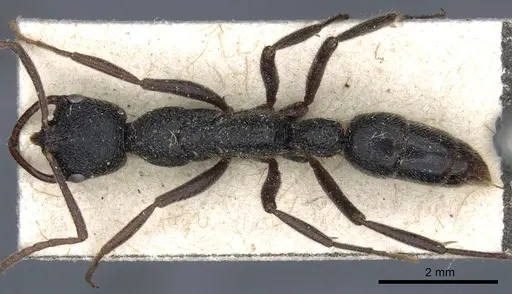
Literature
Loading distribution map...Loading products...