
Leptanilloides manauara
- Sci. Name
- Leptanilloides manauara
- Subfamily
- Dorylinae
- Author
- Brandão <i>et al.</i>, 1999
- Distribution
- Found in 0 countries
Introduction
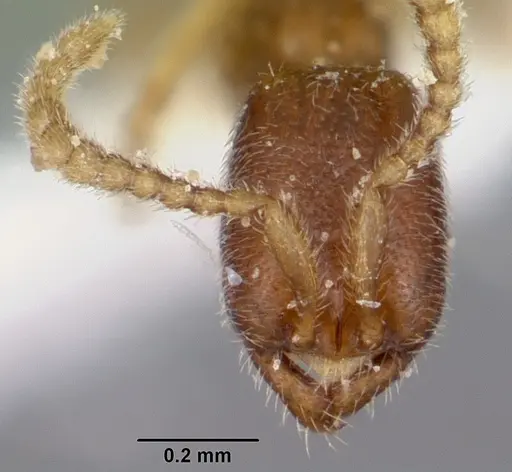
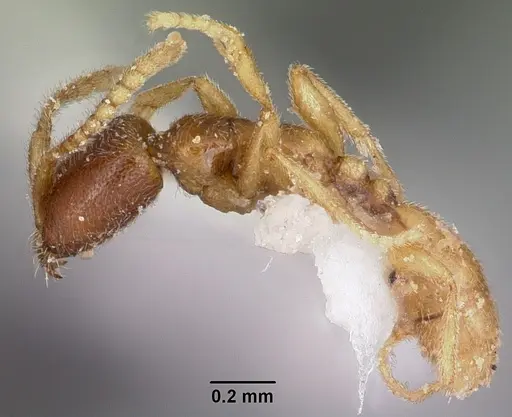
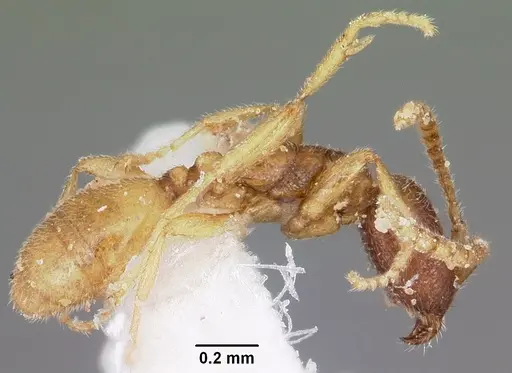
Leptanilloides manauara is an extremely rare Amazonian ant species known only from six worker specimens collected in a single soil sample from a forest reserve near Manaus, Brazil. Workers are tiny, with distinctive coarse sculpturing on the head, a wide head shape, and a slightly concave dorsal outline of the alitrunk . This species belongs to the Dorylinae subfamily in the tribe Leptanilloidini. The genus Leptanilloides is worker-based, meaning queens have never been described, and virtually nothing is known about this species' biology, colony structure, or behavior in the wild .
Quick Summary
- Difficulty: Expert
- Origin & Habitat: Known only from primary Amazonian rainforest in Amazonas, Brazil, specifically from a soil sample collected at Fazenda Esteio, ZF-23 Road, km 28,approximately 70km north of Manaus (Reserve 1301,02°26'13"S,59°48'35"W) [2][3]. The single collection was from a soil sample in a 100-hectare reserve of primary lowland Amazon forest surrounded by continuous forest [1]. Distribution also includes lowland Amazon and Atlantic coastal rainforest [2].
- Colony Type: Unconfirmed, colony structure is entirely unknown. Queens have never been described, and no observations of live colonies exist.
- Size & Growth:
- Queen: Unknown, queens have never been described or collected [2].
- Worker: Workers are very small, size data unavailable for total body length. Available measurements: head length 0.41mm, head width 0.35mm, scape length 0.27mm, mesosoma length 0.44mm [1].
- Colony: Unknown, no colony size data exists.
- Growth: Unknown, no development data exists.
- Development: Unknown, development has never been observed or documented. (No direct data on development exists.)
- Antkeeping:
- Temperature: Unknown, no thermal data exists. As an Amazonian lowland species, likely need warm conditions around 24-28°C.
- Humidity: Unknown, no humidity data exists. As an Amazonian soil-dwelling species, likely requires high humidity similar to other tropical soil ants.
- Diapause: Unknown, no seasonal data exists. Amazonian ants may not require true hibernation.
- Nesting: Only known from soil samples, they appear to be ground-nesting. In captivity, a small test tube setup or mini formicarium with moist soil would be appropriate.
- Behavior: Behavior is entirely unobserved. They are extremely small, so escape prevention must be excellent if ever kept. No data on aggression, sting, or foraging style exists.
- Common Issues: no established husbandry guidelines, this species has never been kept in captivity, queens have never been described, wild colony adoption is not possible, extremely limited distribution may indicate specialized habitat requirements, no dietary information exists, unknown what they eat, very small size makes escape likely without fine mesh barriers
Species Identification and Morphology
Leptanilloides manauara workers are among the smallest Amazonian ants. The most distinctive features include coarse sculpturing on the head, a wide head (cephalic index 87), rounded head sides in full-face view, and blunt teeth on the genae. The alitrunk has a slightly concave dorsal outline at the metanotal groove, and the propodeum has a dorsum that is continuous with the declivity. The petiolar ventral process is relatively small. These morphological features distinguish it from other Leptanilloides species and related genera. The species was originally described as Leptanilloides manauara in 1999 before being transferred to Leptanilloides in 2016 [1][2].
Distribution and Habitat
This species is known only from a single collection in the Brazilian Amazon. The type locality is Fazenda Esteio, located on the ZF-23 road at kilometer 28,approximately 70 kilometers north of Manaus in Amazonas state, Brazil. The collection was made in Reserve 1301,a 100-hectare fragment of primary lowland Amazonian forest within a larger area of continuous primary forest. The specimen was collected from a soil sample (sample H46) in December 1993 as part of the 'Projeto Dinâmica Biológica de Fragmentos Florestais' (Biological Dynamics of Forest Fragments Project), a joint INPA/Smithsonian research initiative [3][1]. This extremely limited distribution suggests either a genuinely rare species or one that has been undersampled due to its small size and soil-dwelling habits.
Why This Species Is Not Recommended for Keepers
Leptanilloides manauara is one of the least-known ant species in existence and is absolutely not suitable for antkeeping. There is no documented case of this species ever being kept in captivity, and virtually every aspect of its biology remains a complete mystery. Queens have never been described or collected, only workers are known from museum specimens. This means you cannot obtain a colony through any legal means. We have no information about what they eat, how they form colonies, what temperature and humidity they need, whether they have any special defensive behaviors, or even basic colony size. Attempting to keep this species would be pure experimentation with essentially no chance of success. For keepers interested in rare or challenging species, there are far better-documented options with established care guidelines. [2][1]
What We Might Infer From Relatives
While direct data is nonexistent, we can make educated guesses based on related ants. Leptanilloides belongs to the Dorylinae subfamily, which includes army ants known for raiding behavior and often large colonies. However, Leptanilloides is in a different tribe (Leptanilloidini) than typical army ants (Ecitonini) and may have very different biology. Other Dorylinae are typically claustral, but this cannot be confirmed for this species. As tiny Amazonian soil ants, they likely prefer warm, humid conditions similar to other tropical ground-dwelling ants. Their extremely small size suggests they may be predatory on micro-arthropods or feed on soil organisms, but this is pure speculation. Any husbandry would be experimental at best.
Taxonomic History
Leptanilloides manauara was originally described in 1999 by Brandão, Diniz, Agosti, and Delabie under the name Leptanilloides manauara, based on worker specimens collected in the Brazilian Amazon [1]. In 2016,Borowiec transferred this species to the genus Leptanilloides during a generic revision of the Dorylinae subfamily [2]. The genus Leptanilloides is considered a worker-based genus, meaning it was established based on worker morphology rather than associated queens or males. There is some suggestion that Leptanilloides may be a senior synonym of the genus Amyrmex, though this has not been definitively proven [2]. The species name 'manauara' is a noun in apposition, referring to what local people in the Manaus area call themselves.
Frequently Asked Questions
Can I keep Leptanilloides manauara ants?
No. This species has never been kept in captivity and queens have never been described or collected. There is no legal way to obtain a colony, and even if you could, we have no information about their care requirements. This is not a species for antkeepers.
Where does Leptanilloides manauara live?
Only known from a single soil sample collected in a forest reserve 70km north of Manaus, Brazil, in the Amazon basin. It has never been found anywhere else.
How big are Leptanilloides manauara workers?
They are tiny ants. Available measurements show head width 0.35mm and mesosoma length 0.44mm, with total body size estimated around 3.5-4mm.
What do Leptanilloides manauara eat?
Unknown, their diet has never been documented or observed. As tiny soil-dwelling Dorylinae, they may be predatory on micro-arthropods, but this is purely speculative.
Do Leptanilloides manauara queens exist?
Queens have never been described or collected. The genus Leptanilloides is worker-based, meaning we only know workers from this species. No one has ever observed a queen of this species.
How many queens do Leptanilloides manauara colonies have?
Unknown, colony structure is completely unstudied. No one has ever found or described a colony of this species.
What temperature do Leptanilloides manauara need?
Unknown, no thermal data exists. As an Amazonian species, they likely need warm conditions around 24-28°C, but this is an educated guess, not established fact.
How long does it take for Leptanilloides manauara to develop from egg to worker?
Unknown, development has never been observed or documented. Even basic colony founding has never been studied for this species.
Is Leptanilloides manauara aggressive?
Unknown, behavior has never been observed. No one has ever documented how these ants interact with each other or with intruders.
Are Leptanilloides manauara good for beginners?
No. This species is absolutely not suitable for any level of antkeeping. There is no care information, no known way to obtain colonies, and no established husbandry guidelines. This is a species for scientific study, not captivity.
Why is so little known about Leptanilloides manauara?
This species is known only from six worker specimens collected in a single soil sample in 1993. It has never been found since, despite extensive ant surveys in the Amazon region. Its extreme rarity, tiny size, and soil-dwelling habits make it very difficult to study.
Report an Issue
The current care sheet is based fully on literature. See inconsistencies, or something that's incorrect? Please , it will be resolved after review from an admin. Contributing to the blogs tab also helps providing information, to make us be able to further improve the caresheets. Thank you for your support!
References

This caresheet is licensed under CC BY-SA 4.0 .
Community Blogs
CASENT0104668
View on AntWeb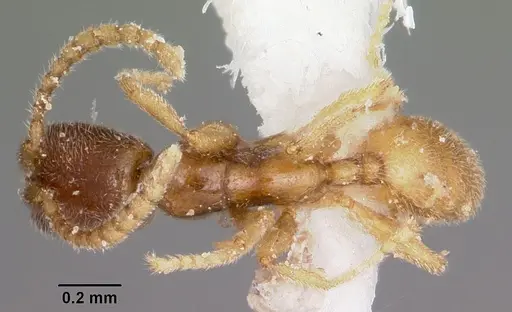
Literature
Loading distribution map...Loading products...