
Lepisiota erythraea
- Sci. Name
- Lepisiota erythraea
- Tribe
- Plagiolepidini
- Subfamily
- Formicinae
- Author
- Forel, 1910
- Distribution
- Found in 0 countries
Introduction
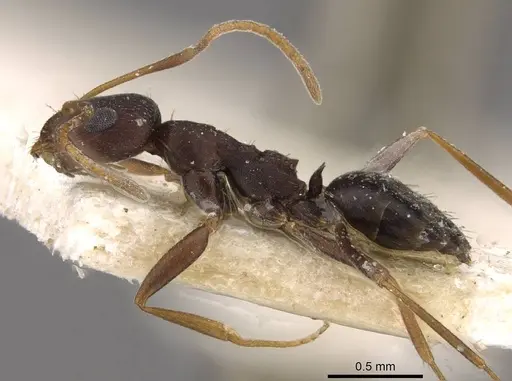
Lepisiota erythraea is an ant species from the Formicinae subfamily . It was originally described from Ethiopia and is now known across Eritrea, Ethiopia, Saudi Arabia, and Yemen . The most distinctive feature is the pair of long, sharp, triangular petiolar spines – workers also have a completely opaque, finely granulate gaster . The original description by Forel (1910) noted a rounded petiole, but the type material clearly shows spines . Size data for workers and queens is not recorded in available literature.
Quick Summary
- Difficulty: Medium – unconfirmed care requirements
- Origin & Habitat: Native to northeast Africa (Eritrea, Ethiopia) and the Arabian Peninsula (Saudi Arabia, Yemen) [2][3][1]. Its natural habitat is not explicitly documented but is presumed to be warm, dry to arid lowlands typical of the Horn of Africa and Arabian Peninsula.
- Colony Type: Colony structure and queen number have not been documented. No information available on monogyny, polygyny, or ergatoid queens.
- Size & Growth:
- Queen: Size data unavailable – not recorded in literature.
- Worker: Size data unavailable – not recorded in literature. Workers are small based on the size of the type specimens, but exact measurements are lacking.
- Colony: Unknown – no documented colony size.
- Growth: Unknown – no documented growth rate.
- Development: Unknown – no documented development timeline. (No data available, estimates from related species are purely speculative.)
- Antkeeping:
- Temperature: Care requirements are not documented. Based on its warm arid distribution, a temperature range of roughly 24–28°C is a reasonable starting point, but this is unconfirmed.
- Humidity: No documented humidity requirements. Given the arid habitat, low to moderate humidity is likely important. Use a dry nest with a small moist area and observe the colony.
- Diapause: Unknown – subtropical origin suggests no strong diapause requirement, but this is unconfirmed.
- Nesting: No species-specific nesting preferences are documented. For small ants like this, Y-tong (AAC), plaster, or soil nests with tight, narrow chambers would be suitable. Avoid overly wet substrates.
- Behavior: No specific behavioral studies exist. Workers are small ants that likely forage on the ground and low vegetation, typical of Formicinae. Escape risk is high due to small size – use fine mesh or Fluon barriers.
- Common Issues: escape prevention is critical due to the small worker size – use fine barriers and tight seals., lack of published care data means keepers must adjust conditions by trial and error., overly humid conditions may cause mold or stress – the species is adapted to dry environments., no reliable information on founding behavior or colony growth – avoid disturbance during early stages.
Identification
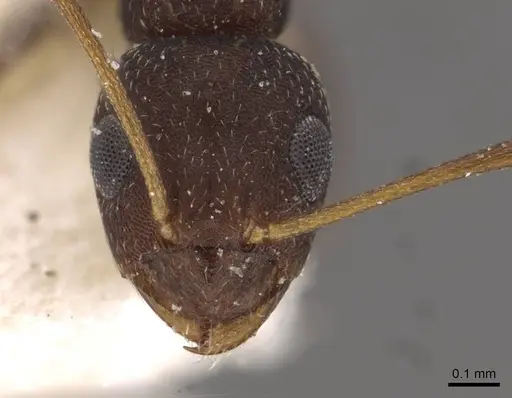
Workers of Lepisiota erythraea are distinguished by a pair of long, sharp, triangular petiolar spines and a completely opaque, finely granulate gaster [3]. The original description by Forel (1910) mentioned a rounded petiole, but examination of type material shows clear spines [3]. The mesosoma bears a few pairs of hairs [4]. Size measurements are not available in the literature.
Distribution and Habitat
The species is recorded from Eritrea, Ethiopia, Saudi Arabia, and Yemen [2][3][1]. It is classified as part of the Afrotropical region [4]. No detailed ecological information is available, but the regions are arid to semi-arid lowlands.
Housing and Nest Setup
Because no species-specific nesting preferences are known, general advice for small ants applies. Y-tong (AAC) or plaster nests with narrow, tight chambers work well. Test tube setups are fine for founding, but requiring later transfer to a formicarium. Ensure all connections are sealed to prevent escape, as workers are tiny. Provide a dry nest with a small, localized moisture source to mimic arid conditions.
Feeding and Diet
Based on the genus and subfamily, this species is likely omnivorous. Offer small protein sources (fruit flies, pinhead crickets) and sugar water or honey water. No documented dietary preferences exist, so observe what the colony accepts. Remove uneaten food to prevent mold.
Temperature and Seasonal Care
Temperature requirements are unconfirmed. Given the species' warm origin, a stable temperature around 24–28°C is a reasonable guess. Diapause requirements are unknown – if a winter rest is needed, a mild reduction to 15–18°C for 4–6 weeks might be trialed, but this is purely speculative. Keep careful records and adjust based on colony response.
Colony Founding
Founding behavior is undocumented. It is unknown whether queens found independently (claustral or semi-claustral) or require any form of social parasitism. Keepers should provide a dark, undisturbed test tube and hope for the best. Do not disturb the queen – if she produces workers, note the timing and conditions for future reference.
Frequently Asked Questions
How long does it take for Lepisiota erythraea to raise first workers?
Unknown – no documented data. If you observe this, please share your records.
What size colony does Lepisiota erythraea reach?
Unknown – no documented colony sizes.
Can I keep multiple Lepisiota erythraea queens together?
Unknown – not documented. It is not recommended as it may lead to fighting.
What temperature do Lepisiota erythraea need?
Requirements are not documented. Based on the warm distribution, aim for 24–28°C. This is a best guess.
Are Lepisiota erythraea good for beginners?
No – due to the lack of published care data, this species is not recommended for beginners. Only experienced keepers with a willingness to experiment should attempt it.
Do Lepisiota erythraea need hibernation?
Unknown – no documented information. A mild winter rest is possible but unconfirmed.
What do Lepisiota erythraea eat?
Based on the genus, they are likely omnivorous, accepting small insects and sugars. No specific studies exist.
When should I move my Lepisiota erythraea colony to a formicarium?
No specific guidance exists. Use general rules – move when the test tube becomes crowded or the colony stops growing. Observe carefully.
Why are my Lepisiota erythraea dying?
Common possibilities include incorrect humidity (too wet), temperature stress, or disturbance during founding. However, no systematic causes are documented.
Report an Issue
The current care sheet is based fully on literature. See inconsistencies, or something that's incorrect? Please , it will be resolved after review from an admin. Contributing to the blogs tab also helps providing information, to make us be able to further improve the caresheets. Thank you for your support!
References

This caresheet is licensed under CC BY-SA 4.0 .
Community Blogs
CASENT0909880
View on AntWeb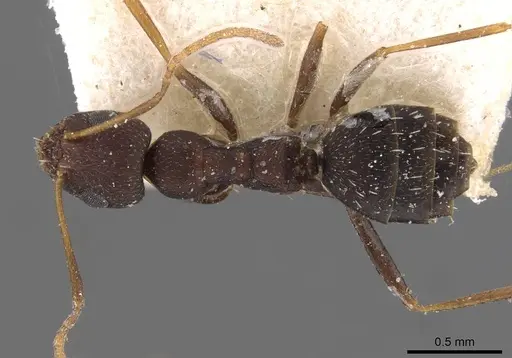
Literature
Loading distribution map...Loading products...