
Lepisiota elbazi
- Sci. Name
- Lepisiota elbazi
- Tribe
- Plagiolepidini
- Subfamily
- Formicinae
- Author
- Sharaf & Hita Garcia, 2020
- Distribution
- Found in 1 countries
Introduction
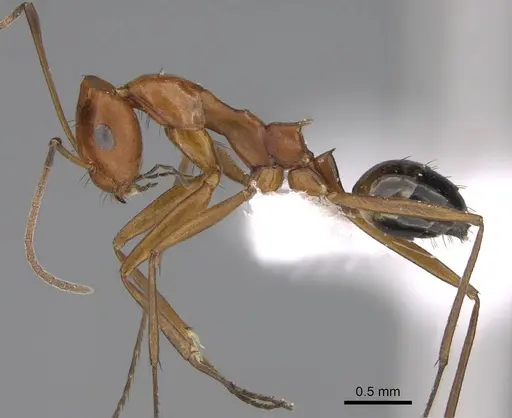
Lepisiota elbazi is a newly described ant species from the Dhofar Governorate of Oman, known only from two worker specimens collected in 2017 . Workers measure 3.2-3.5mm in total length, making them a small ant species . They have a distinctive bicolored appearance: the head, mesosoma, and petiole are yellow to red-yellow, while the gaster is dark brown to black with the first tergite slightly lighter . This species was discovered foraging in leaf litter covering dry soil under an Acacia tree (now classified as Vachellia) at Ayn Razat, Oman, and appears to be endemic to this region .
Quick Summary
- Difficulty: Unknown, insufficient data for care recommendations
- Origin & Habitat: Endemic to Dhofar Governorate, Oman. Workers have only been collected at Ayn Razat (17.12443N,54.23832E,98m elevation), foraging in leaf litter covering dry soil under an Acacia tree [1][2].
- Colony Type: Unknown, colony structure has not been documented. Only two workers have ever been collected [1].
- Size & Growth:
- Antkeeping:
- Temperature: Inferred from habitat: Dhofar is a hot, arid region. Start around 24-28°C and observe colony activity [1].
- Humidity: Inferred from collection data: found in dry soil conditions under Acacia trees. Keep nest substrate moderately dry [1][2].
- Diapause: Unknown, no seasonal data available. Dhofar has mild winters.
- Nesting: Inferred: likely nests in soil or under stones in dry habitats. A naturalistic setup with sandy soil or a Y-tong/plaster nest with low humidity would be appropriate [1].
- Behavior: Only two workers have ever been observed, both collected while foraging in leaf litter. Based on genus patterns, they likely search for small prey and honeydew. Their tiny size (3.2-3.5mm) means escape prevention must be excellent, they can squeeze through very small gaps [1].
- Common Issues: insufficient data, only two worker specimens have ever been collected, escape prevention is critical due to their very small size, colony structure and founding behavior remain completely unstudied, wild-caught colonies are likely nearly impossible to obtain since the species appears extremely rare
Species Discovery and Rarity
Lepisiota elbazi was described in 2020,making it one of the newest ant species known to science. The entire known population consists of just two worker specimens collected at Ayn Razat in the Dhofar Governorate of Oman [1]. This extreme rarity means almost nothing is known about their biology in the wild. The species name 'elbazi' honors Professor Farouk El-Baz, an Egyptian space scientist [1]. Dhofar Governorate is in southern Oman and has a unique climate influenced by the Indian Ocean monsoons, creating conditions that support several endemic ant species [2].
Identification and Appearance
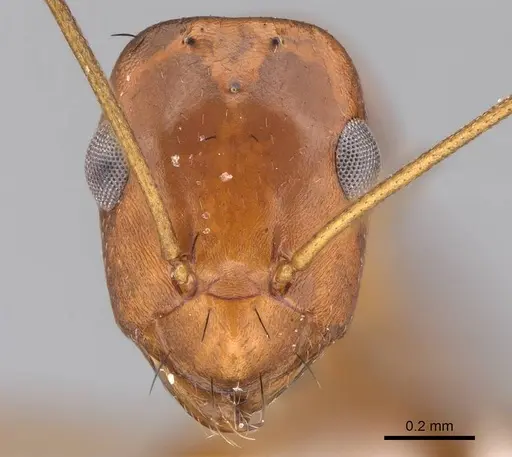
This species is distinctive among Lepisiota for its bicolored appearance. Workers have a yellow to red-yellow head, mesosoma, and petiole, while the gaster is dark brown to black with the first tergite slightly lighter [1][2]. They have an elongated head that is more than 1.3-1.6× longer than broad, with a straight posterior margin. The antennal scapes are very long, surpassing the posterior margin of the head by more than one third of their length. The propodeal spines are long and acute, and the petiole has two dorsal spines [1]. Body pilosity is limited, with only two pairs of hairs on the posterior margin of the head, two to three pairs on the promesonotum, and one to two pairs on the first gastral tergite [1].
Natural Habitat and Distribution
Lepisiota elbazi is known only from Ayn Razat in Dhofar Governorate, Oman, at an elevation of 98 meters [1]. The two known workers were collected in November 2017,foraging in leaf litter covering dry soil beneath an Acacia tree (now classified as Vachellia) [1][2]. This habitat suggests they prefer dry, shaded microclimates in arid regions. The Dhofar region of Oman has a unique environment where the summer monsoon creates a brief rainy season, supporting vegetation that differs from the surrounding Arabian Desert. This species appears to be endemic to Oman and may be restricted to very specific microhabitats [1][2].
Care Recommendations
Since this species has never been kept in captivity and basic biology is unknown, any care recommendations are educated guesses based on the collection data and genus patterns. The workers were found in dry soil under Acacia trees, suggesting they prefer arid to semi-arid conditions with low humidity. Keep the nest substrate on the dry side, think desert conditions rather than tropical rainforest. Temperature should be warm, likely in the 24-28°C range, reflecting the hot climate of Dhofar. For nesting, a naturalistic setup with sandy soil or a Y-tong/plaster nest with low moisture would be appropriate. Feed small protein sources like fruit flies or tiny insects, and offer sugar water or honey occasionally. Because workers are only 3.2-3.5mm long, excellent escape prevention is essential, use fine mesh and tight-fitting barriers [1].
Similar Species and Identification Key
Lepisiota elbazi is most similar to L. arabica from the southwestern mountains of Saudi Arabia. It can be distinguished from its closest relative by having fewer body hairs, a longer head, longer scapes, longer propodeal spines, and a shorter mesosoma [1]. The genus Lepisiota contains many species across Africa, Asia, and the Mediterranean region. In Oman, Dhofar Governorate has several endemic ant species, making it a region of significant zoogeographic interest [2]. If you are attempting to identify this species, key characteristics include the bicolored body, elongated head, very long antennal scapes, and the limited number of body hairs [1].
Frequently Asked Questions
How do I keep Lepisiota elbazi ants?
Care recommendations cannot be confidently provided, this is one of the rarest ant species in the world with only two known specimens. Based on genus patterns and collection data, they likely prefer dry, warm conditions. If you obtain a colony, keep nest substrate moderately dry and maintain temperatures around 24-28°C.
What do Lepisiota elbazi ants eat?
Unknown, no feeding observations have been documented. Based on typical ant diets, they likely accept small insects and honeydew.
How big do Lepisiota elbazi colonies get?
Unknown, only two workers have ever been collected. Colony size has not been studied in the wild or documented in captivity.
Are Lepisiota elbazi good for beginners?
No, this species is not recommended for beginners. Basic biology is completely unknown, and colonies may be impossible to obtain since the species appears extremely rare in the wild.
What is the queen size of Lepisiota elbazi?
Unknown, queens have never been described. The species was only described in 2020 from two worker specimens.
How long does it take for Lepisiota elbazi to develop from egg to worker?
Unknown, development has not been studied. No data exists on egg-to-worker timeline for this species.
Do Lepisiota elbazi need hibernation?
Unknown, no seasonal data is available. Dhofar, Oman has mild winters, so a diapause period may not be necessary or may be minimal.
Can I keep multiple Lepisiota elbazi queens together?
Unknown, colony structure has not been documented. The colony type (single-queen or multiple-queen) remains unstudied.
Where does Lepisiota elbazi live in the wild?
Only known from Ayn Razat in Dhofar Governorate, Oman. Workers were collected foraging in leaf litter covering dry soil under an Acacia tree at 98m elevation.
Is Lepisiota elbazi endangered?
The conservation status has not been assessed. However, with only two known specimens from a single location, this species may be at risk if its habitat is disturbed.
How do I identify Lepisiota elbazi?
Key identifying features include: tiny size (3.2-3.5mm), bicolored body (yellow head/mesosoma, dark gaster), very elongated head, long antennal scapes that extend well past the head, propodeal spines, and bispinose petiole. Limited body pilosity with only 2-3 pairs of hairs on the promesonotum.
Report an Issue
The current care sheet is based fully on literature. See inconsistencies, or something that's incorrect? Please , it will be resolved after review from an admin. Contributing to the blogs tab also helps providing information, to make us be able to further improve the caresheets. Thank you for your support!
References

This caresheet is licensed under CC BY-SA 4.0 .
Community Blogs
CASENT0922860
View on AntWeb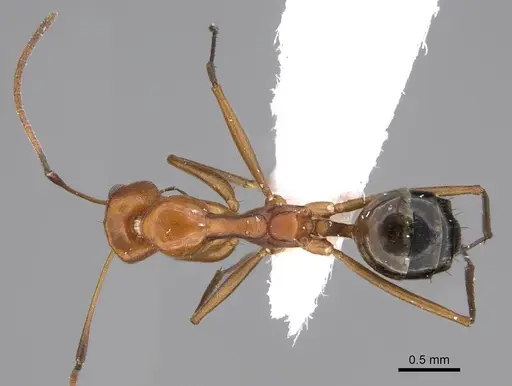
Literature
Loading distribution map...Loading products...