
Iridomyrmex roseatus
- Sci. Name
- Iridomyrmex roseatus
- Tribe
- Leptomyrmecini
- Subfamily
- Dolichoderinae
- Author
- Heterick & Shattuck, 2011
- Distribution
- Found in 1 countries
Introduction
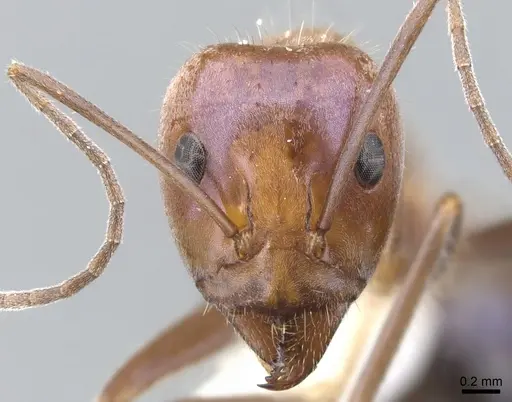
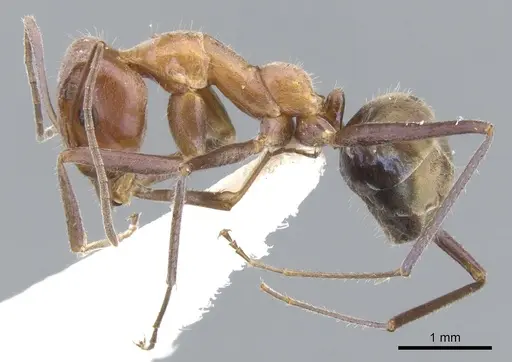
Iridomyrmex roseatus is a medium-large Australian ant with orange-red foreparts and pink iridescence, while the abdomen and legs are brown to black with bluish to greenish-yellow iridescence . It has a strong anteromedial clypeal spur, a triangular projection on the face, that makes it distinct from other Australian ants . The species is found in northern temperate and tropical Australia, recorded from all states except Victoria and Tasmania, and is common in drier areas like mallee and mulga woodlands . Habits are similar to meat ants, but detailed behavioral observations are lacking .
Quick Summary
- Difficulty: Medium
- Origin & Habitat: Northern Australia, arid and semi-arid mallee and mulga woodlands across Queensland, New South Wales, South Australia, Western Australia, and Northern Territory [1][2]. This is a dry-country ant adapted to warm, harsh conditions.
- Colony Type: Colony structure is unconfirmed. Based on related Iridomyrmex species, likely monogyne with single-queen colonies, though this requires confirmation for this specific species.
- Size & Growth:
- Queen: Size data unavailable, no total length measurements in literature
- Worker: Size data unavailable, no total length measurements in literature
- Colony: Up to several thousand workers, estimated from similar Iridomyrmex species
- Growth: Moderate, based on related species patterns
- Development: Unconfirmed for this species, estimated 6-8 weeks based on related Iridomyrmex patterns [2] (Development timeline is inferred from related species, direct observations for I. roseatus are lacking)
- Antkeeping:
- Temperature: Keep warm at 25-30°C during active season, based on arid Australian habitat [1]. Use a heating cable on one side of the nest to create a gradient for self-regulation.
- Humidity: Low to moderate, keep nest substrate consistently moist but not waterlogged, as this species comes from arid regions [1][2].
- Diapause: Unknown for this species, based on genus patterns, may reduce activity in cooler months but true hibernation is unconfirmed [2].
- Nesting: Natural nesting occurs in soil under stones in dry woodlands [2]. In captivity, use Y-tong (AAC) or plaster nests with a dry substrate gradient.
- Behavior: Likely similar to meat ants, relatively aggressive foragers with territorial behavior. Workers are active and collect nectar, honeydew, and small prey. Medium-large size means moderate escape risk, ensure secure barriers. Defense mechanism: lacks a functional sting, secretes defensive chemicals from abdomen tip (based on subfamily Dolichoderinae) [1].
- Common Issues: lack of species-specific care information means keepers must extrapolate from related species., overheating risk, direct heat sources can desiccate the colony in dry setups., moisture sensitivity, too much humidity can cause fungal problems unlike their natural dry habitat., limited availability, this species is not commonly kept in the antkeeping hobby., aggressive temperament similar to meat ants means careful handling and secure housing is needed.
Appearance and Identification
Iridomyrmex roseatus workers are distinctive medium-large ants with orange-red foreparts and pink iridescence, while the abdomen and legs are brown to black with bluish to greenish-yellow iridescence [1]. They have numerous erect pale yellow to whitish setae. The strong anteromedial clypeal spur is unique to this species and prevents confusion with any other Australian ant [1]. Eyes are semi-circular and positioned above the midpoint of the head capsule. Males and queens are not described in available literature.
Natural Habitat and Distribution
This species has a generally northern temperate and tropical distribution in Australia, recorded from all states except Victoria and Tasmania [1]. It is common in drier areas and has been collected in arid and semi-arid localities, often in mallee or mulga woodlands [1]. Workers have been captured in malaise traps and at Hakea blossoms, indicating foraging at flowers [1]. It is the fifth most common larger ant species in some habitats [3].
Related Species and Care Comparison
The habits of Iridomyrmex roseatus are likely similar to meat ants (Iridomyrmex purpureus group), which are aggressive, territorial, and build large colonies [2]. While specific behaviors are not documented, keepers should expect active foraging and potential large colony sizes. Meat ants accept sugar water and protein, so I. roseatus likely has similar dietary preferences.
Feeding and Diet
Based on presence at Hakea blossoms and related species, these ants likely have an omnivorous diet: nectar, honeydew, and small invertebrates [1]. In captivity, offer sugar water or honey continuously and protein like fruit flies or mealworms 2-3 times per week. Remove uneaten prey after 24-48 hours to prevent mold.
Temperature and Seasonal Care
As an Australian ant from arid regions, I. roseatus prefers warm conditions. Maintain 25-30°C during active season for optimal brood development [1]. During cooler months, room temperature is acceptable, but growth may slow. True hibernation is unconfirmed, consider a cool period at 15-18°C if activity reduces. Avoid temperatures below 15°C for extended periods.
Nesting in Captivity
In the wild, these ants likely nest in soil under stones in dry woodlands [2]. For captivity, use Y-tong or plaster nests with a dry substrate gradient. Allow portions to dry out between water additions. A naturalistic setup with sandy soil and stones mimics their habitat. Ensure secure outworld barriers due to active foraging.
Frequently Asked Questions
How long does it take for Iridomyrmex roseatus to produce first workers?
The exact timeline is unconfirmed. Based on related Iridomyrmex species, expect first workers approximately 6-8 weeks after egg laying at 25-30°C [2]. The queen is likely claustral, but this is unconfirmed for this species.
What do Iridomyrmex roseatus ants eat?
They likely eat nectar, honeydew, and small insects, based on presence at Hakea blossoms and related species [1]. In captivity, offer sugar water and protein like fruit flies or mealworms.
What temperature do Iridomyrmex roseatus ants need?
Keep them warm at 25-30°C during active season, as they are adapted to arid Australian conditions [1]. Use a heating cable for a temperature gradient.
Are Iridomyrmex roseatus good for beginners?
This species is rated Medium difficulty. Due to limited availability and care information, beginners may prefer more common species like Lasius or Camponotus.
How big do Iridomyrmex roseatus colonies get?
Colony size is not documented, but based on related Iridomyrmex species, they likely reach up to several thousand workers over several years.
Do Iridomyrmex roseatus need hibernation?
Diapause requirements are unconfirmed. As a northern Australian species, they may reduce activity in cooler months but true hibernation is not required [2].
Can I keep multiple queens together?
Colony structure is unconfirmed. Based on related Iridomyrmex species, they are likely monogyne (single queen). Combining unrelated queens is not recommended without evidence.
What humidity level do Iridomyrmex roseatus need?
Low to moderate humidity, keep the nest substrate moist but not wet, as they come from arid regions [1][2].
Where is Iridomyrmex roseatus found in the wild?
Northern Australia, Queensland, New South Wales, South Australia, Western Australia, and Northern Territory, in arid and semi-arid woodlands [1].
What makes Iridomyrmex roseatus different from other ants?
Their pink iridescence on orange-red foreparts (name means 'dressed in pink' in Latin) and unique triangular clypeal spur distinguish them [1].
Is Iridomyrmex roseatus available in the antkeeping hobby?
This species is not commonly available, it was described in 2011 and has limited distribution data. Most antkeepers work with more common Iridomyrmex species like meat ants.
Report an Issue
The current care sheet is based fully on literature. See inconsistencies, or something that's incorrect? Please , it will be resolved after review from an admin. Contributing to the blogs tab also helps providing information, to make us be able to further improve the caresheets. Thank you for your support!
References

This caresheet is licensed under CC BY-SA 4.0 .
Community Blogs
CASENT0903100
View on AntWeb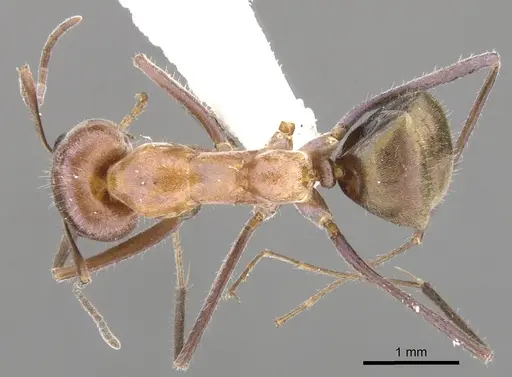
Literature
Loading distribution map...Loading products...