
Iridomyrmex luteoclypeatus
- Sci. Name
- Iridomyrmex luteoclypeatus
- Tribe
- Leptomyrmecini
- Subfamily
- Dolichoderinae
- Author
- Heterick & Shattuck, 2011
- Distribution
- Found in 1 countries
Introduction
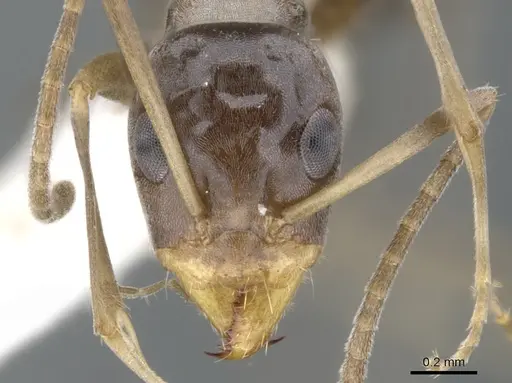
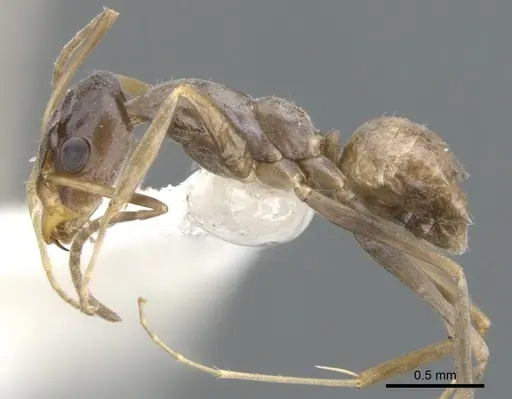
Iridomyrmex luteoclypeatus is a small ant native to the arid interior of Australia. Workers have a distinctive appearance with yellow mandibles and lower clypeal region contrasting against a medium to dark brown body that displays pale bluish to purple iridescence . The species name comes from Latin roots meaning 'yellow shield-shaped' - a reference to those yellow markings . This ant is forager active during the day and is very similar in appearance to the related Iridomyrmex bicknelli, with which it has been confused in museum collections - the two species can be distinguished by the shape of the posterior head margin (planar in I. luteoclypeatus versus convex in I. bicknelli) and the sides of the head (parallel or weakly convex in I. luteoclypeatus versus convergent toward the mandibles in I. bicknelli) . The species is distributed across the dry center of Australia from north-eastern Western Australia through South Australia to western Queensland .
Quick Summary
- Difficulty: Medium
- Origin & Habitat: Arid central Australia, found from north-eastern Western Australia through South Australia to western Queensland, typically in dry, open habitats [1][2]
- Colony Type: Colony structure is unconfirmed, the genus Iridomyrmex contains both single-queen and multi-queen species, but specific data for I. luteoclypeatus is lacking
- Size & Growth:
- Queen: Unconfirmed, no queen measurements available for this species
- Worker: ~3-4mm inferred from Iridomyrmex genus patterns, full body measurements unavailable [1]
- Colony: Unknown, no colony size data available
- Growth: Unknown, no development data available for this species
- Development: Unknown, no direct development data available for this species (Development timeline is unconfirmed. Related Iridomyrmex species typically develop relatively quickly, but specific data for this species does not exist.)
- Antkeeping:
- Temperature: Based on arid Australian distribution, keep warm in the low-to-mid 20s°C range. Provide a temperature gradient allowing workers to self-regulate.
- Humidity: Arid-adapted species, keep nest substrate moderately dry to dry. Provide a small water source in the outworld but avoid excessive moisture in the nest area.
- Diapause: Unknown for this species. Arid-region ants may have reduced activity during extreme heat rather than cold-induced diapause. Further study needed.
- Nesting: Natural nesting preferences unconfirmed. Based on arid habitat, likely nests in soil or under stones in the wild. In captivity, standard test tubes or soil nests work well, avoid overly humid conditions.
- Behavior: Forages diurnally according to available data [2]. Temperament is not well-documented, but Iridomyrmex species are typically moderate in aggression with well-developed foraging behavior. This species lacks a functional sting, dolichoderine ants defend by biting and secreting defensive chemicals from a slit-like opening at the tip of the abdomen. Escape prevention should be adequate for their small size, they can climb smooth surfaces. Workers are active foragers that likely recruit nestmates to food sources.
- Common Issues: limited biological data makes specific care recommendations uncertain, colony structure (single vs multiple queens) is unconfirmed, development timeline is unknown, making growth expectations uncertain, escape prevention needed despite small size, they can still climb, arid-adapted species may be sensitive to overwatering or high humidity
Identification and Appearance
Iridomyrmex luteoclypeatus workers are small ants, full body measurements are not available, but based on Iridomyrmex genus patterns, workers are approximately 3-4mm in total length [1]. The most distinctive feature is the yellow coloration on the mandibles and lower clypeal region (the shield-shaped area that gives the species its name), which contrasts with the medium to dark brown body that displays a pale bluish to purple iridescence [1][2]. This coloration helps distinguish them from the similar Iridomyrmex bicknelli, which is generally very dark brown or black with more pronounced bluish to yellowish-green iridescence [1]. The posterior margin of the head is planar (flat), while in I. bicknelli it is weakly to strongly convex. The sides of the head in full-face view are parallel or weakly convex in I. luteoclypeatus, versus convergent toward the mandibles in I. bicknelli [1]. These identification details are important because the two species have been confused in museum collections.
Distribution and Habitat
This species is found across the dry interior of Australia, from extreme north-eastern Western Australia to extreme western Queensland, and south throughout South Australia [1][2]. A more recent record from Carnarvon on the mid-west coast of Western Australia extends the known range [2]. Notably, no samples have been recorded from New South Wales, Victoria, or Tasmania [2]. The distribution spans arid to semi-arid regions, suggesting this species is well-adapted to dry conditions. The arid center of Australia experiences extreme temperatures and low rainfall, so this ant has evolved to cope with challenging environmental conditions including high temperatures and limited water availability.
Feeding and Diet
Specific dietary preferences for Iridomyrmex luteoclypeatus have not been documented. Like other members of the genus Iridomyrmex, they are likely generalist foragers that collect nectar, honeydew, and small insects. In captivity, you should offer a varied diet including sugar water or honey as an energy source, and protein sources such as small insects (fruit flies, pinhead crickets, mealworms). Given their small worker size, prey items should be appropriately sized. Iridomyrmex species are typically active foragers that will discover and recruit to food sources, so place food in the outworld where workers can easily access it.
Temperature and Care
Based on the species' distribution in arid central Australia, provide warm conditions in the low-to-mid 20s°C range. A temperature gradient is recommended so workers can self-regulate their body temperature by moving between warmer and cooler areas of the nest. This species is adapted to arid conditions, so avoid high humidity in the nest area, keep the substrate moderately dry rather than damp. A small water source in the outworld will allow workers to drink without creating overly humid conditions in the nest. Room temperature (around 20-24°C) is likely suitable for this species given its Australian origin.
Defense Mechanism
Iridomyrmex luteoclypeatus belongs to the subfamily Dolichoderinae, which lacks a functional sting. Instead, these ants defend by biting and secreting defensive chemical compounds from a slit-like opening at the tip of the abdomen. This is a smear defense mechanism common to dolichoderine ants.
Behavior and Colony Structure
Iridomyrmex luteoclypeatus is diurnal, meaning workers forage during the day [2]. Beyond this, detailed behavioral observations are lacking for this species. The genus Iridomyrmex includes both aggressive and more docile species, but specific temperament data for I. luteoclypeatus is not available. Colony structure (single-queen versus multi-queen) is also unconfirmed for this species. Workers are small but active foragers, and likely use chemical communication to recruit nestmates to food discoveries. For captive care, assume standard dolichoderine behavior until proven otherwise.
Frequently Asked Questions
How long does it take for Iridomyrmex luteoclypeatus to produce first workers?
The development timeline is unconfirmed for this species, no specific data exists on egg-to-worker development time.
What do Iridomyrmex luteoclypeatus ants eat?
Specific dietary data is lacking, but like other Iridomyrmex species, they likely accept sugar sources (honey, sugar water) and small protein items (fruit flies, small insects). Offer a varied diet and observe what they accept.
Are Iridomyrmex luteoclypeatus good for beginners?
This species is not well-documented in the antkeeping hobby, and limited biological data makes specific care recommendations uncertain. It may be suitable for intermediate keepers comfortable with species that require some educated guesswork in care.
What temperature should I keep Iridomyrmex luteoclypeatus at?
Based on their arid Australian distribution, aim for low-to-mid 20s°C. A temperature gradient allowing workers to choose their preferred warmth level is ideal. Room temperature (20-24°C) is likely suitable.
How big do Iridomyrmex luteoclypeatus colonies get?
Colony size data is not available for this species.
Can I keep multiple queens together?
Colony structure (single-queen or multi-queen) is unconfirmed for this species. Without documented evidence of multi-queen colonies, it is not recommended to combine unrelated foundress queens.
Do Iridomyrmex luteoclypeatus need hibernation?
Diapause requirements are unknown for this species. Arid-region ants may reduce activity during extreme conditions rather than enter true cold-induced hibernation. Further study is needed.
What humidity level do Iridomyrmex luteoclypeatus need?
As an arid-adapted species from central Australia, keep nest substrate moderately dry to dry. Avoid damp or humid conditions in the nest area. A small water source in the outworld is sufficient for drinking.
How do I identify Iridomyrmex luteoclypeatus?
Look for the distinctive yellow mandibles and lower clypeal region contrasting with medium to dark brown body that has pale bluish to purple iridescence. The posterior head margin is planar (flat), and the sides of the head are parallel or weakly convex when viewed from the front.
Report an Issue
The current care sheet is based fully on literature. See inconsistencies, or something that's incorrect? Please , it will be resolved after review from an admin. Contributing to the blogs tab also helps providing information, to make us be able to further improve the caresheets. Thank you for your support!
References

This caresheet is licensed under CC BY-SA 4.0 .
Community Blogs
CASENT0903097
View on AntWeb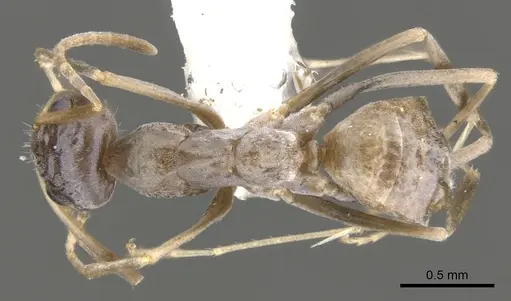
Literature
Loading distribution map...Loading products...