
Hypoponera nivariana
- Sci. Name
- Hypoponera nivariana
- Tribe
- Ponerini
- Subfamily
- Ponerinae
- Author
- Santschi, 1908
- Distribution
- Found in 1 countries
Introduction
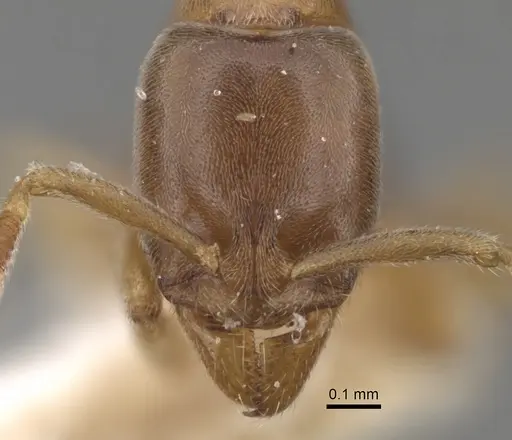
Hypoponera nivariana is a tiny, pale yellow ant endemic to Tenerife in the Canary Islands, Spain . This species belongs to the Hypoponera punctatissima group and displays a uniform dull yellow coloration throughout its body . Workers have small but distinct eyes positioned far forward on the head . This is an extremely rare species known from only five collections totaling just 13 workers and a single queen . Queens remain undescribed, and males have never been collected . The species may be a Canary Islands endemic, or potentially an Afrotropical species yet to be discovered on the continental mainland. Some researchers speculate it might represent a hybrid between Hypoponera eduardi and Hypoponera punctatissima, given its mix of characteristics from both species .
Quick Summary
- Difficulty: Expert
- Origin & Habitat: Endemic to Tenerife in the Canary Islands, Spain. Found in the Palaearctic region [1][2]. Natural habitat details are not documented.
- Colony Type: Unknown colony structure. Only a single queen has ever been collected, and queens remain undescribed. Males have never been collected [3].
- Size & Growth:
- Queen: Undescribed, queens are known but have not been measured [3]
- Worker: ~2mm (inferred from Hypoponera genus)
- Colony: Unknown, only 13 workers total have ever been collected [1]
- Growth: Unknown
- Development: Unknown, no development data exists for this species (Development timeline has not been studied.)
- Antkeeping:
- Temperature: Unknown for this species. Based on Canary Islands climate, aim for roughly 20-26°C and observe colony activity.
- Humidity: Unknown. Many Hypoponera species prefer moist conditions. Given the island habitat, moderate to high humidity is likely beneficial.
- Diapause: Unknown. No data on overwintering requirements exists for this species.
- Nesting: No specific nesting data exists. Related Hypoponera species typically nest in soil, rotting wood, or under stones. A naturalistic setup with moist substrate or a Y-tong/plaster nest would be appropriate.
- Behavior: Behavior is unstudied in captivity. Based on genus patterns, Hypoponera are typically predatory or omnivorous, with workers foraging individually. This species has a functional stinger typical of the Ponerinae subfamily. Their small size means escape prevention is critical, they can squeeze through extremely tiny gaps. Workers likely forage on the ground surface.
- Common Issues: this species is extremely rare in the wild and may not be available in the antkeeping hobby, no captive husbandry information exists, all care is speculative based on genus-level patterns, escape prevention is critical due to tiny worker size, slow growth is typical for small ponerine ants, patience is essential, wild-caught colonies may have parasites or health issues given the limited specimen numbers
Species Overview and Rarity
Hypoponera nivariana represents one of the most poorly known ant species in the Canary Islands. Described by Santschi in 1908,it has been collected only five times in total, with the entire known museum collection consisting of just 13 workers and a single queen [3]. This extreme rarity makes it a species of significant scientific interest rather than a typical antkeeping subject.
The taxonomic position of H. nivariana has been debated. Bolton and Fisher (2011) noted that at first glance it appears to be a small, depigmented version of Hypoponera eduardi that has lost most of its sculpture, but with dimensions falling within the lower end of the Hypoponera punctatissima range [1]. Some researchers have speculated it might be a hybrid between eduardi and punctatissima, though this remains unproven [3].
For antkeepers, this species presents a significant challenge: there is essentially no captive husbandry information available. All care recommendations must be inferred from genus-level patterns and related species, making successful cultivation uncertain.
Identification and Morphology
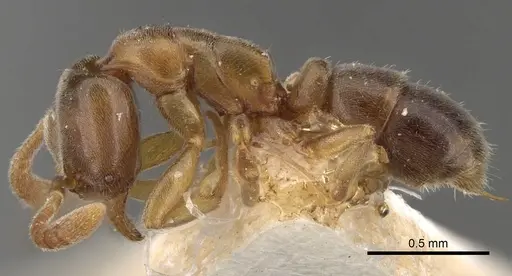
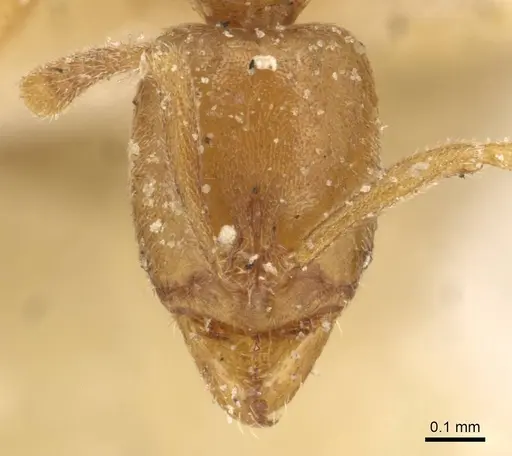
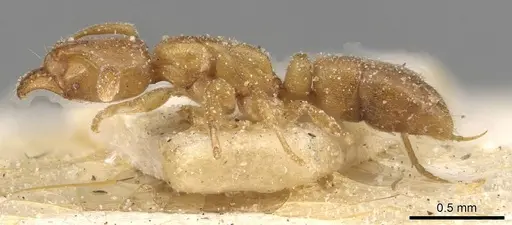
Workers of Hypoponera nivariana are tiny, pale yellow ants with a uniform coloration throughout the entire body [1]. The scape (the first segment of the antenna) is notably short, when laid straight back from its insertion, it fails to reach the midpoint of the posterior margin of the head [1]. The eyes are small but distinct, positioned far forward on the side of the head [1].
The mesonotal-mesopleural suture is absent, and the metanotal groove is conspicuously incised across the dorsum of the mesosoma [1]. The propodeal declivity is bluntly rounded into the sides without sharp marginations or carinae [1]. The dorsum of the mesosoma is almost smooth, with only minute and inconspicuous punctulae present [1]. The petiole node in profile has almost parallel anterior and posterior faces that converge only slightly at the apex [1].
Distribution and Endemism
Hypoponera nivariana is known only from Tenerife in the Canary Islands, making it a potential island endemic [1]. The species has never been recorded on the continental mainland, though it remains unclear whether this represents a true restricted distribution or simply a case of the species not yet being discovered in continental Afrotropical areas [3].
The Canary Islands provide a unique subtropical environment with moderate temperatures year-round. The presence of this species only on Tenerife suggests either very specific habitat requirements or potentially a recent introduction to the islands. Given the complete absence of males in collections and the single known queen, reproductive biology in the wild remains poorly understood [3].
For conservation perspective, the extreme rarity of this species raises concerns about its population status. Only five collections have ever been made, with the most recent being many decades ago [3].
Inferred Care Requirements
Since no captive husbandry data exists for Hypoponera nivariana, care recommendations must be based on genus-level patterns and related species. Hypoponera species are typically predatory or omnivorous, feeding on small invertebrates and honeydew. In captivity, you might offer small live prey such as springtails, fruit flies, or other micro-arthropods, along with occasional sugar sources like honey water.
Temperature requirements are unknown, but the Canary Islands experience moderate temperatures ranging from roughly 15-25°C depending on season. Starting in the low-mid 20s°C range and observing colony behavior would be appropriate. Many Hypoponera species prefer moist conditions, so maintaining moderate humidity in the nest is advisable.
Given their tiny size, escape prevention is absolutely critical. Use fine mesh barriers and ensure all enclosures are escape-proof. A naturalistic setup with moist substrate or a small plaster/Y-tong nest would be suitable starting points.
Challenges and Considerations
This species is not recommended for beginners due to the complete lack of captive husbandry information. Even experienced antkeepers will face significant challenges in establishing successful protocols. The extreme rarity of the species in the wild also raises questions about whether colonies are available in the antkeeping hobby at all.
If you do obtain this species, expect a slow-growing colony given typical patterns for small Ponerine ants. Patience will be essential. Monitor for signs of stress, and be prepared to adjust temperature and humidity based on colony response. The lack of male specimens in collections suggests breeding in captivity may present additional challenges.
Consider the ethical implications of keeping such a rare species. Unlike common ant species with established captive protocols, every successful colony of an endemic island species represents potentially significant conservation value. [3]
Frequently Asked Questions
How long does it take for Hypoponera nivariana to develop from egg to worker?
The development timeline is completely unknown, no research has examined the biology of this species.
What do Hypoponera nivariana ants eat?
Diet is unstudied for this species. Based on genus patterns, they likely accept small live prey and sugar sources. Offer a varied diet and observe acceptance.
Are Hypoponera nivariana good for beginners?
No. This is an expert-level species due to the complete lack of captive husbandry information. All care must be inferred from genus-level patterns, making success uncertain.
Do Hypoponera nivariana ants sting?
This species has a functional stinger typical of the Ponerinae subfamily. However, due to their tiny size, any sting would likely be imperceptible to humans.
What temperature do Hypoponera nivariana need?
Temperature requirements are unknown. Based on the Canary Islands climate, aim for roughly 20-26°C and adjust based on colony activity.
Can I keep multiple queens together?
Colony structure is unconfirmed. Only a single queen has ever been collected, so combining unrelated queens is not recommended without further study.
How big do Hypoponera nivariana colonies get?
Maximum colony size is unknown. Only 13 workers have ever been collected in the wild.
Do Hypoponera nivariana need hibernation?
Diapause requirements are unknown. The Canary Islands have mild winters, so any hibernation would likely be minimal or unnecessary in captivity.
What is the best nest type for Hypoponera nivariana?
No specific data exists. Based on genus patterns, a naturalistic setup with moist substrate or a small Y-tong/plaster nest would be appropriate.
Is Hypoponera nivariana available in the antkeeping hobby?
This species is extremely rare. It has been collected only five times in history and may not be available in the antkeeping trade.
Report an Issue
The current care sheet is based fully on literature. See inconsistencies, or something that's incorrect? Please , it will be resolved after review from an admin. Contributing to the blogs tab also helps providing information, to make us be able to further improve the caresheets. Thank you for your support!
References

This caresheet is licensed under CC BY-SA 4.0 .
Community Blogs
CASENT0281909
View on AntWeb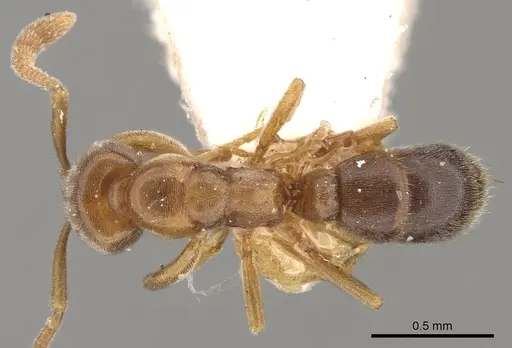
CASENT0915203
View on AntWeb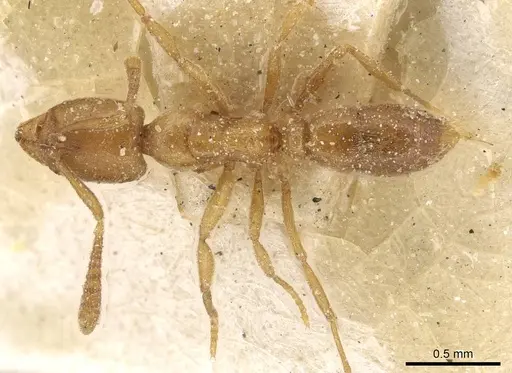
Literature
Loading distribution map...Loading products...