
Hylomyrma praepotens
- Sci. Name
- Hylomyrma praepotens
- Tribe
- Pogonomyrmecini
- Subfamily
- Myrmicinae
- Author
- Kempf, 1973
- Distribution
- Found in 2 countries
Introduction
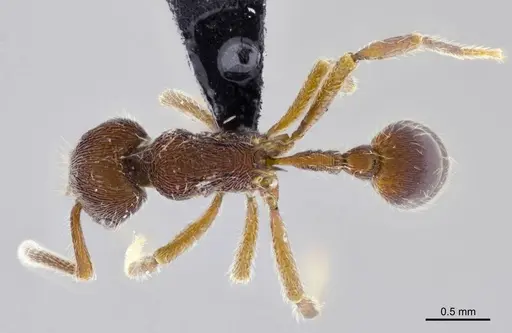
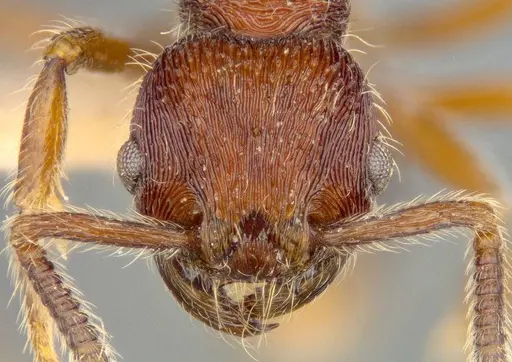
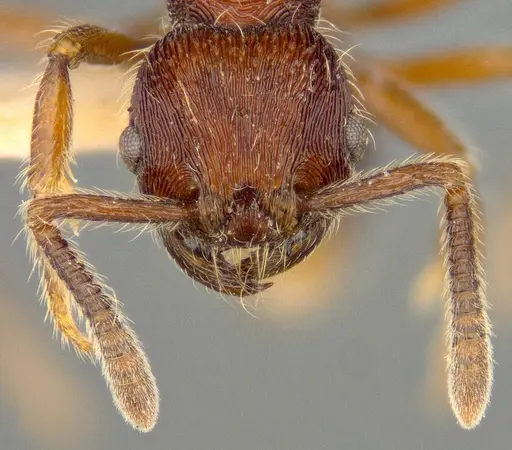
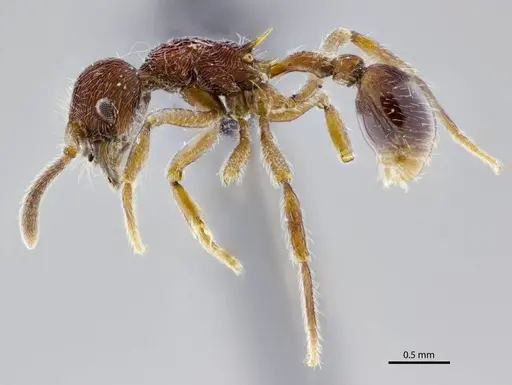
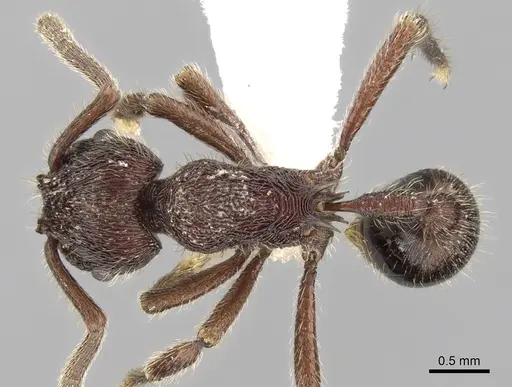
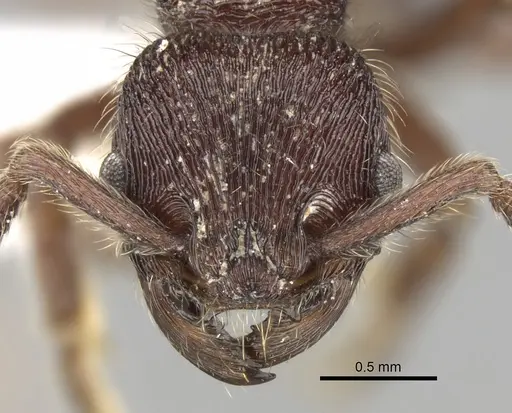
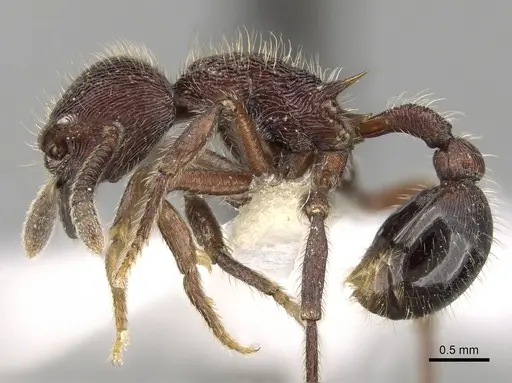
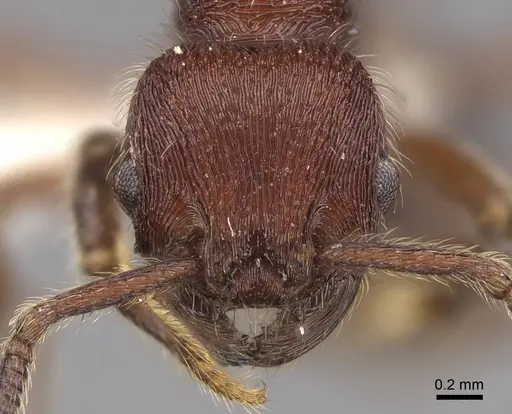
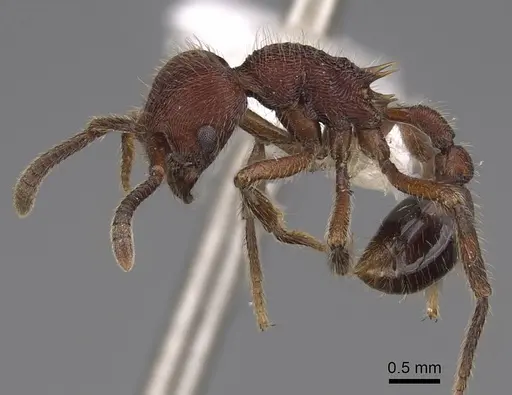
Hylomyrma praepotens is the largest species in the Hylomyrma genus, with workers measuring 6.1–6.4 mm and queens reaching 6.75 mm . They have a shiny body covered in thick, longitudinal striae on the head that diverge toward the back, long propodeal spines, and a continuous convex dorsal margin on the petiole . The clypeus bears a pair of large blunt teeth on its front edge. These ants are known from scattered localities across the northern Amazon region of South America: Colombia (Amazonas and Meta), Ecuador, Brazil, Peru, and French Guiana . All specimens were collected from forest leaf-litter using Berlese-Tüllgren funnels or Winkler extractors, suggesting the colonies nest in superficial soil layers or decaying organic matter on the forest floor . Almost nothing is known about their biology, making this one of the most poorly documented ant species in the world.
Quick Summary
- Difficulty: Unknown, species has never been kept in captivity
- Origin & Habitat: Northern Amazon basin (Colombia, Ecuador, Brazil, Peru, French Guiana) in lowland tropical rainforest leaf-litter and superficial soil layers [1][2][3][5].
- Colony Type: Unknown, colony structure has not been documented. Intercastes (specimens with both worker and queen characteristics) have been observed, suggesting complex social organization [1].
- Size & Growth:
- Queen: 6.75 mm [1]
- Worker: 6.1–6.4 mm [1]
- Colony: Unknown, only a few specimens have ever been collected
- Growth: Unknown, no captive data available
- Development: Unknown, no development data exists for this species (No information exists on egg-to-worker development time. Related Pogonomyrmecini species typically take 6–10 weeks at warm temperatures, but this is a rough estimate only.)
- Antkeeping:
- Temperature: Unknown, must be inferred from habitat. As an Amazon leaf-litter species, likely prefers warm conditions around 24–28 °C. Start at 24–26 °C and observe colony activity
- Humidity: Likely requires high humidity similar to other Amazon leaf-litter ants. Keep substrate consistently moist but not waterlogged. Collection data suggests they tolerate damp forest floor conditions [1]
- Diapause: Unknown, no seasonal data available. As a tropical species, may not require a diapause period, but this is unconfirmed.
- Nesting: Natural nesting occurs in leaf-litter and superficial soil layers. In captivity, a naturalistic setup with moist substrate (dirt-filled formicarium or terrarium-style nest) would likely work best. Avoid completely dry environments.
- Behavior: Behavior is unstudied in captivity. Based on collection from leaf-litter, they are likely ground-nesting. Escape risk is moderate given their 6 mm+ worker size, standard barriers should suffice. Sting potency is unknown, treat with caution as Myrmicinae ants often have functional stings.
- Common Issues: this is a completely unstudied species with no captive husbandry information, expect a steep learning curve, no information on what they eat, diet is completely unknown, colony size and growth rate are unknown, making it difficult to plan housing, founding behavior has never been observed, claustral vs. semi-claustral is unknown, no data on whether they accept sugar, what protein sources they prefer, or feeding schedules, hibernation or seasonal requirements are completely unstudied
Why This Species Is Challenging to Keep
Hylomyrma praepotens is one of the most poorly documented ant species in the hobby. This is not a species you can purchase and care for using existing knowledge, every aspect of captive husbandry will need to be discovered through experimentation. The species has been collected only a handful of times across its range, and no researcher has ever documented its biology in detail. You will be a pioneer if you attempt to keep this species. This makes it unsuitable for beginners, and even experienced antkeepers should approach with extreme caution. There is no information on founding behavior, diet preferences, temperature tolerance, humidity requirements, or any of the basic parameters antkeepers rely on. What we know is limited to: they are large for their genus (6–7 mm), they live in Amazon leaf-litter, and they were collected using specialized extraction methods from forest floor debris [1].
Natural History and Distribution
This species occupies a narrow band of the northern Amazon basin. Specimens have been recorded from the Colombian departments of Amazonas (near Leticia) and Meta, as well as scattered locations in Ecuador, Brazil, Peru, and French Guiana [2][3][4][5][6]. The type locality is 7km northwest of Leticia, Colombia, collected in February 1972 from forest litter using a Berlese-Tüllgren funnel extraction [1]. The unique Brazilian specimen was collected using a Winkler extractor, which samples leaf-litter and topsoil [1]. This collection method data tells us the colonies live in the superficial soil layers and decaying organic matter on the rainforest floor, not in deep soil or in trees. The species co-occurs with Hylomyrma immanis in at least one Colombian locality [1].
Morphology and Identification
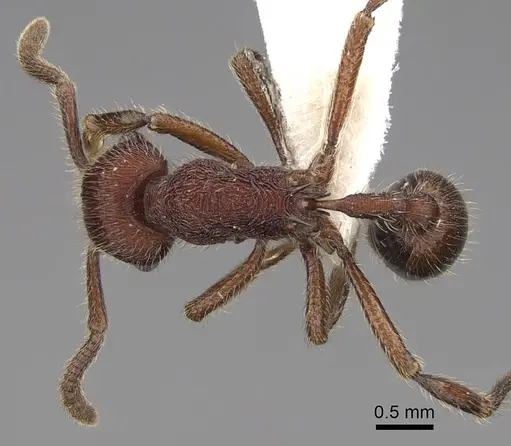
Hylomyrma praepotens is the largest species in the Hylomyrma genus, with workers measuring 6.1–6.4 mm total length [1]. The most distinctive features include: a shiny (not dull) integument, thick longitudinal striae on the head that diverge toward the back, very long propodeal spines, and a continuous convex dorsal margin on the petiole [1]. The clypeus (the plate covering the mouth) has a pair of large blunt teeth on its front margin. The first gastral segment (the abdomen just behind the waist) has very long striae on top and semicircular striae underneath [1]. Queens are slightly larger at 6.75 mm and have larger eyes with 18 ommatidia compared to 16 in workers [1]. The species is easily distinguished from its closest relative Hylomyrma immanis by the shiny integument (H. immanis is subopaque/dull) and the thick striae with clear spaces between them (H. immanis has thin striae with indistinguishable spaces) [1].
What Might Work for Housing
Since we know from collection data that these ants live in leaf-litter and superficial soil layers, a naturalistic terrarium-style setup would be the most logical starting point. The use of both Berlese funnels and Winkler extractors suggests they can be found by sifting through the top few centimeters of forest floor material. In captivity, this translates to a setup with a deep layer of moist, humus-rich substrate rather than a clean sand or plaster nest. A dirt-filled formicarium or a simple tank-style enclosure with a soil substrate would be appropriate. Given their size (6 mm workers), they are large enough that escape prevention is manageable, standard fluon barriers on smooth surfaces should work. However, since we have no data on whether they prefer dark enclosed spaces or will readily travel through exposed areas, provide both options: a covered nest chamber and an open foraging area. [1]
Inferring Care Requirements from Related Species
While no direct data exists for Hylomyrma praepotens, we can make educated guesses based on its placement in the tribe Pogonomyrmecini and its Amazonian habitat. The Amazon leaf-litter habitat suggests they need constant warmth (24–28 °C), high humidity, and a substrate that stays moist but doesn't become stagnant. Unlike desert Pogonomyrmex, these forest-floor ants likely cannot tolerate dry conditions. However, these are inferences only, the actual requirements could differ substantially. Any successful husbandry discoveries with this species would represent genuinely new scientific knowledge.
Frequently Asked Questions
Has anyone successfully kept Hylomyrma praepotens in captivity?
No, this species has never been documented in the ant-keeping hobby. There is no captive husbandry information available. This is one of the least-studied ant species in the world [1].
What do Hylomyrma praepotens ants eat?
Unknown, their diet has never been studied or documented. You would need to experiment with various foods to discover what they accept.
How long does it take for Hylomyrma praepotens to go from egg to worker?
Unknown, no development data exists for this species. There is no information on egg, larva, or pupa development times. Even the most basic timeline is completely unstudied.
Do Hylomyrma praepotens colonies have one queen or multiple queens?
Unknown, colony structure has never been documented. We don't know if they are monogyne (single queen) or polygyne (multiple queens).
What temperature and humidity do Hylomyrma praepotens need?
Unknown, no captive data exists. Based on their Amazonian rainforest habitat, they likely need warm (24–28 °C) and humid conditions, but this is an inference, not a confirmed requirement [1].
Can beginners keep Hylomyrma praepotens?
No, this species is completely unsuitable for beginners or even most experienced antkeepers. There is zero captive husbandry information available. Keeping this species would require discovering every aspect of care through experimentation, which is extremely risky for the colony.
Where can I get a Hylomyrma praepotens queen?
This species is not available in the ant-keeping hobby. It has only been collected a handful of times by researchers using specialized extraction methods. There are no known breeders or suppliers [1].
Do Hylomyrma praepotens need hibernation or a diapause period?
Unknown, no seasonal biology has been studied. As a tropical Amazon species, they may not require a winter rest period, but this is unconfirmed.
What is the best nest type for Hylomyrma praepotens?
Unknown, no captive data exists. Based on collection from leaf-litter and superficial soil, a naturalistic setup with moist substrate (dirt-filled formicarium or terrarium) would be a logical starting point [1].
Report an Issue
The current care sheet is based fully on literature. See inconsistencies, or something that's incorrect? Please , it will be resolved after review from an admin. Contributing to the blogs tab also helps providing information, to make us be able to further improve the caresheets. Thank you for your support!
References

This caresheet is licensed under CC BY-SA 4.0 .
Community Blogs
Literature
Loading distribution map...Loading products...