
Gnamptogenys schmitti
- Sci. Name
- Gnamptogenys schmitti
- Tribe
- Ectatommini
- Subfamily
- Ectatomminae
- Author
- Forel, 1901
- Distribution
- Found in 1 countries
Introduction
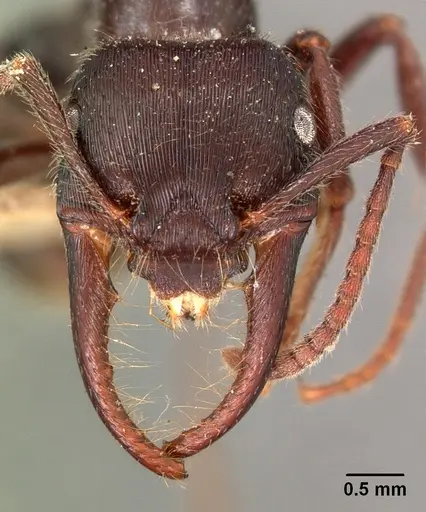
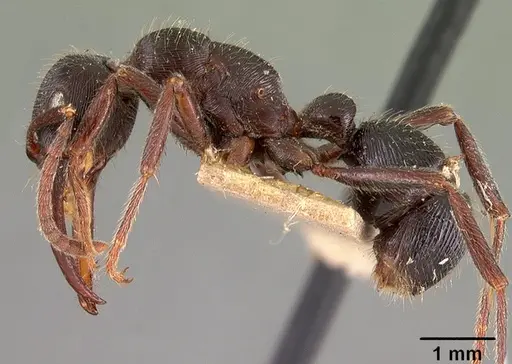
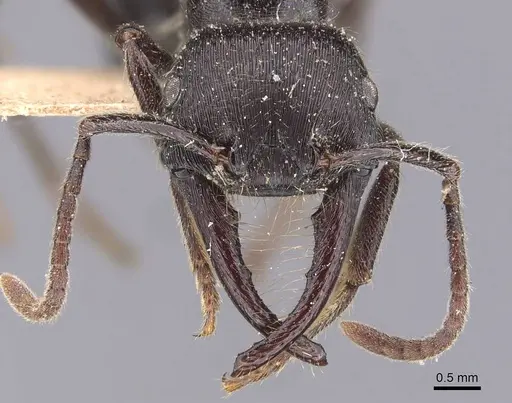
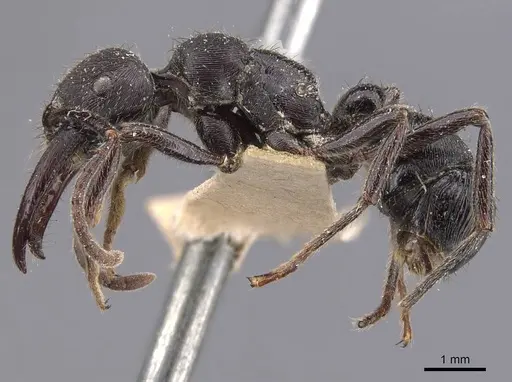
Gnamptogenys schmitti is a medium-sized predatory ant found only on the island of Hispaniola (Haiti and Dominican Republic) . Workers measure 7-9 mm and have a very broad head with long, curved, toothless mandibles that look almost like forceps - an extreme example within its genus . Their body is mostly black with a slight reddish tinge on the mandibles, antennae, and leg joints . This ant is a specialized millipede hunter - one of the most diet‑specialized ants in the Caribbean. Field observations show workers carrying polydesmid millipedes larger than themselves, sometimes completely hidden under their prey . The species has become rarer as deforestation on Hispaniola has destroyed much of its habitat . Workers are slow, timid, and forage mostly at dusk near streams .
Quick Summary
- Difficulty: Expert
- Origin & Habitat: Endemic to Hispaniola (Haiti and Dominican Republic), found at elevations of 610-1,219 meters [1][2]. They live in shaded, humid spots near streams, nesting under stones [1][2].
- Colony Type: Colony structure is unconfirmed, there are no published studies on queen number or social organization.
- Size & Growth:
- Queen: Unknown, the queen has not been described in available literature
- Worker: 7-9 mm [3]
- Colony: Unknown, no colony size data available
- Growth: Unknown
- Development: Unknown, development time has not been studied in this species (Based on related Ectatomminae species, expect several months for complete development, but this is only an estimate.)
- Antkeeping:
- Temperature: Keep warm, roughly 22-26°C. As a tropical Caribbean species it needs stable warmth, if workers seem sluggish, increase slightly, if they cluster away from heat, lower it. No exact optimal temperature is known, so observe and adjust.
- Humidity: High humidity is essential, they naturally live in humid spots near streams. Keep the nest substrate consistently moist but not waterlogged. Provide a water tube and ensure the nest stays damp. Use a soil‑sand mix that holds moisture.
- Diapause: Probably not required, as a tropical species, true hibernation is unlikely. They may become less active during cooler periods but do not need a cold diapause.
- Nesting: In the wild they nest under stones with chambers extending ~15 cm deep [1][2]. In captivity use a deep soil layer (10-15 cm) with flat stones on top, or a plaster/Y‑tong nest with high moisture retention. Tight, dark chambers are preferred.
- Behavior: Workers are slow‑moving and deliberate, similar to other Ectatommini [3]. They are timid and will hide when disturbed [3]. They forage mostly during twilight (crepuscular) [1][2]. They are not aggressive and rely on stealth. Escape risk is moderate, at 7-9 mm they can squeeze through small gaps, so use standard escape prevention.
- Common Issues: specialized diet makes feeding difficult, they require live millipedes or similar prey, which are hard to obtain consistently, high humidity needs can cause mold problems if ventilation is poor, slow growth and lack of captive breeding data make successful rearing challenging, wild‑caught colonies may carry parasites, given their declining wild populations
Feeding and Diet
Gnamptogenys schmitti is a highly specialized predator, it feeds almost exclusively on millipedes (Diplopoda) [1][2][4]. In the wild, researchers found numerous millipede fragments and entire individuals in the nest [3]. One forager was observed carrying a polydesmid millipede thrown over its body, completely hiding the ant beneath [1][2]. Some studies also found Coleoptera and Isopoda in nests, suggesting occasional acceptance of other prey [5]. In captivity, this specialized diet is the biggest challenge. You will need to culture or source live millipedes regularly. Other small arthropods (e.g., isopods) may be tried experimentally, but success is uncertain. The elongated, toothless mandibles are adapted for gripping millipedes, so standard ant foods like mealworms or fruit flies may be ignored. Sugar sources are unlikely to be accepted.
Natural History and Behavior
This species is endemic to Hispaniola, found only in Haiti and the Dominican Republic [6][1]. Its range has shrunk considerably due to deforestation [3]. They live at 610-1,219 meters elevation, in humid spots near streams [1][2]. Workers are slow and deliberate, moving like Ectatomma tuberculatum [3]. They are very timid and will hide when the nest is disturbed [3]. Foraging is crepuscular, active mainly in late afternoon/early evening [1][2]. Males are attracted to lights and have been collected at night [3]. The most remarkable behavior is their hunting technique: workers track and capture millipedes much larger than themselves, then carry them back to the nest. The ant may be completely hidden beneath the millipede, possibly as camouflage during the slow return trip [1][2].
Nesting and Habitat
In nature, Gnamptogenys schmitti nests under stones in humid areas near streams [1][2]. The nest entrance is a round hole about 6 mm (quarter‑inch) across, leading to a tunnel under a stone [3]. Some workers stay near the entrance, but most of the colony (along with brood) is in deeper chambers, ~15 cm below the surface [3]. For captive care, replicate these conditions: use a deep substrate layer (at least 10-15 cm) of a moisture‑retaining mix (e.g., soil‑sand). Place flat stones or other cover objects on top to create dark, enclosed spaces. A plaster or Y‑tong nest with good humidity control can also work. The key is keeping the nest dark and consistently damp.
Temperature and Care
As a tropical species from Hispaniola, this ant needs stable warm conditions. Aim for 22-26°C, which matches the climate of their native streamside habitats [1][2]. Unlike temperate species, they do not need a hibernation period. Avoid direct sunlight or heating elements that dry out the nest. A gentle heat gradient (warm one side, cool the other) lets workers self‑regulate. If using a heating cable, place it on top of the nest rather than underneath to slow moisture loss. Signs of stress: if workers cluster together and become sluggish, the temperature may be too low, if they avoid the heated area, it may be too hot. Always provide fresh water (e.g., test‑tube reservoir with cotton plug) and high ambient humidity.
Conservation Status
Gnamptogenys schmitti has a very restricted range and its habitat has been heavily impacted by deforestation on Hispaniola [3]. It is considered a rare, geographically restricted species. If you keep this ant, you are working with a vulnerable and specialized insect. Captive breeding could help conserve it, but the specialized diet and lack of captive data make this challenging. Never release captive colonies into the wild, especially outside Hispaniola. Within its native range, consult local conservation authorities before any release.
Frequently Asked Questions
What do Gnamptogenys schmitti ants eat?
They are specialized millipede predators. In the wild, they feed almost exclusively on Diplopoda (millipedes) [1][2][4]. Occasionally they may take Coleoptera and Isopoda [5]. In captivity, you must provide live millipedes regularly, other prey may be accepted experimentally, but success is not guaranteed. Standard ant foods like mealworms or sugar water are unlikely to be accepted.
How big do Gnamptogenys schmitti workers get?
Workers measure 7-9 mm [3].
Where is Gnamptogenys schmitti found?
This species is endemic to Hispaniola, found only in Haiti and the Dominican Republic at elevations between 610-1,219 meters [1][2].
Are Gnamptogenys schmitti good for beginners?
No. This is an expert-level species because of its extremely specialized diet (requiring live millipedes), high humidity needs, and lack of documented captive breeding. It is also rare in the wild.
Do Gnamptogenys schmitti ants sting?
They have a functional sting, like other Ectatomminae [3]. However, they are timid and slow-moving, so they are not aggressive. The sting is small and unlikely to penetrate human skin noticeably.
What temperature do Gnamptogenys schmitti need?
Keep them warm at roughly 22-26°C. As a tropical Caribbean species, they do not require hibernation and prefer consistent warmth.
How do Gnamptogenys schmitti nest?
In the wild, they nest under stones with a round entrance (~6 mm) and chambers extending about 15 cm into the soil [1][2]. In captivity, use a deep substrate (10-15 cm) with flat stones on top, or a humid plaster/Y‑tong nest with dark chambers.
Why are my Gnamptogenys schmitti dying?
Without established captive care guidelines, common problems may include: lack of appropriate prey (millipedes), low humidity, temperature stress, or parasites from wild‑caught colonies. Their specialized needs make them challenging to keep alive.
Can I keep multiple queens together?
Not enough is known about their colony structure to say. Combining queens has not been documented and is not recommended given their rarity and difficulty.
How long does it take for Gnamptogenys schmitti to develop from egg to worker?
This is unknown, the development time has not been studied. Based on related Ectatomminae, expect several months, but this is only an estimate.
Are Gnamptogenys schmitti endangered?
Their range has shrunk considerably due to deforestation on Hispaniola [3]. They are considered a rare, geographically restricted species. Handle with extra care given their conservation status.
When do Gnamptogenys schmitti alates (reproductives) appear?
This is unconfirmed. Males have been collected at night, attracted to lights [3], suggesting nuptial flights occur on warm, humid evenings. The exact timing is unknown.
Report an Issue
The current care sheet is based fully on literature. See inconsistencies, or something that's incorrect? Please , it will be resolved after review from an admin. Contributing to the blogs tab also helps providing information, to make us be able to further improve the caresheets. Thank you for your support!
References

This caresheet is licensed under CC BY-SA 4.0 .
Community Blogs
CASENT0102010
View on AntWeb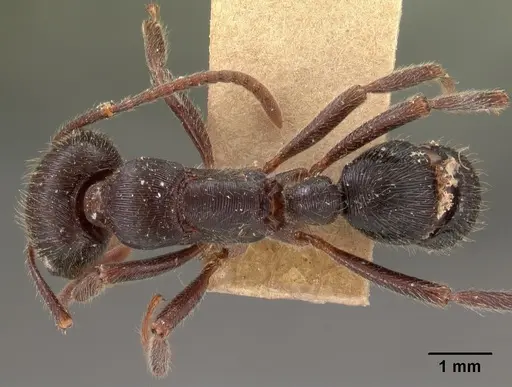
CASENT0907193
View on AntWeb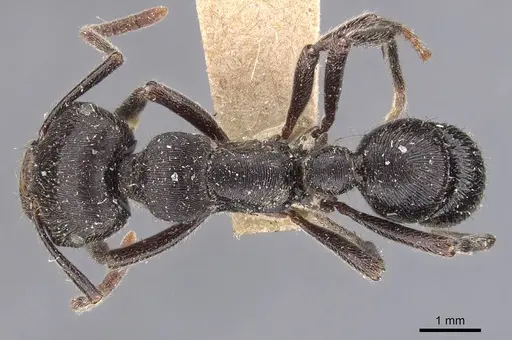
Literature
Loading distribution map...Loading products...