
Gesomyrmex kalshoveni
- Sci. Name
- Gesomyrmex kalshoveni
- Tribe
- Gesomyrmecini
- Subfamily
- Formicinae
- Author
- Wheeler, 1929
- Distribution
- Found in 1 countries
Introduction
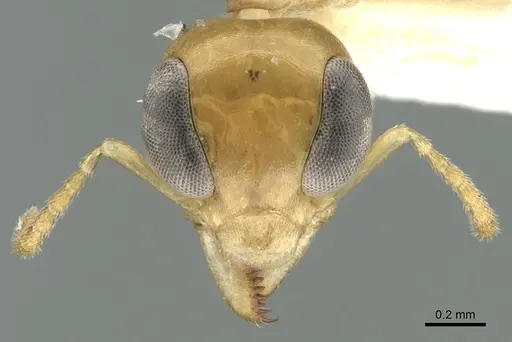
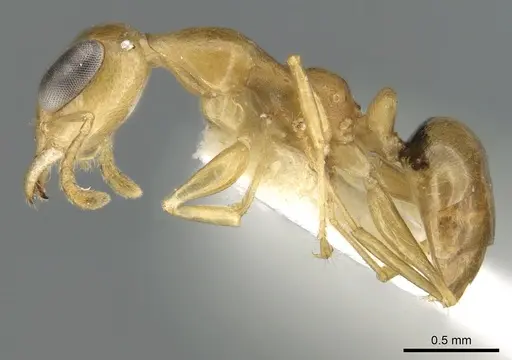
Gesomyrmex kalshoveni is a rare arboreal ant in the Formicinae subfamily. Workers are highly polymorphic, ranging from 2.8mm to 6.6mm total length, with distinct minima, media, and maxima castes in the same colony. They have a honey-yellow body, paler gaster and legs, large eyes, and 8-jointed antennae. The species ranges from Java, Indonesia, to Yunnan, China, and lives exclusively in tree branches within primary tropical forest . This genus is a living relict from the Eocene epoch. While once widespread during ancient warm periods, Gesomyrmex survives today only in isolated primary forest pockets, making captive colonies extremely rare .
Quick Summary
- Difficulty: Expert
- Origin & Habitat: Native to Indonesia (Java) and southern China (Yunnan province). This species is a strict primary forest specialist and never appears in secondary forest or plantations [2]. They nest in small tree branches in old mixed forest or teak stands [1].
- Colony Type: Unconfirmed. Based on typical Formicinae patterns, likely single-queen colonies, but social structure remains unstudied.
- Size & Growth:
- Queen: size data unavailable
- Worker: ~2.8-6.6mm total length, workers are highly polymorphic with minima, media, and maxima castes [1][3]
- Colony: Unknown from research
- Growth: Unknown, likely moderate based on related tropical Formicinae
- Development: Estimated 6-8 weeks at 24-28°C, based on related tropical Formicinae patterns (Development speed depends on stable warmth and consistent humidity.)
- Antkeeping:
- Temperature: Keep consistently warm, roughly 24-28°C. As a tropical species, they need stable heat year-round [4].
- Humidity: Provide a humidity gradient. Keep the nest substrate consistently moist but not waterlogged, matching the humid canopy environment [1].
- Diapause: No, tropical species do not require winter diapause [4].
- Nesting: Arboreal specialists that nest in tree branches. Use Y-tong (AAC) nests with narrow chambers, or vertical setups with cork bark and twigs. Avoid horizontal soil nests [1].
- Behavior: Generally peaceful. Formicinae ants spray formic acid instead of stinging. Workers are active foragers with good vision. Escape risk is moderate, use fine mesh or fluon barriers to prevent loss [1].
- Common Issues: colony death from cold stress if temperatures drop below 22°C, colony decline from stress due to simplified captive environments, colony loss from mold growth if ventilation is poor, colony failure from inappropriate horizontal soil nests, development delays from chambers too small for major workers
Housing and Nest Setup
Gesomyrmex kalshoveni lives in tree branches and twigs. You need a setup that mimics this arboreal niche. Y-tong (AAC) nests work best when you carve narrow chambers that fit their polymorphic workers. You can also build vertical setups using cork bark, artificial twigs, or stacked nesting blocks. Do not use horizontal soil formicariums. These ants prefer above-ground nesting and will ignore flat ground setups [1]. Provide a water reservoir to maintain humidity without flooding the nest [1].
Temperature and Heating
This species comes from tropical Java and southern China. You must keep the nest area at 24-28°C year-round. A heating cable placed on top of the nest creates gentle warmth without drying out the substrate. Room temperature works only if your home stays in the low-to-mid 20s°C range. Watch colony activity closely. If workers cluster together excessively, they need more heat. Never let temperatures drop below 22°C for extended periods, as cold stress kills tropical colonies [4][5].
Feeding and Diet
Like other Formicinae, Gesomyrmex kalshoveni likely feeds on honeydew and small insects. You should offer sugar water or diluted honey as a constant energy source. Provide small protein items like fruit flies, pinhead crickets, or soft-bodied insects two to three times per week. Place food on elevated platforms or branches in the outworld to match their canopy foraging habits. Remove uneaten prey within 24 hours to prevent mold [1].
Humidity Management
These ants live in humid primary forest canopies. You need to maintain consistent moisture without waterlogging the nest. Use a water reservoir in your Y-tong nest or a test tube feeder. Mist the outworld occasionally if the air feels dry. Balance humidity with strong ventilation to stop mold from taking over. Check substrate moisture regularly and adjust based on condensation levels and colony behavior [1].
Conservation and Rarity
Gesomyrmex kalshoveni is a strict primary forest specialist. You will never find them in secondary forest or rubber plantations [2]. Their extreme rarity in the wild means captive colonies are very hard to obtain. If you keep this species, you handle a relict population that survived from the Eocene epoch [3]. Never release captive colonies into non-native areas. These ants are sensitive to habitat disturbance and struggle in simplified environments [2].
Frequently Asked Questions
Is Gesomyrmex kalshoveni good for beginners?
No. This is an expert-level species. They require specific arboreal housing, stable tropical temperatures, high humidity, and careful ventilation. They are a poor choice for beginners. Start with common Formicinae like Lasius niger or Camponotus species first.
What size are Gesomyrmex kalshoveni workers?
Workers are highly polymorphic. Minima workers measure 2.8-3.2mm total length. Media workers measure 3.5-4.5mm. Major workers reach 5-6.6mm. All three castes develop in the same colony [1][3].
What do Gesomyrmex kalshoveni eat?
They likely feed on honeydew and small insects in the wild. In captivity, offer sugar water or diluted honey constantly. Provide small protein sources like fruit flies or pinhead crickets two to three times per week.
Where is Gesomyrmex kalshoveni found in the wild?
This species lives in Indonesia (Java) and southern China (Yunnan province). They are a primary forest specialist and never appear in secondary forest or plantations [2][5].
How long does it take for eggs to develop into workers?
Development speed is not directly studied for this species. Based on related tropical Formicinae, expect 6-8 weeks from egg to worker at 24-28°C.
Do Gesomyrmex kalshoveni need hibernation?
No. This is a tropical species from Java and southern China. They do not hibernate and need stable temperatures year-round.
Can I keep multiple queens together?
The colony structure of this species is not documented. Based on typical Formicinae patterns, they likely form single-queen colonies. Combining unrelated queens is not recommended.
What type of nest should I use?
Use an arboreal-style setup like a Y-tong (AAC) nest with narrow chambers, or a vertical setup with cork bark and twigs. Avoid horizontal soil nests. These ants nest in tree branches and need above-ground structures [1].
Why are they called living fossils?
Gesomyrmex dates back to the Eocene period. During the PETM, this genus spread across tropical regions. Today, only a few species survive as relict populations in isolated primary forests [3][4].
Report an Issue
The current care sheet is based fully on literature. See inconsistencies, or something that's incorrect? Please , it will be resolved after review from an admin. Contributing to the blogs tab also helps providing information, to make us be able to further improve the caresheets. Thank you for your support!
References

This caresheet is licensed under CC BY-SA 4.0 .
Community Blogs
CASENT0906288
View on AntWeb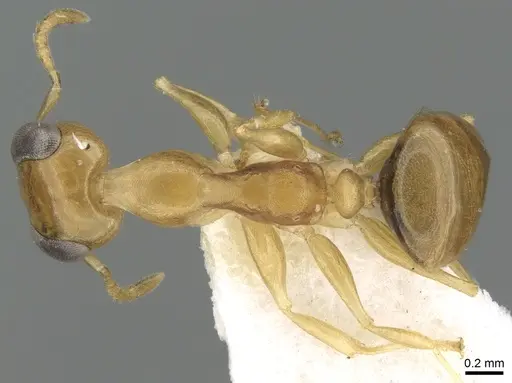
Literature
Loading distribution map...Loading products...