
Eurhopalothrix jennya
- Sci. Name
- Eurhopalothrix jennya
- Tribe
- Attini
- Subfamily
- Myrmicinae
- Author
- Taylor, 1990
- Distribution
- Found in 2 countries
Introduction
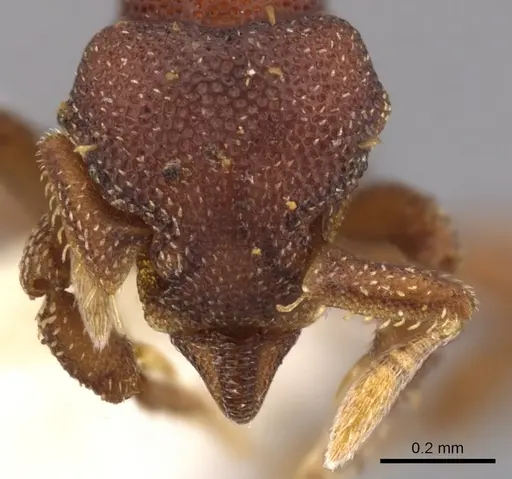
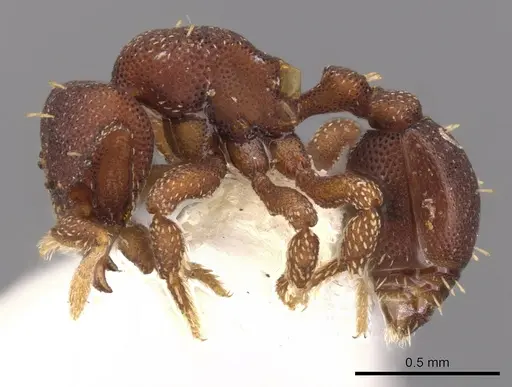
Eurhopalothrix jennya is a minute ant native to the rainforests of Borneo and Sumatra. Workers are extremely small, with queens reaching approximately 0.8 mm . Their bodies are dark reddish-brown with distinctive yellowish antennae, and they possess specialized enlarged hairs on their heads and bodies that likely serve sensory functions [AntWiki]. These ants live in the leaf litter and soil of lowland rainforests, where they forage cryptically among decaying vegetation . They represent an extreme challenge for antkeepers due to their incredibly small size and poorly understood biology.
Quick Summary
- Difficulty: Expert
- Origin & Habitat: Lowland rainforests of Borneo (Malaysia) and Sumatra (Indonesia), collected from leaf litter and soil [2][1].
- Colony Type: Unknown, observed colonies appear to be small.
- Size & Growth:
- Queen: approximately 0.8 mm, inferred from partial measurements [1].
- Worker: approximately 0.6 mm, inferred from partial measurements [2].
- Colony: Small, observed colonies contain fewer than 10 workers [1].
- Growth: Unknown
- Development: Unknown, no development data available for this species. (Development timing is unstudied.)
- Antkeeping:
- Temperature: 24-28°C (estimated for tropical rainforest species), keep stable and warm.
- Humidity: High, maintain damp substrate similar to forest floor leaf litter.
- Diapause: No, tropical species that remains active year-round [1].
- Nesting: Naturalistic setups with leaf litter, soil, and rotting wood, avoid large open chambers.
- Behavior: Cryptic and slow-moving, non-aggressive. Workers are extremely small and pose maximum escape risk [2].
- Common Issues: workers are only approximately 0.6 mm and will escape through the tiniest gaps in standard mesh or loose-fitting lids., dietary requirements are unconfirmed in captivity, colonies may starve without appropriate tiny prey., slow growth and small colony size mean beginners often disturb them too frequently., desiccation is a constant risk due to their minute size and tropical humidity requirements.
Natural History and Distribution
Eurhopalothrix jennya inhabits the leaf litter of lowland rainforests in Borneo and Sumatra [2][1]. They have been collected from soil and leaf litter samples using extraction methods, indicating they live in the decomposing layer of the forest floor [3]. The type specimens come from Sarawak, Malaysia, specifically from Kampong Segu and Gunung Mulu National Park, while recent records confirm their presence in West Sumatra, Indonesia [1]. They prefer humid, shaded environments and have been found near water sources such as waterfalls in disturbed forest areas [1].
Housing and Escape Prevention
At approximately 0.6 mm, workers can squeeze through gaps smaller than standard insect mesh threads. You must use extremely fine barriers, fine steel mesh with very small holes, or completely sealed containers with glued joints. A naturalistic setup with leaf litter, rotting wood pieces, and moist soil works best. Keep chambers small and tight, large open spaces stress tiny ants and increase desiccation risk. Avoid tall outworlds where they can climb and escape. [2]
Temperature and Humidity
As a tropical species from rainforest habitats, they need warmth and consistently high humidity. Keep them at roughly 24-28°C with substrate that feels damp to the touch but not waterlogged. You can use room temperature if your home stays warm, or add a gentle heat source on one side of the nest. Avoid drying out at all costs, these ants desiccate quickly due to their small size. No hibernation or cooling period is needed [1].
Feeding and Diet
Stable isotope analysis shows they occupy a high trophic position (δ15N values of 6.5-7.4), meaning they are predators or scavengers feeding on other small arthropods [4][3]. In captivity, offer tiny live prey such as springtails, soil mites, or fruit fly larvae. They may accept protein pastes or finely crushed insects. Sugar sources like honey water are likely secondary but can be offered occasionally. Do not rely on large prey items like mealworms or crickets.
Colony Founding
Founding behavior is completely unconfirmed for this species. If you obtain a queen, provide a small founding chamber with both a humid area and access to tiny live prey. Watch carefully to see if she leaves the chamber to hunt. Do not disturb the founding setup frequently, as these ants are sensitive to vibration and light.
Frequently Asked Questions
Can I keep Eurhopalothrix jennya in a test tube?
Yes, but use very small tubes and ensure the cotton plug is packed extremely tight, workers can squeeze through gaps that other ants cannot. A naturalistic setup with soil is often better for humidity control.
What do Eurhopalothrix jennya eat?
They are predators based on stable isotope data. Feed them tiny live prey like springtails, mites, or fruit fly larvae. Avoid large prey that they cannot subdue or fit in their mouths.
How long until Eurhopalothrix jennya gets first workers?
Unknown, no development data exists for this species.
Do Eurhopalothrix jennya need hibernation?
No. They come from tropical rainforests and remain active year-round. Keep them warm consistently [1].
Are Eurhopalothrix jennya good for beginners?
No. They are expert-level ants due to their extremely small size, unknown founding biology, and likely slow growth. Most beginners will struggle with escape prevention and feeding.
How big do Eurhopalothrix jennya colonies get?
Unknown. Observed wild colonies contained fewer than 10 workers, suggesting they may remain small [1].
Can I keep multiple Eurhopalothrix jennya queens together?
Not recommended. Combining multiple queens has not been documented for this species, and they may fight or be rejected by workers.
Report an Issue
The current care sheet is based fully on literature. See inconsistencies, or something that's incorrect? Please , it will be resolved after review from an admin. Contributing to the blogs tab also helps providing information, to make us be able to further improve the caresheets. Thank you for your support!
References

This caresheet is licensed under CC BY-SA 4.0 .
Community Blogs
CASENT0900937
View on AntWeb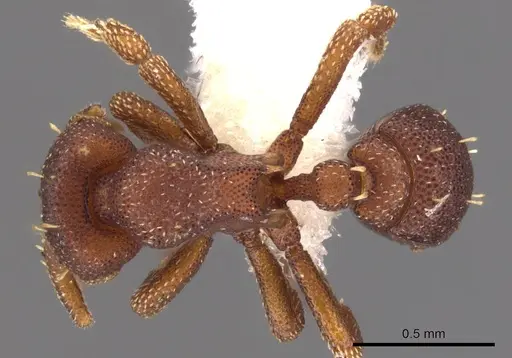
Literature
Loading distribution map...Loading products...