
Echinopla cherapunjiensis
- Sci. Name
- Echinopla cherapunjiensis
- Tribe
- Camponotini
- Subfamily
- Formicinae
- Author
- Bharti & Gul, 2012
- Distribution
- Found in 4 countries
Introduction
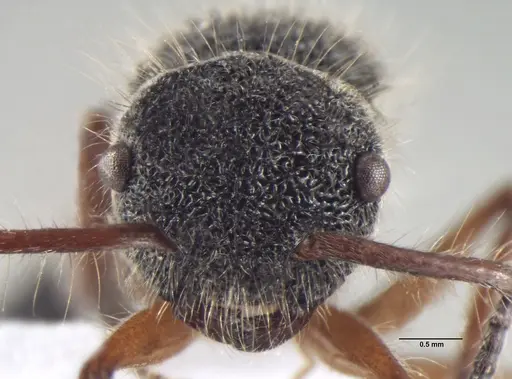
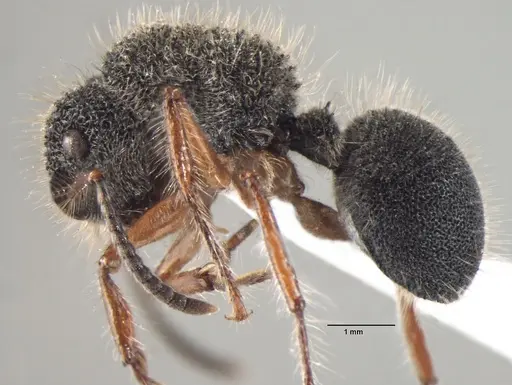
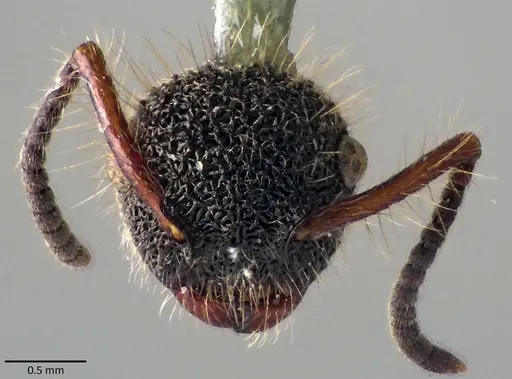
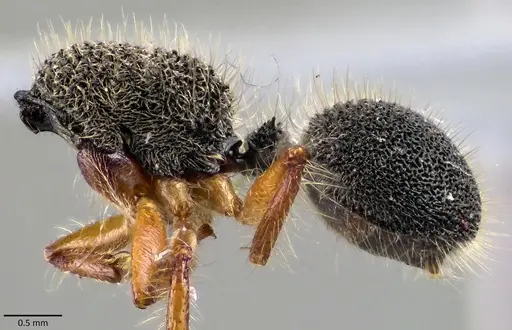
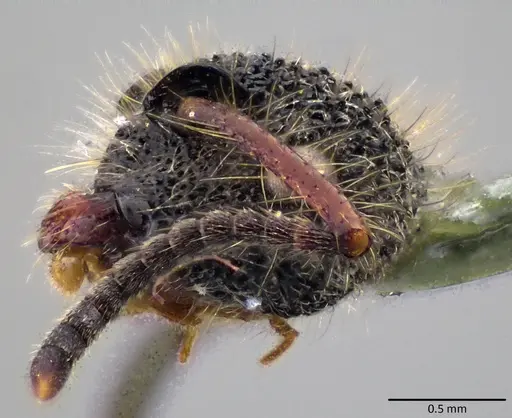
Echinopla cherapunjiensis is a medium-sized ant from the Formicinae subfamily. Workers are 5.7-6.8 mm long, with a black body and yellowish legs, scape (first antennal segment), and mouthparts . The head, thorax, and waist area are covered in a rough, bumpy texture, and the waist scale has seven distinct teeth . Long white hairs cover the whole body, giving them a fuzzy look . This species belongs to the Echinopla melanarctos species group and is named after Cherapunji, India, where it was first found .
Quick Summary
- Difficulty: Unknown, limited data available, not recommended for beginners
- Origin & Habitat: Native to the eastern Himalayas and Southeast Asia, found in northeastern India (Meghalaya), southern China (Yunnan, Guangxi), Laos, West Malaysia, and Myanmar [4][5][1]. Lives in wet rainforests with high rainfall at elevations between 500 and 1200 m [3]. A habitat specialist restricted to secondary forest – not found in primary forest or rubber plantations [6]. Nests inside hollow twigs of broad-leaved trees [3].
- Colony Type: Colony structure is unconfirmed. No direct observations of founding colonies or queen number exist in the scientific literature.
- Size & Growth:
- Queen: 7.7 mm (single gyne measured from China) [1]
- Worker: 5.7–6.8 mm [1]
- Colony: Unknown – no colony size data available
- Growth: Unknown – no development data exists
- Development: Unknown – no direct measurements. Based on typical Formicinae patterns, likely 6–10 weeks at optimal temperature. (Development timeline has not been studied for this species. Estimates are based on related genera.)
- Antkeeping:
- Temperature: Likely needs warm conditions around 22–26 °C based on tropical/subtropical origin. The species tolerates a range from 500 m to 1200 m elevation across its distribution, suggesting some flexibility.
- Humidity: Requires high humidity – native to wet rainforest conditions with high annual rainfall. Keep nest substrate consistently moist but not waterlogged, similar to conditions inside a hollow twig in a forest canopy.
- Diapause: Unknown – no data on overwintering requirements. Do not assume hibernation is required without evidence.
- Nesting: Natural nesting occurs inside hollow twigs of broad-leaved trees [3]. In captivity, use Y-tong (AAC), plaster, soil, or 3D-printed nests with chambers scaled to their medium size. Consider adding small twigs or branches to provide a naturalistic setup.
- Behavior: Not well documented in captivity. As a Formicinae ant, it lacks a functional sting and defends by biting and spraying formic acid. Workers are medium-sized (5.7–6.8 mm), so escape prevention should be adequate but not as critical as for tiny ants. Foraging behavior and aggression levels are unknown.
- Common Issues: limited data on captive care increases risk of colony loss, high specific humidity needs may lead to dehydration or mold if not balanced, wild-caught colonies are the only source and may have unknown health issues, species rarity makes it difficult to find advice or replacements if the colony dies, habitat specialist may not adapt well to artificial conditions
Natural History and Distribution
Echinopla cherapunjiensis is a rare ant species with a scattered distribution across the eastern Himalayas and Southeast Asia. It was first described from Meghalaya, northeastern India, at an elevation of 1200 m [3]. Since then, it has been recorded from southern China (Yunnan and Guangxi provinces), Laos, West Malaysia, and most recently Myanmar [4][5][1]. This is the northernmost record of the genus Echinopla in the world [1]. The species seems to be genuinely rare – it was found only once during intensive surveys in the Himalayas [3]. It lives in secondary forest habitats and has not been found in primary forest or rubber plantations [6]. Its known elevational range spans from 500 m to 1200 m above sea level.
Identification and Morphology
Workers of Echinopla cherapunjiensis measure 5.7–6.8 mm in total length, making them medium-sized ants [1]. The most distinctive features are the coarse, bumpy (tuberculate) sculpture covering the head and thorax, and the unique waist scale armed with seven teeth [3][2]. The body is mostly black, with contrasting yellowish legs, antennal scapes, and mouthparts [2]. White hairs (pilosity) are spread across the entire body, including legs and scape [3]. The eyes are very prominent, bulging out of the head's outline [1]. The thorax top is nearly straight in side view, not arched as in some related species [1]. The first segment of the abdomen has a many-pored (polyporous) surface [2]. Queens are larger, at 7.7 mm, but have been rarely documented [1].
Nesting and Habitat Preferences
In the wild, Echinopla cherapunjiensis nests inside hollow twigs of broad-leaved trees in rainforest environments [3]. This means they are not ground nesters but live in pre-existing cavities in wood. Their natural habitat has wet, high-rainfall conditions [3]. The species is a habitat specialist limited to secondary forest – it has not been found in primary forest or rubber plantations [6]. For captive housing, provide a setup that mimics their natural twig-nesting behavior: either a naturalistic formicarium with small branches or twigs, or a Y-tong, plaster, soil, or 3D-printed nest with appropriately sized chambers. The nest should be kept moist but well-ventilated to avoid mold.
Temperature and Humidity Requirements
Based on the species' distribution across tropical and subtropical parts of Southeast Asia (Yunnan, Meghalaya, Laos, Malaysia, Myanmar), these ants likely prefer warm, humid conditions. Their elevational range (500–1200 m) suggests they can handle some temperature variation. Start at 22–26 °C and monitor activity to fine-tune. Humidity is likely critical – the wet rainforest conditions of their native habitat mean they need consistently moist surroundings. Their preference for hollow twigs suggests they are used to stable humidity inside enclosed spaces. Avoid both excessive dryness and stagnant, overly wet conditions that could lead to mold [3].
Feeding and Diet
No specific dietary studies exist for Echinopla cherapunjiensis. As a member of the Formicinae subfamily, it likely has a generalist diet similar to related ants like Camponotus. They probably consume honeydew (the sugary waste from aphids and scale insects), plant nectar, and small insects for protein. In captivity, offer a constant supply of sugar water or honey as an energy source, plus protein-rich foods like small insects (fruit flies, small crickets, mealworms). Given their medium size, they should be able to handle prey roughly their own size or smaller.
Behavior and Captive Care
Direct observations of captive behavior are not documented in scientific literature. As Formicinae ants, they lack a functional sting and rely on biting and spraying formic acid for defense. Workers are moderately sized (5.7–6.8 mm), so escape prevention should be adequate but these are not tiny ants prone to squeezing through fine mesh. Colony social structure (monogyne vs. polygyne) is unknown, and founding behavior has not been observed. The species is extremely rare in the antkeeping hobby due to its limited distribution and the difficulty of collecting nesting colonies from hollow twigs. Anyone acquiring this species would be pioneering captive husbandry with no established protocols to follow.
Frequently Asked Questions
How long does it take for Echinopla cherapunjiensis to develop from egg to worker?
The development timeline has not been scientifically documented for this species. Based on typical Formicinae patterns from related genera, expect approximately 6–10 weeks from egg to first worker at optimal temperature. This is an estimate only – actual times may vary.
What temperature should I keep Echinopla cherapunjiensis at?
Start around 22–26 °C based on their tropical/subtropical distribution. The species has been found at elevations from 500–1200 m, suggesting some flexibility. Observe your colony's activity level and adjust accordingly – workers should be active and foraging, not sluggish or clustering away from heat.
What do Echinopla cherapunjiensis eat?
While not specifically studied, they likely accept a generalist diet like other Formicinae. Offer sugar water or honey as a constant energy source, plus small insects (fruit flies, small crickets, mealworms) for protein. They may also tend aphids for honeydew if given the opportunity.
Are Echinopla cherapunjiensis good for beginners?
This species is not recommended for beginners. It is extremely rare in the antkeeping hobby, has no established captive breeding protocols, and requires specific humidity conditions that may be challenging to maintain. Additionally, wild-caught colonies are the only source, and these may have unknown issues.
What type of nest should I use for Echinopla cherapunjiensis?
In nature, they nest inside hollow twigs of broad-leaved trees. In captivity, Y-tong (AAC), plaster, soil, or 3D-printed nests with chambers scaled to their medium size (5.7–6.8 mm workers) would work well. A naturalistic setup incorporating small twigs or branches may also be appropriate. The key is providing a moist, enclosed space that mimics a tree cavity.
How big do Echinopla cherapunjiensis colonies get?
Maximum colony size is unknown – no scientific data exists on colony sizes for this species. Related Echinopla species typically form moderate-sized colonies. Based on worker size and genus patterns, colonies likely reach no more than several hundred workers.
Do Echinopla cherapunjiensis need hibernation?
Diapause or hibernation requirements are unknown. The high-elevation Himalayan populations may experience cooler seasonal temperatures, but overwintering behavior has not been documented. Do not assume hibernation is required without evidence.
Can I keep multiple Echinopla cherapunjiensis queens together?
Colony structure (monogyne vs polygyne) has not been documented for this species. Combining unrelated queens is not recommended since this behavior has not been studied and could result in aggression.
Where does Echinopla cherapunjiensis come from?
This species is native to the eastern Himalayas and Southeast Asia, specifically northeastern India (Meghalaya), southern China (Yunnan, Guangxi), Laos, West Malaysia, and Myanmar. It is a rare species found at elevations between 500–1200 m in secondary forest habitats [4][5][1].
Report an Issue
The current care sheet is based fully on literature. See inconsistencies, or something that's incorrect? Please , it will be resolved after review from an admin. Contributing to the blogs tab also helps providing information, to make us be able to further improve the caresheets. Thank you for your support!
References

This caresheet is licensed under CC BY-SA 4.0 .
Community Blogs
ANTWEB1008034
View on AntWeb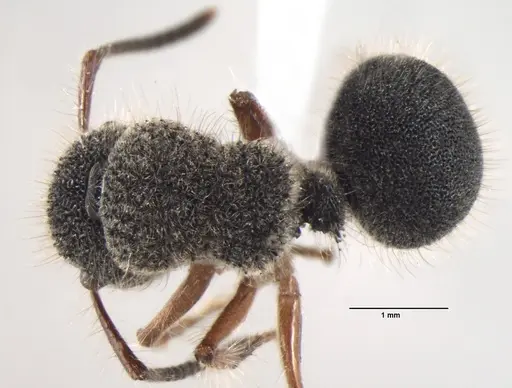
ANTWEB1041844
View on AntWeb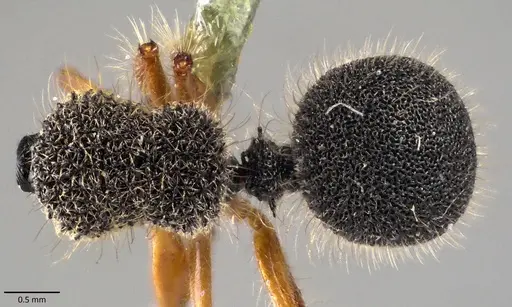
Literature
Loading distribution map...Loading products...