
Discothyrea penthos
- Sci. Name
- Discothyrea penthos
- Tribe
- Proceratiini
- Subfamily
- Proceratiinae
- Author
- Hita-Garcia & Lieberman, 2019
- Distribution
- Found in 1 countries
Introduction
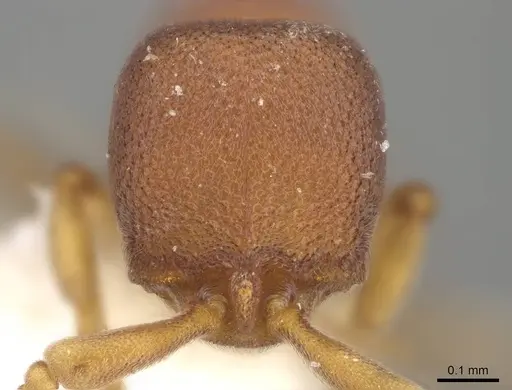
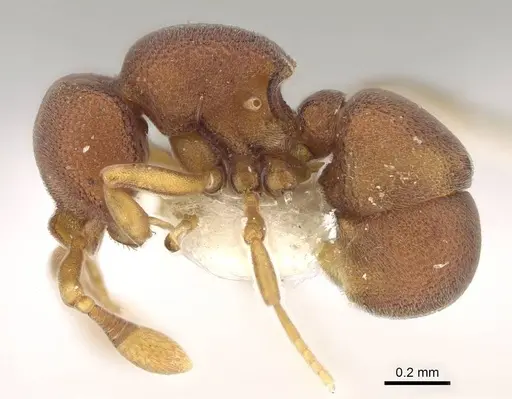
Discothyrea penthos is a tiny ant species known only from four rainforest localities in Ivory Coast, West Africa . Workers are minute, and full body size measurements are unavailable . They have a broad, almost square head, a conspicuously thick and stocky middle body section, large propodeal teeth, and a uniquely shaped third abdominal segment . Their color ranges from bright orange to yellowish, and they lack visible hairs on their backs, giving them a nearly hairless look . This species lives in leaf litter and is the only Discothyrea species apparently found only in the Guinean rainforests of West Africa . The most striking feature of this ant is its heavily sculptured body contrasted with a smooth, shiny patch around the propodeal spiracle . The name 'penthos' comes from Greek mythology and honors the rapidly shrinking rainforest habitat where these ants survive . Only worker ants have been described so far, and no queen or colony data exists .
Quick Summary
- Difficulty: Expert
- Origin & Habitat: Guinean rainforests of West Africa, specifically Ivory Coast. They live in leaf litter at low elevations around 20 meters [1].
- Colony Type: Unknown, colony structure has not been documented [1].
- Size & Growth:
- Queen: Undescribed, queen caste has not been documented [1]
- Worker: size data unavailable [1]
- Colony: Unknown, only known from a handful of worker specimens [1]
- Growth: Unknown
- Development: Unknown, no development data exists for this species [1] (Based on related Discothyrea patterns, development likely takes several months, but this is entirely speculative)
- Antkeeping:
- Temperature: No specific data available. As a West African rainforest species, they likely need warm conditions in the low-to-mid 20s°C range. Start around 24-26°C and observe colony activity.
- Humidity: Rainforest leaf litter species need consistent moisture. Keep the nest substrate damp but never waterlogged. Provide a humidity gradient so they can choose their preferred zone.
- Diapause: Unknown, no data on seasonal requirements. West African rainforest species often do not require traditional hibernation.
- Nesting: Natural nesting occurs in leaf litter. In captivity, small test tube setups work well for founding colonies. For established groups, Y-tong nests or plaster nests with very small chambers scaled to their tiny size work best.
- Behavior: No behavioral data exists for this species in captivity. Based on related Discothyrea patterns, they are likely predatory on tiny arthropods and may be shy or reclusive. Their very small size means escape prevention must be excellent. Handle with extreme care as they are fragile and easily crushed.
- Common Issues: escape prevention is critical due to their minute size, use fine mesh and tight-fitting lids, no captive husbandry information exists, all care is speculative, high humidity requirements can lead to mold if ventilation is poor, extremely rare in the hobby, captive colonies may not exist, wild-caught colonies may have parasites or fail to adapt to captivity
Rarity and Conservation Status
Discothyrea penthos is one of the rarest ant species in the world, known only from four rainforest localities in Ivory Coast [1]. The species was only described in 2019,making it one of the most recently discovered ant species in Africa [1]. Its name 'penthos' comes from Greek mythology, referring to the spirit of grief and mourning, chosen to recognize the highly threatened and rapidly diminishing rainforest habitat where this species lives [1]. This is the only Discothyrea species apparently endemic to the Guinean rainforests of West Africa [1]. In captivity, this species is essentially unavailable, true captive colonies may not exist in the antkeeping hobby [1].
Identification and Distinguishing Features
You can identify this species by several unique characteristics: a broad, almost square head, a conspicuously thick and robust middle body section, large propodeal teeth, and a distinctive squared-to-trapezoidal lobe on the third abdominal segment [1]. The propodeal teeth are relatively large and sit on narrow lamellulae [1]. Unlike many ants, they lack erect hairs on all dorsal surfaces, giving them a nearly hairless appearance [1]. The area around the propodeal spiracle is distinctly smooth and shiny, strongly contrasting with the pitted sculpture covering the rest of the body [1]. They are uniformly bright luteous-orange to yellowish in color [1]. The only similar species are Discothyrea hawkesi and Discothyrea kalypso, which share the distinctive abdominal sternite shape but are generally smaller and more elongated [1].
Housing and Nest Preferences
As a leaf litter species from West African rainforests, these ants need high humidity and small-scale housing [1]. In captivity, small test tube setups work well for founding colonies, with the water reservoir kept small to prevent flooding. For established colonies, Y-tong nests or plaster nests with very small chambers scaled to their tiny worker size are appropriate. The chambers should be tight, these are very small ants that can slip through gaps that seem negligible. A layer of damp substrate like coconut fiber or soil helps maintain humidity. Avoid large, open spaces in the nest as these ants prefer tight, enclosed spaces. Provide a small outworld for foraging that is also escape-proof.
Feeding and Diet
No specific feeding data exists for this species [1]. However, Discothyrea ants are typically predatory, feeding on tiny arthropods such as springtails, mites, and other micro-invertebrates found in leaf litter. In captivity, offer small live prey such as springtails, fruit flies, and other tiny insects. Given their minute size, prey items should be appropriately small, essentially micro-prey. Sugar sources are unlikely to be accepted given the typical diet of this genus. Feed small amounts of live prey every few days, removing any uneaten prey to prevent mold issues.
Temperature and Humidity Requirements
As a West African rainforest species from low elevation (~20 meters), they likely require warm and humid conditions [1]. The exact requirements are unknown, but a temperature in the low-to-mid 20s°C (around 24-26°C) is a reasonable starting point. Create a temperature gradient so the ants can choose their preferred zone. Humidity should be high, think damp forest floor. The substrate should feel consistently moist but never waterlogged. Some drier areas in the setup allow the ants to escape excess moisture. Monitor for condensation and mold, which can be problematic in high-humidity setups. A small water reservoir in test tube setups helps maintain humidity.
Handling and Temperament
Due to their extremely small size (under 1mm), these ants are incredibly fragile and can easily be crushed or lost. Handle any setup with extreme care. Their temperament is unknown but likely shy and non-aggressive, as is typical for tiny leaf-litter ants. They probably avoid confrontation and will retreat rather than fight. The stinger is present but likely too small to penetrate human skin effectively. Escape prevention is paramount, their minute size means they can squeeze through gaps that seem impossibly small. Use fine mesh on all openings and check for gaps regularly. Any connection points in tubing or nest equipment should be inspected carefully.
Frequently Asked Questions
Is Discothyrea penthos available in the antkeeping hobby?
No, this species is extremely rare and was only described in 2019. True captive colonies likely do not exist in the antkeeping hobby. It is endemic to Ivory Coast and known from only four localities [1].
How big are Discothyrea penthos workers?
Workers are minute, and full body size measurements are unavailable [1]. They are about half a millimeter long based on mesosoma length, making them one of the smallest ant species in the world [1].
Where does Discothyrea penthos live in the wild?
This species is only found in the Guinean rainforests of Ivory Coast, West Africa. It lives in leaf litter at low elevation (around 20 meters) [1]. It is the only Discothyrea species apparently endemic to this region [1].
What do Discothyrea penthos eat?
No specific feeding data exists, but Discothyrea species are typically predatory on tiny arthropods. In captivity, you would likely need to offer small live prey such as springtails, fruit flies, and other micro-arthropods. Their tiny size means prey must be appropriately small.
Do Discothyrea penthos ants sting?
They possess a stinger but it is likely too small to penetrate human skin effectively. Given their minute size and shy nature, stinging is not a concern.
What temperature should I keep Discothyrea penthos at?
No specific data exists, but as a West African rainforest species, they likely need warm conditions around 24-26°C. Start in this range and observe colony behavior. A temperature gradient allows the ants to choose their preferred zone.
How do I house Discothyrea penthos in captivity?
Small test tube setups work well for founding colonies. For established colonies, use Y-tong nests or plaster nests with very small chambers scaled to their tiny size. High humidity is essential. Escape prevention must be excellent due to their minute size.
Are Discothyrea penthos good for beginners?
No, this species is rated Expert difficulty due to several factors: no captive husbandry information exists, they require high humidity, they are extremely small and fragile, and true captive colonies likely do not exist [1]. This is not a species for beginners [1].
What makes Discothyrea penthos special?
This species is one of the rarest ants in the world, known from only four rainforest localities in Ivory Coast [1]. It was only described in 2019 and has several unique physical features including a distinctive abdominal sternite shape and large propodeal teeth [1]. Its name 'penthos' (Greek for grief/mourning) recognizes the threatened state of its rainforest habitat [1].
Can I keep multiple Discothyrea penthos queens together?
No data exists on colony structure or queen behavior for this species [1]. Combining unrelated queens is not recommended given how little is known about their biology and how rare the species is [1].
Report an Issue
The current care sheet is based fully on literature. See inconsistencies, or something that's incorrect? Please , it will be resolved after review from an admin. Contributing to the blogs tab also helps providing information, to make us be able to further improve the caresheets. Thank you for your support!
References

This caresheet is licensed under CC BY-SA 4.0 .
Community Blogs
CASENT0247383
View on AntWeb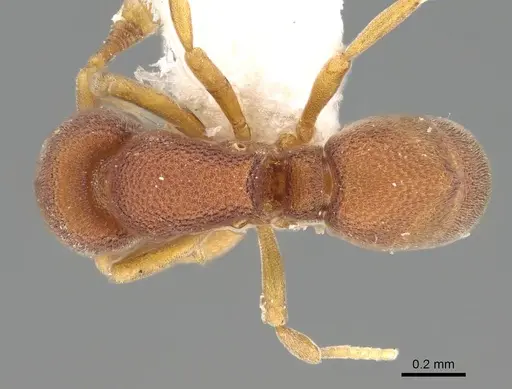
Literature
Loading distribution map...Loading products...