
Cylindromyrmex brasiliensis
- Sci. Name
- Cylindromyrmex brasiliensis
- Subfamily
- Dorylinae
- Author
- Emery, 1901
- Distribution
- Found in 4 countries
Introduction
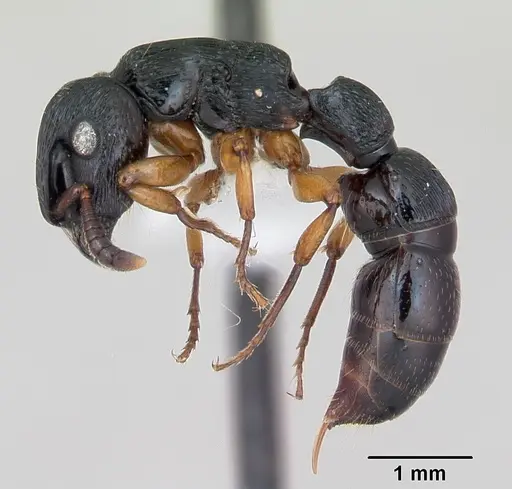
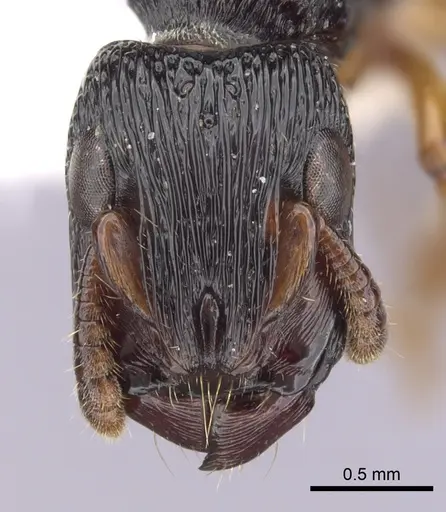
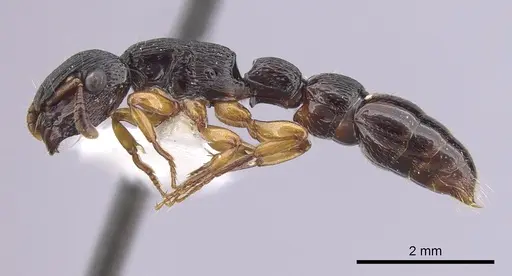
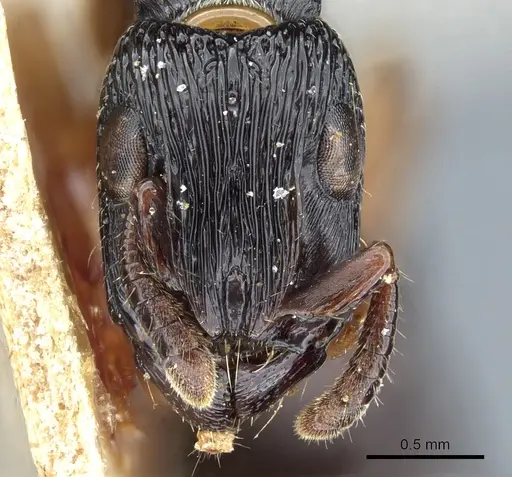
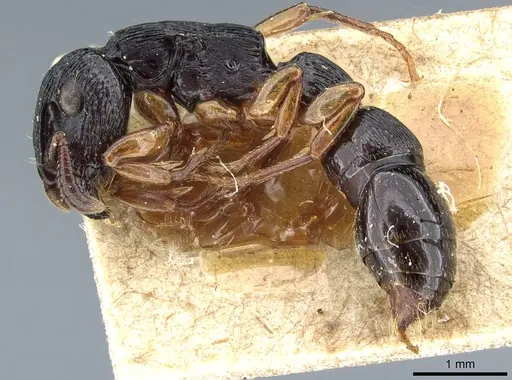
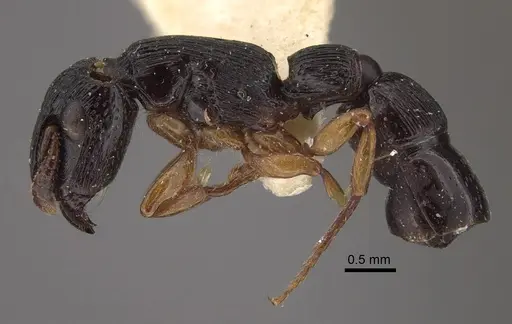
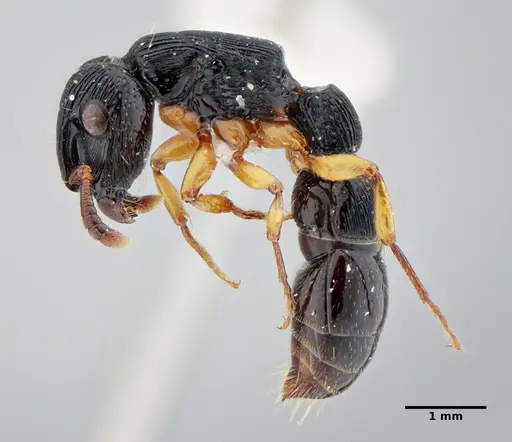
Cylindromyrmex brasiliensis is a medium-sized predatory ant from the subfamily Dorylinae (army ants). Workers measure 5.56-8.48 mm, making them larger than many common ant species. They are glossy black with a key identifying feature: their legs are dark orange or light brown instead of black, which helps tell them apart from similar species like Cylindromyrmex striatus and Cylindromyrmex whymperi . The head, mesosoma, and petiole have fine longitudinal striations. Queens reach about 8.56 mm and males 8.78 mm . This species is a termite specialist, actively hunting termites in their galleries . Unlike some Dorylinae that form massive swarming colonies, Cylindromyrmex brasiliensis lives in smaller colonies found nesting in cavities inside rotten wood, under bark of dead trees, and sometimes in abandoned termite galleries . It is the most basal (primitive) species within the striatus clade, making it interesting from an evolutionary perspective .
Quick Summary
- Difficulty: Expert
- Origin & Habitat: Native to the Neotropical region: Brazil, Paraguay, French Guiana, Argentina, and Venezuela. Found in Atlantic Forest habitats, including both native forest and Eucalyptus plantations. Nests in cavities within rotten wood, under bark of dead trees, and in termite galleries [1][2][3].
- Colony Type: Colony structure is not fully documented. One studied colony had no morphologically distinct queen, suggesting possible gamergate reproduction, but the queen caste is confirmed to exist from other studies. Workers are monomorphic but vary in size within the nest. Some workers showed possible physogastry (slightly enlarged abdomen). The colony was not living as a termite inquiline [2].
- Size & Growth:
- Queen: 8.56 mm [1]
- Worker: 5.56-8.48 mm [1]
- Colony: At least 94 workers documented in one colony, with pupae, larvae, and eggs [2]
- Growth: Unknown, no captive breeding data available
- Development: Unknown, no development studies exist for this species (Development timeline unconfirmed. Related Dorylinae species suggest several months but exact times are unknown.)
- Antkeeping:
- Temperature: Keep at room temperature, roughly 22-26°C. No specific studies exist, so use a temperature gradient and watch colony activity. Inferred from tropical forest habitat.
- Humidity: Requires moderate to high humidity. Keep nest substrate consistently moist but not waterlogged, mimicking the damp conditions of rotting wood in forest habitats. Provide some drier areas for the ants to self-regulate. Inferred from nesting habits [2].
- Diapause: Unknown, no studies on overwintering or dormancy. As a tropical species, they likely do not require hibernation, but seasonal slowdowns may occur.
- Nesting: Provide a naturalistic setup with rotting wood pieces or a Y-tong/plaster nest with cavities. They naturally nest in cavities within rotten wood and under bark [2]. Avoid dry, arid setups. The nest should have tight-fitting lids as workers are medium-sized.
- Behavior: These are predatory ants that actively hunt termites. They are not aggressive toward humans but will defend their nest. Workers are medium-sized and can escape through standard barriers, though not as prone to escaping as tiny species. They are primarily nocturnal or crepuscular foragers, hunting in and around termite galleries. Their hunting is more solitary or small-group based rather than massive swarming raids typical of some Dorylinae [2].
- Common Issues: no captive breeding data exists, this species is extremely rare in antkeeping and may not adapt well to captivity, predatory specialisation means they require live termite prey or suitable alternatives, which is difficult to provide consistently, stress from collection and transport often kills wild-caught colonies, high humidity requirements can lead to mold problems if ventilation is inadequate, queen presence may be difficult to confirm in established colonies as queens are not always morphologically distinct
Identification and Distinguishing Features
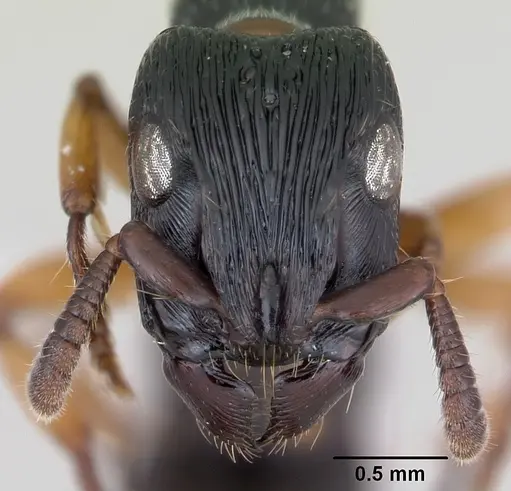
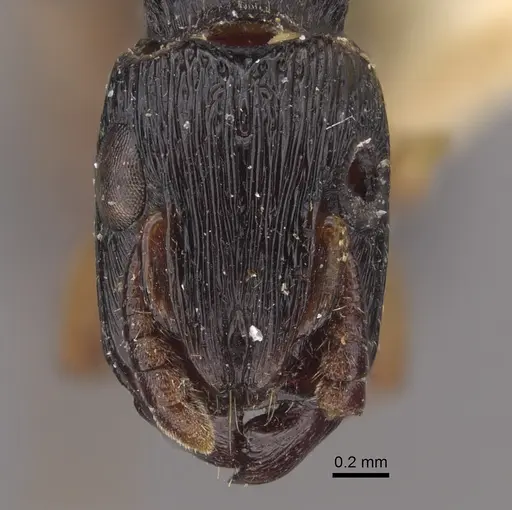
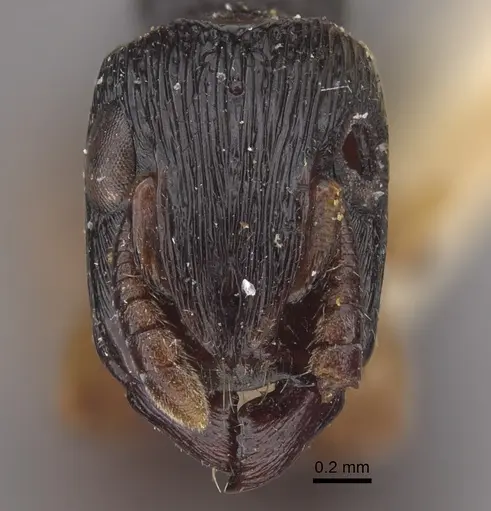
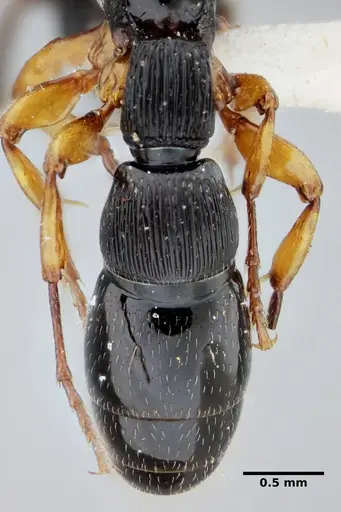
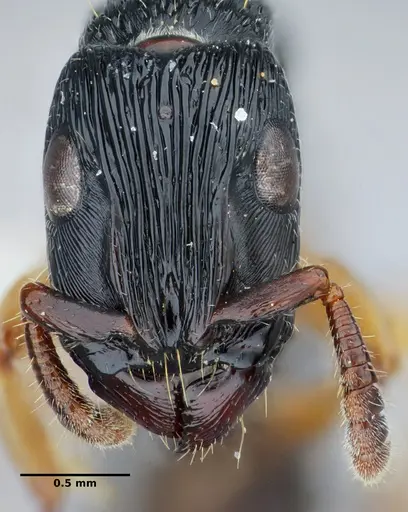
Cylindromyrmex brasiliensis workers measure 5.56-8.48 mm and are glossy black with a key identifying feature: their legs are dark orange or light brown, unlike the black legs of similar species Cylindromyrmex striatus and Cylindromyrmex whymperi. The mesosoma, petiole, and postpetiole have thinner, less regular striations compared to its relatives. The dorsal surface of the postpetiole bears approximately 33-35 longitudinal striae. The head is about one-fifth longer than wide, with large, slightly convex compound eyes positioned behind the midline. Scapes extend past the anterior border of the eyes. Queens are larger at 8.56 mm, and males reach 8.78 mm [1].
Natural History and Habitat
This species lives in the Neotropical region across Brazil, Paraguay, French Guiana, Argentina, and Venezuela. In Brazil, specimens have been recorded in states including Pernambuco, Bahia, Rio de Janeiro, São Paulo, Paraná, Santa Catarina, Rio Grande do Sul, and Minas Gerais [2][3]. They inhabit Atlantic Forest environments, including both primary forest and secondary growth areas. Nests are found in cavities within rotten wood trunks, under the bark of dead trees, and occasionally inside abandoned termite galleries. One documented colony was found in a rotten wood trunk with galleries and tunnels excavated in wood, living alongside colonies of Heteroponera dolo and Gnamptogenys sp. [2].
Feeding and Predatory Behavior
Cylindromyrmex brasiliensis is a specialized predator of termites [2]. In the wild, they hunt and consume termites found in and around their nesting sites. For captive care, providing live termite prey would be ideal, though this is logistically challenging. They may accept other small insects as prey, but their specialized diet makes them difficult to maintain. Sugar sources are unlikely to be accepted given their predatory nature. This species is NOT a termite inquiline (living parasitically in termite nests), they are active predators that hunt termites rather than coexisting with them [2].
Colony Structure and Reproduction
A studied colony contained 94 workers,50 pupae, plus numerous larvae and eggs. Notably, no morphologically differentiated queen was found in this colony, though the queen caste has been confirmed to exist through other studies [2]. Workers are monomorphic (all the same shape) but vary in size within the same nest. Some workers showed slight enlargement possibly indicating physogastry (reproductive development). The karyotype is 2n = 34,composed of 9 pairs of metacentric and 8 pairs of acrocentric chromosomes [2]. The colony was not an inquiline of termites [2].
Keeping Considerations
This species is not recommended for beginners. No captive breeding protocols exist, and they are extremely rare in the antkeeping hobby. They require high humidity mimicking damp forest floor conditions and nesting in rotting wood. A naturalistic setup with moist substrate and hiding places works best. Their predatory specialisation on termites makes feeding challenging [2], live termite prey is ideal but difficult to source consistently. Room temperature around 22-26°C is appropriate based on their tropical habitat. Escape prevention is important though not as critical as for tiny species. If you obtain a colony, minimize disturbances and provide a stable environment.
Frequently Asked Questions
How long does it take for Cylindromyrmex brasiliensis to develop from egg to worker?
The development timeline is unknown, no studies have documented their egg-to-worker development. Related Dorylinae species suggest several months, but specific times for this species are unconfirmed.
Can I keep Cylindromyrmex brasiliensis in a test tube setup?
A test tube may work for founding colonies but is not ideal long-term. These ants naturally nest in cavities within rotting wood, so a naturalistic setup or Y-tong nest with moist substrate is more appropriate.
What do Cylindromyrmex brasiliensis eat?
They are termite predators [2]. In captivity, live termite prey is ideal but difficult to provide. They may accept other small live insects experimentally, but success is uncertain. Sugar sources are unlikely to be accepted.
Are Cylindromyrmex brasiliensis good for beginners?
No. This is an expert-level species with no captive breeding data available. Their specialized predatory diet and specific humidity requirements make them extremely challenging to keep successfully.
How big do Cylindromyrmex brasiliensis colonies get?
A documented wild colony had 94 workers with pupae, larvae, and eggs [2]. Maximum colony size is unknown but appears to be smaller than typical army ant colonies. They are not supercolonial.
Do Cylindromyrmex brasiliensis need hibernation?
Diapause requirements are unknown. As a tropical species from Brazil, they likely do not require hibernation. However, seasonal slowdowns may occur. Do not hibernate unless you observe natural colony slowdown.
Where does Cylindromyrmex brasiliensis live in the wild?
They inhabit the Neotropical region across Brazil, Paraguay, French Guiana, Argentina, and Venezuela. Nests are found in cavities within rotten wood, under bark of dead trees, and in abandoned termite galleries in Atlantic Forest habitats [1][2][3].
Can I keep multiple queens together?
Colony structure (monogyne vs polygyne) is unconfirmed. Combining unrelated queens is not recommended since this has not been documented in scientific literature.
Why are my Cylindromyrmex brasiliensis dying?
Common causes include: stress from collection/transport, inability to accept substitute prey, humidity too low (they need damp conditions), or disturbance of the nest. Wild-caught colonies often have high mortality rates.
Report an Issue
The current care sheet is based fully on literature. See inconsistencies, or something that's incorrect? Please , it will be resolved after review from an admin. Contributing to the blogs tab also helps providing information, to make us be able to further improve the caresheets. Thank you for your support!
References

This caresheet is licensed under CC BY-SA 4.0 .
Community Blogs
CASENT0173502
View on AntWeb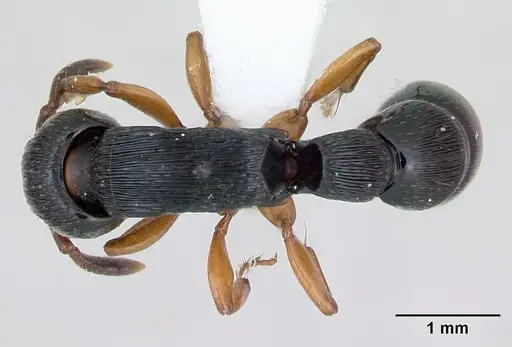
CASENT0249335
View on AntWeb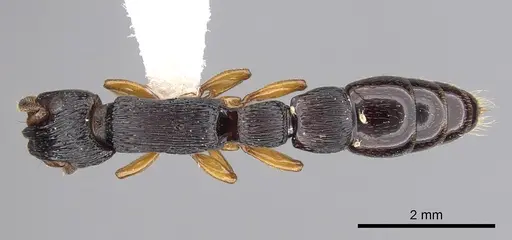
CASENT0903785
View on AntWeb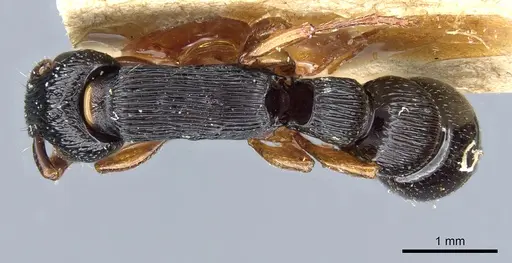
CASENT0917744
View on AntWeb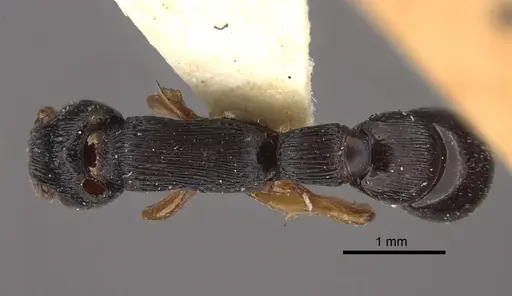
UFV-LABECOL-004349
View on AntWeb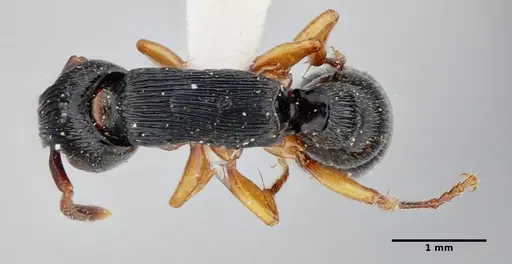
Literature
Loading distribution map...Loading products...